

38
A. Geethakarthi
2.3 Adsorption Isotherms
The relationship between the amount of material adsorbed and its concentration in
the feed in equilibrium with the adsorbent is called an adsorption isotherm. Langmuir
adsorption isotherm equation is one of the most widely used models to describe the
equilibrium behaviours of adsorbate uptake. The Langmuir isotherm equation can
be theoretically derived based on some fundamental assumptions. The Freundlich
[25] isotherm was derived by assuming a heterogeneous surface with a non-uniform
distribution of heat of adsorption over the surface, whereas in the Langmuir [66]
theory the basic assumption is that the sorption takes place at specific homogeneous
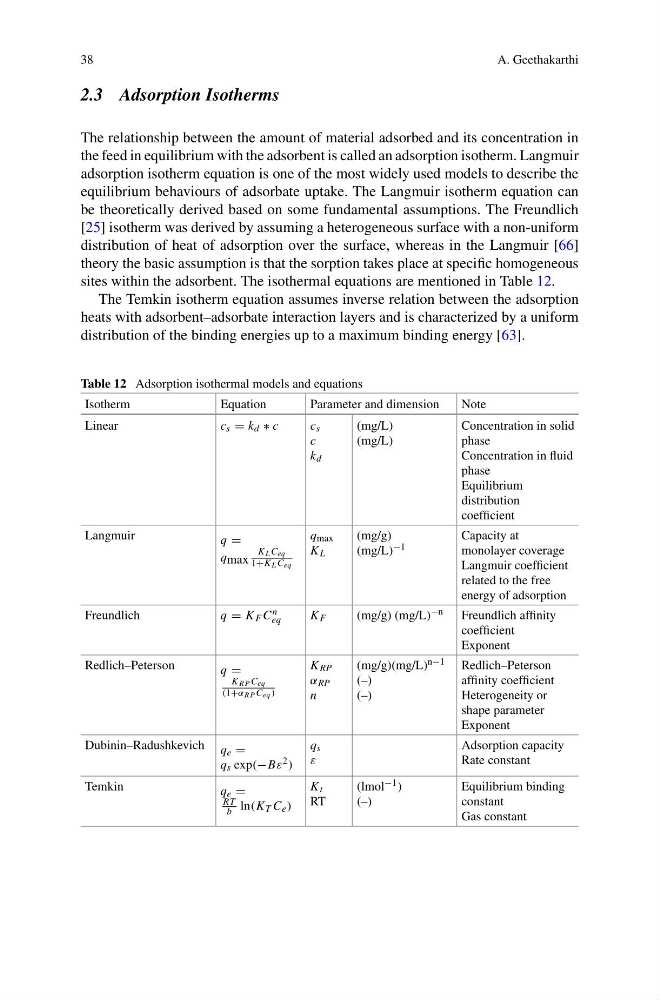
sites within the adsorbent. The isothermal equations are mentioned in Table 12.
The Temkin isotherm equation assumes inverse relation between the adsorption
heats with adsorbent–adsorbate interaction layers and is characterized by a uniform
distribution of the binding energies up to a maximum binding energy [63].
Table 12 Adsorption isothermal models and equations
Isotherm
Equation
Parameter and dimension
Note
Linear
c s = k d ∗ c
c s
c
k d
(mg/L)
(mg/L)
Concentration in solid
phase
Concentration in fluid
phase
Equilibrium
distribution
coefficient
Langmuir
q =
q max
K L Ceq
1+K L Ceq
q max
K L
(mg/g)
(mg/L) −1
Capacity at
monolayer coverage
Langmuir coefficient
related to the free
energy of adsorption
Freundlich
q = K F C n
eq
K F
(mg/g) (mg/L) −n Freundlich affinity
coefficient
Exponent
Redlich–Peterson
q =
K R P Ceq
(1+α R P Ceq )
K RP
α RP
n
(mg/g)(mg/L) n−1
(–)
(–)
Redlich–Peterson
affinity coefficient
Heterogeneity or
shape parameter
Exponent
Dubinin–Radushkevich q e =
q s exp(−Bε 2 )
q s
ε
Adsorption capacity
Rate constant
Temkin
q e =
RT
b ln(K T C e )
K t
RT
(lmol −1 )
(–)
Equilibrium binding
constant
Gas constant
A. Geethakarthi
2.3 Adsorption Isotherms
The relationship between the amount of material adsorbed and its concentration in
the feed in equilibrium with the adsorbent is called an adsorption isotherm. Langmuir
adsorption isotherm equation is one of the most widely used models to describe the
equilibrium behaviours of adsorbate uptake. The Langmuir isotherm equation can
be theoretically derived based on some fundamental assumptions. The Freundlich
[25] isotherm was derived by assuming a heterogeneous surface with a non-uniform
distribution of heat of adsorption over the surface, whereas in the Langmuir [66]
theory the basic assumption is that the sorption takes place at specific homogeneous
sites within the adsorbent. The isothermal equations are mentioned in Table 12.
The Temkin isotherm equation assumes inverse relation between the adsorption
heats with adsorbent–adsorbate interaction layers and is characterized by a uniform
distribution of the binding energies up to a maximum binding energy [63].
Table 12 Adsorption isothermal models and equations
Isotherm
Equation
Parameter and dimension
Note
Linear
c s = k d ∗ c
c s
c
k d
(mg/L)
(mg/L)
Concentration in solid
phase
Concentration in fluid
phase
Equilibrium
distribution
coefficient
Langmuir
q =
q max
K L Ceq
1+K L Ceq
q max
K L
(mg/g)
(mg/L) −1
Capacity at
monolayer coverage
Langmuir coefficient
related to the free
energy of adsorption
Freundlich
q = K F C n
eq
K F
(mg/g) (mg/L) −n Freundlich affinity
coefficient
Exponent
Redlich–Peterson
q =
K R P Ceq
(1+α R P Ceq )
K RP
α RP
n
(mg/g)(mg/L) n−1
(–)
(–)
Redlich–Peterson
affinity coefficient
Heterogeneity or
shape parameter
Exponent
Dubinin–Radushkevich q e =
q s exp(−Bε 2 )
q s
ε
Adsorption capacity
Rate constant
Temkin
q e =
RT
b ln(K T C e )
K t
RT
(lmol −1 )
(–)
Equilibrium binding
constant
Gas constant