

Application of Sustainable and Low-Cost Sludge-Based Adsorbents …
29
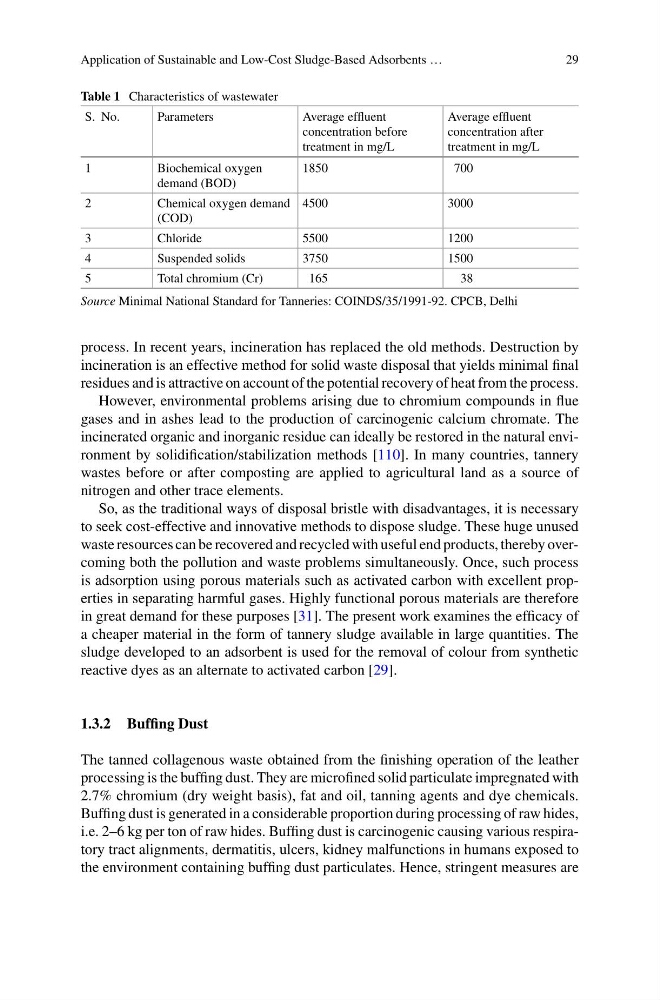
Table 1 Characteristics of wastewater
S. No.
Parameters
Average effluent
concentration before
treatment in mg/L
Average effluent
concentration after
treatment in mg/L
1
Biochemical oxygen
demand (BOD)
1850
700
2
Chemical oxygen demand
(COD)
4500
3000
3
Chloride
5500
1200
4
Suspended solids
3750
1500
5
Total chromium (Cr)
165
38
Source Minimal National Standard for Tanneries: COINDS/35/1991-92. CPCB, Delhi
process. In recent years, incineration has replaced the old methods. Destruction by
incineration is an effective method for solid waste disposal that yields minimal final
residues and is attractive on account of the potential recovery of heat from the process.
However, environmental problems arising due to chromium compounds in flue
gases and in ashes lead to the production of carcinogenic calcium chromate. The
incinerated organic and inorganic residue can ideally be restored in the natural environment by solidification/stabilization methods [110]. In many countries, tannery
wastes before or after composting are applied to agricultural land as a source of
nitrogen and other trace elements.
So, as the traditional ways of disposal bristle with disadvantages, it is necessary
to seek cost-effective and innovative methods to dispose sludge. These huge unused
waste resources can be recovered and recycled with useful end products, thereby overcoming both the pollution and waste problems simultaneously. Once, such process
is adsorption using porous materials such as activated carbon with excellent properties in separating harmful gases. Highly functional porous materials are therefore
in great demand for these purposes [31]. The present work examines the efficacy of
a cheaper material in the form of tannery sludge available in large quantities. The
sludge developed to an adsorbent is used for the removal of colour from synthetic
reactive dyes as an alternate to activated carbon [29].
1.3.2 Buffing Dust
The tanned collagenous waste obtained from the finishing operation of the leather
processing is the buffing dust. They are microfined solid particulate impregnated with
2.7% chromium (dry weight basis), fat and oil, tanning agents and dye chemicals.
Buffing dust is generated in a considerable proportion during processing of raw hides,
i.e. 2–6 kg per ton of raw hides. Buffing dust is carcinogenic causing various respiratory tract alignments, dermatitis, ulcers, kidney malfunctions in humans exposed to
the environment containing buffing dust particulates. Hence, stringent measures are
29
Table 1 Characteristics of wastewater
S. No.
Parameters
Average effluent
concentration before
treatment in mg/L
Average effluent
concentration after
treatment in mg/L
1
Biochemical oxygen
demand (BOD)
1850
700
2
Chemical oxygen demand
(COD)
4500
3000
3
Chloride
5500
1200
4
Suspended solids
3750
1500
5
Total chromium (Cr)
165
38
Source Minimal National Standard for Tanneries: COINDS/35/1991-92. CPCB, Delhi
process. In recent years, incineration has replaced the old methods. Destruction by
incineration is an effective method for solid waste disposal that yields minimal final
residues and is attractive on account of the potential recovery of heat from the process.
However, environmental problems arising due to chromium compounds in flue
gases and in ashes lead to the production of carcinogenic calcium chromate. The
incinerated organic and inorganic residue can ideally be restored in the natural environment by solidification/stabilization methods [110]. In many countries, tannery
wastes before or after composting are applied to agricultural land as a source of
nitrogen and other trace elements.
So, as the traditional ways of disposal bristle with disadvantages, it is necessary
to seek cost-effective and innovative methods to dispose sludge. These huge unused
waste resources can be recovered and recycled with useful end products, thereby overcoming both the pollution and waste problems simultaneously. Once, such process
is adsorption using porous materials such as activated carbon with excellent properties in separating harmful gases. Highly functional porous materials are therefore
in great demand for these purposes [31]. The present work examines the efficacy of
a cheaper material in the form of tannery sludge available in large quantities. The
sludge developed to an adsorbent is used for the removal of colour from synthetic
reactive dyes as an alternate to activated carbon [29].
1.3.2 Buffing Dust
The tanned collagenous waste obtained from the finishing operation of the leather
processing is the buffing dust. They are microfined solid particulate impregnated with
2.7% chromium (dry weight basis), fat and oil, tanning agents and dye chemicals.
Buffing dust is generated in a considerable proportion during processing of raw hides,
i.e. 2–6 kg per ton of raw hides. Buffing dust is carcinogenic causing various respiratory tract alignments, dermatitis, ulcers, kidney malfunctions in humans exposed to
the environment containing buffing dust particulates. Hence, stringent measures are