

Application of Sustainable and Low-Cost Sludge-Based Adsorbents …
27
its raw materials, solids, liquids and gaseous wastes emanating from processing. With
the increase in number of tanning units and lack of application of suitable methods
of disposal of wastes, the problem of environment pollution is likely to aggravate
further in coming years with a severe impact on environment, necessitating early
measures for control of pollution from tanneries.
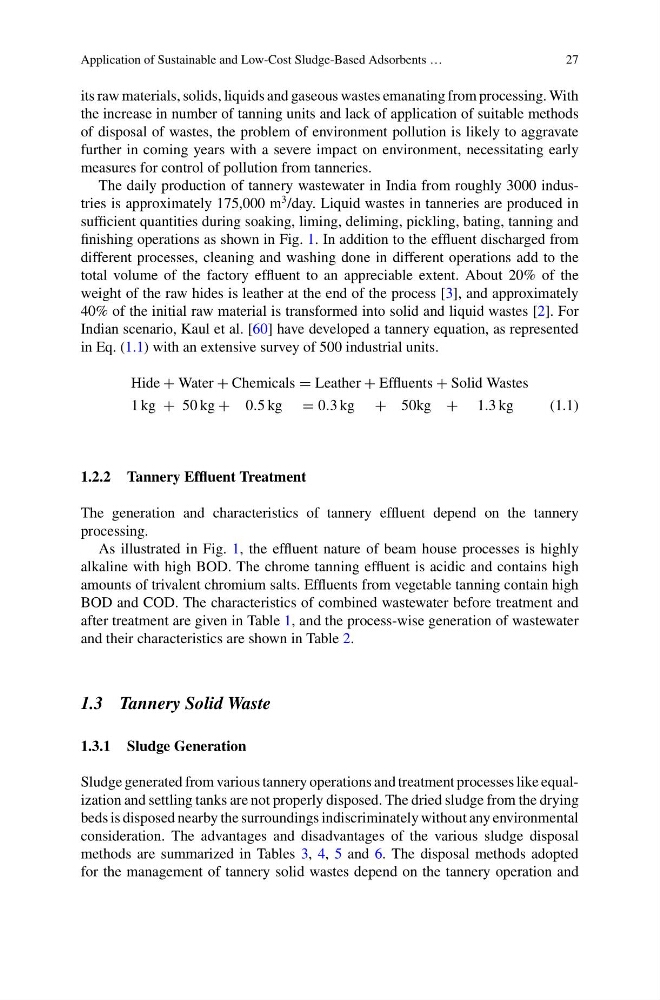
The daily production of tannery wastewater in India from roughly 3000 industries is approximately 175,000 m
3 /day. Liquid wastes in tanneries are produced in
sufficient quantities during soaking, liming, deliming, pickling, bating, tanning and
finishing operations as shown in Fig. 1. In addition to the effluent discharged from
different processes, cleaning and washing done in different operations add to the
total volume of the factory effluent to an appreciable extent. About 20% of the
weight of the raw hides is leather at the end of the process [3], and approximately
40% of the initial raw material is transformed into solid and liquid wastes [2]. For
Indian scenario, Kaul et al. [60] have developed a tannery equation, as represented
in Eq. (1.1) with an extensive survey of 500 industrial units.
Hide + Water + Chemicals = Leather + Effluents + Solid Wastes
1 kg + 50 kg + 0.5 kg = 0.3 kg + 50kg + 1.3 kg
(1.1)
1.2.2 Tannery Effluent Treatment
The generation and characteristics of tannery effluent depend on the tannery
processing.
As illustrated in Fig. 1, the effluent nature of beam house processes is highly
alkaline with high BOD. The chrome tanning effluent is acidic and contains high
amounts of trivalent chromium salts. Effluents from vegetable tanning contain high
BOD and COD. The characteristics of combined wastewater before treatment and
after treatment are given in Table 1, and the process-wise generation of wastewater
and their characteristics are shown in Table 2.
1.3 Tannery Solid Waste
1.3.1 Sludge Generation
Sludge generated from various tannery operations and treatment processes like equalization and settling tanks are not properly disposed. The dried sludge from the drying
beds is disposed nearby the surroundings indiscriminately without any environmental
consideration. The advantages and disadvantages of the various sludge disposal
methods are summarized in Tables 3, 4, 5 and 6. The disposal methods adopted
for the management of tannery solid wastes depend on the tannery operation and
27
its raw materials, solids, liquids and gaseous wastes emanating from processing. With
the increase in number of tanning units and lack of application of suitable methods
of disposal of wastes, the problem of environment pollution is likely to aggravate
further in coming years with a severe impact on environment, necessitating early
measures for control of pollution from tanneries.
The daily production of tannery wastewater in India from roughly 3000 industries is approximately 175,000 m
3 /day. Liquid wastes in tanneries are produced in
sufficient quantities during soaking, liming, deliming, pickling, bating, tanning and
finishing operations as shown in Fig. 1. In addition to the effluent discharged from
different processes, cleaning and washing done in different operations add to the
total volume of the factory effluent to an appreciable extent. About 20% of the
weight of the raw hides is leather at the end of the process [3], and approximately
40% of the initial raw material is transformed into solid and liquid wastes [2]. For
Indian scenario, Kaul et al. [60] have developed a tannery equation, as represented
in Eq. (1.1) with an extensive survey of 500 industrial units.
Hide + Water + Chemicals = Leather + Effluents + Solid Wastes
1 kg + 50 kg + 0.5 kg = 0.3 kg + 50kg + 1.3 kg
(1.1)
1.2.2 Tannery Effluent Treatment
The generation and characteristics of tannery effluent depend on the tannery
processing.
As illustrated in Fig. 1, the effluent nature of beam house processes is highly
alkaline with high BOD. The chrome tanning effluent is acidic and contains high
amounts of trivalent chromium salts. Effluents from vegetable tanning contain high
BOD and COD. The characteristics of combined wastewater before treatment and
after treatment are given in Table 1, and the process-wise generation of wastewater
and their characteristics are shown in Table 2.
1.3 Tannery Solid Waste
1.3.1 Sludge Generation
Sludge generated from various tannery operations and treatment processes like equalization and settling tanks are not properly disposed. The dried sludge from the drying
beds is disposed nearby the surroundings indiscriminately without any environmental
consideration. The advantages and disadvantages of the various sludge disposal
methods are summarized in Tables 3, 4, 5 and 6. The disposal methods adopted
for the management of tannery solid wastes depend on the tannery operation and