

Treatment of Textile Wastewater Using Biochar Produced …
217
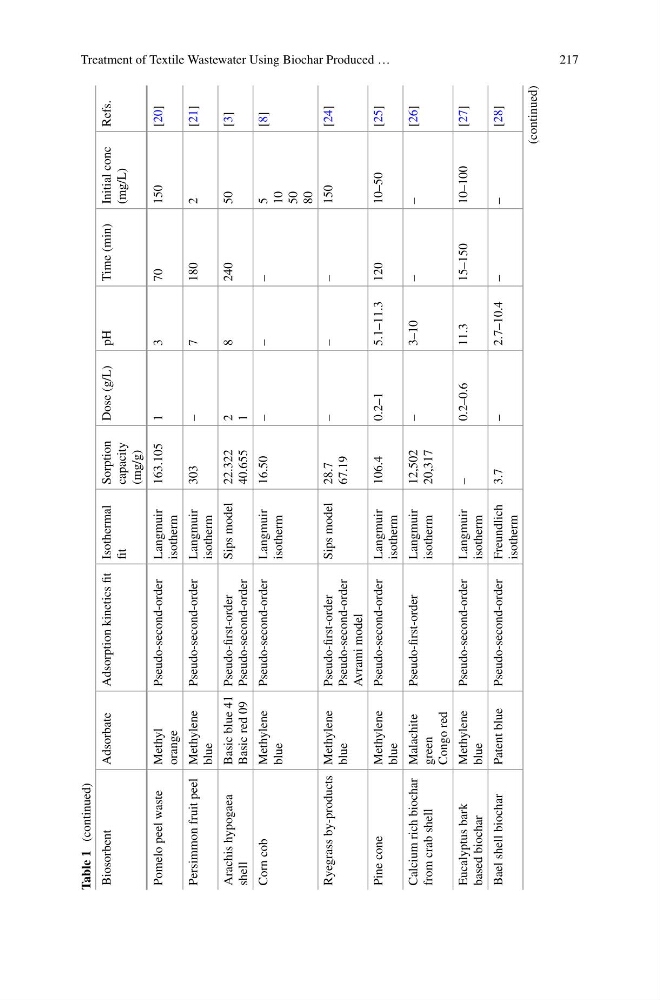
Table 1
(continued)
Biosorbent
Adsorbate
Adsorption kinetics fit Isothermal
fit
Sorption
capacity
(mg/g)
Dose (g/L)
pH
Time (min)
Initial conc
(mg/L)
Refs.
Pomelo peel waste
Methyl
orange
Pseudo-second-order
Langmuir
isotherm
163.105
1
3
70
150
[20]
Persimmon fruit peel Methylene
blue
Pseudo-second-order
Langmuir
isotherm
303
–
7
180
2
[21]
Arachis hypogaea
shell
Basic blue 41
Basic red 09
Pseudo-first-order
Pseudo-second-order
Sips model 22.322
40.655
2
1
8
240
50
[3]
Corn cob
Methylene
blue
Pseudo-second-order
Langmuir
isotherm
16.50
–
–
–
5
10
50
80
[8]
Ryegrass by-products Methylene
blue
Pseudo-first-order
Pseudo-second-order
Avrami model
Sips model 28.7
67.19
–
–
–
150
[24]
Pine cone
Methylene
blue
Pseudo-second-order
Langmuir
isotherm
106.4
0.2–1
5.1–11.3
120
10–50
[25]
Calcium rich biochar
from crab shell
Malachite
green
Congo red
Pseudo-first-order
Langmuir
isotherm
12,502
20,317
–
3–10
–
–
[26]
Eucalyptus bark
based biochar
Methylene
blue
Pseudo-second-order
Langmuir
isotherm
–
0.2–0.6
11.3
15–150
10–100
[27]
Bael shell biochar
Patent blue
Pseudo-second-order
Freundlich
isotherm
3.7
–
2.7–10.4
–
–
[28]
(continued)
217
Table 1
(continued)
Biosorbent
Adsorbate
Adsorption kinetics fit Isothermal
fit
Sorption
capacity
(mg/g)
Dose (g/L)
pH
Time (min)
Initial conc
(mg/L)
Refs.
Pomelo peel waste
Methyl
orange
Pseudo-second-order
Langmuir
isotherm
163.105
1
3
70
150
[20]
Persimmon fruit peel Methylene
blue
Pseudo-second-order
Langmuir
isotherm
303
–
7
180
2
[21]
Arachis hypogaea
shell
Basic blue 41
Basic red 09
Pseudo-first-order
Pseudo-second-order
Sips model 22.322
40.655
2
1
8
240
50
[3]
Corn cob
Methylene
blue
Pseudo-second-order
Langmuir
isotherm
16.50
–
–
–
5
10
50
80
[8]
Ryegrass by-products Methylene
blue
Pseudo-first-order
Pseudo-second-order
Avrami model
Sips model 28.7
67.19
–
–
–
150
[24]
Pine cone
Methylene
blue
Pseudo-second-order
Langmuir
isotherm
106.4
0.2–1
5.1–11.3
120
10–50
[25]
Calcium rich biochar
from crab shell
Malachite
green
Congo red
Pseudo-first-order
Langmuir
isotherm
12,502
20,317
–
3–10
–
–
[26]
Eucalyptus bark
based biochar
Methylene
blue
Pseudo-second-order
Langmuir
isotherm
–
0.2–0.6
11.3
15–150
10–100
[27]
Bael shell biochar
Patent blue
Pseudo-second-order
Freundlich
isotherm
3.7
–
2.7–10.4
–
–
[28]
(continued)