

14
C. Gutiérrez-Bouzán et al.
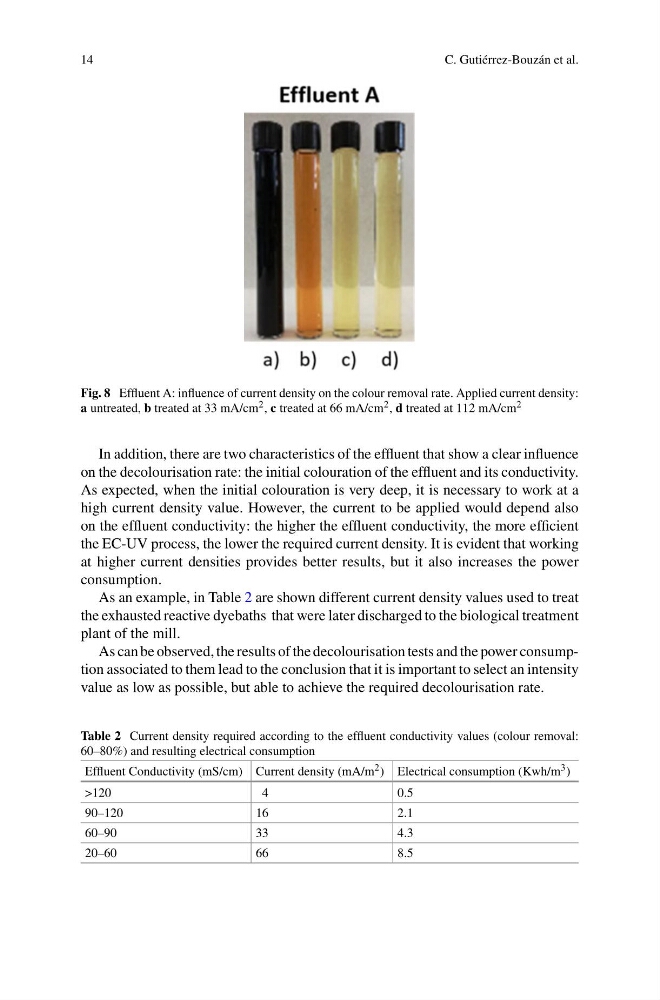
Fig. 8 Effluent A: influence of current density on the colour removal rate. Applied current density:
a untreated, b treated at 33 mA/cm 2 , c treated at 66 mA/cm 2 , d treated at 112 mA/cm 2
In addition, there are two characteristics of the effluent that show a clear influence
on the decolourisation rate: the initial colouration of the effluent and its conductivity.
As expected, when the initial colouration is very deep, it is necessary to work at a
high current density value. However, the current to be applied would depend also
on the effluent conductivity: the higher the effluent conductivity, the more efficient
the EC-UV process, the lower the required current density. It is evident that working
at higher current densities provides better results, but it also increases the power
consumption.
As an example, in Table 2 are shown different current density values used to treat
the exhausted reactive dyebaths that were later discharged to the biological treatment
plant of the mill.
As can be observed, the results of the decolourisation tests and the power consumption associated to them lead to the conclusion that it is important to select an intensity
value as low as possible, but able to achieve the required decolourisation rate.
Table 2 Current density required according to the effluent conductivity values (colour removal:
60–80%) and resulting electrical consumption
Effluent Conductivity (mS/cm) Current density (mA/m 2 ) Electrical consumption (Kwh/m 3 )
>120
4
0.5
90–120
16
2.1
60–90
33
4.3
20–60
66
8.5
C. Gutiérrez-Bouzán et al.
Fig. 8 Effluent A: influence of current density on the colour removal rate. Applied current density:
a untreated, b treated at 33 mA/cm 2 , c treated at 66 mA/cm 2 , d treated at 112 mA/cm 2
In addition, there are two characteristics of the effluent that show a clear influence
on the decolourisation rate: the initial colouration of the effluent and its conductivity.
As expected, when the initial colouration is very deep, it is necessary to work at a
high current density value. However, the current to be applied would depend also
on the effluent conductivity: the higher the effluent conductivity, the more efficient
the EC-UV process, the lower the required current density. It is evident that working
at higher current densities provides better results, but it also increases the power
consumption.
As an example, in Table 2 are shown different current density values used to treat
the exhausted reactive dyebaths that were later discharged to the biological treatment
plant of the mill.
As can be observed, the results of the decolourisation tests and the power consumption associated to them lead to the conclusion that it is important to select an intensity
value as low as possible, but able to achieve the required decolourisation rate.
Table 2 Current density required according to the effluent conductivity values (colour removal:
60–80%) and resulting electrical consumption
Effluent Conductivity (mS/cm) Current density (mA/m 2 ) Electrical consumption (Kwh/m 3 )
>120
4
0.5
90–120
16
2.1
60–90
33
4.3
20–60
66
8.5