

Advanced Oxidation Processes (AOP)—Effective Innovative …
193
3.6 Photocatalytic Reaction
The reactions that use both light and a catalyst are termed as photocatalytic reactions,
and it means a substance which alters the rate of reaction by its presence. Hence,
photocatalyst is a substance which is used to enhance the rate of any chemical reaction
induced on exposure to light, and this phenomenon is called photocatalysis. The
catalyst used is semiconductors, and when exposed to sunlight or artificial light
source with sufficient energy, it absorbs the light rays and acts as catalyst to induce
chemical reactions to happen [58].
Fundamentals of Photocatalysis
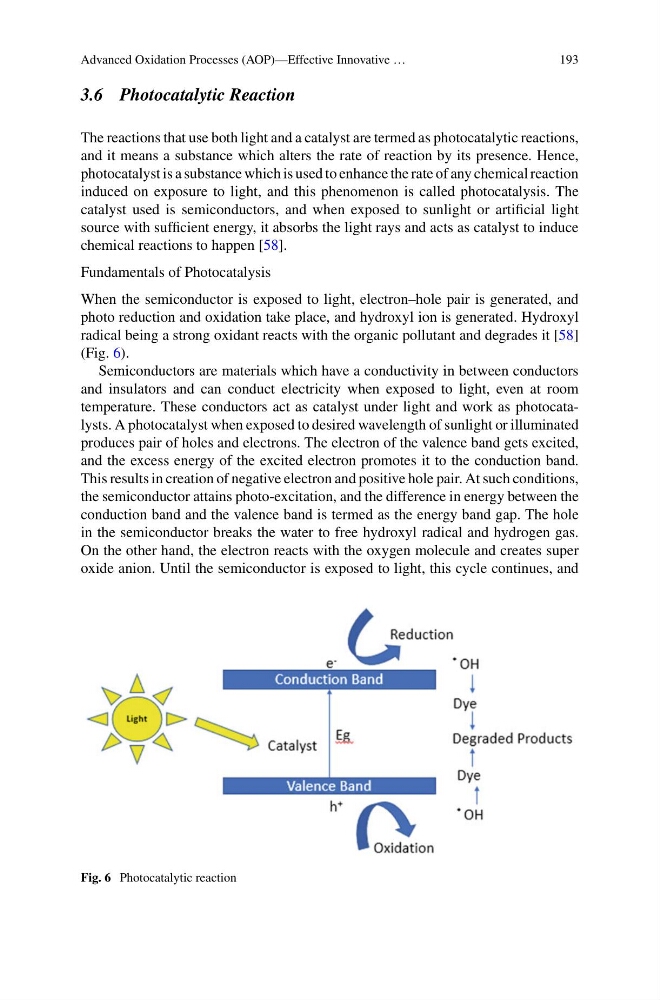
When the semiconductor is exposed to light, electron–hole pair is generated, and
photo reduction and oxidation take place, and hydroxyl ion is generated. Hydroxyl
radical being a strong oxidant reacts with the organic pollutant and degrades it [58]
(Fig. 6).
Semiconductors are materials which have a conductivity in between conductors
and insulators and can conduct electricity when exposed to light, even at room
temperature. These conductors act as catalyst under light and work as photocatalysts. A photocatalyst when exposed to desired wavelength of sunlight or illuminated
produces pair of holes and electrons. The electron of the valence band gets excited,
and the excess energy of the excited electron promotes it to the conduction band.
This results in creation of negative electron and positive hole pair. At such conditions,
the semiconductor attains photo-excitation, and the difference in energy between the
conduction band and the valence band is termed as the energy band gap. The hole
in the semiconductor breaks the water to free hydroxyl radical and hydrogen gas.
On the other hand, the electron reacts with the oxygen molecule and creates super
oxide anion. Until the semiconductor is exposed to light, this cycle continues, and
Fig. 6 Photocatalytic reaction
193
3.6 Photocatalytic Reaction
The reactions that use both light and a catalyst are termed as photocatalytic reactions,
and it means a substance which alters the rate of reaction by its presence. Hence,
photocatalyst is a substance which is used to enhance the rate of any chemical reaction
induced on exposure to light, and this phenomenon is called photocatalysis. The
catalyst used is semiconductors, and when exposed to sunlight or artificial light
source with sufficient energy, it absorbs the light rays and acts as catalyst to induce
chemical reactions to happen [58].
Fundamentals of Photocatalysis
When the semiconductor is exposed to light, electron–hole pair is generated, and
photo reduction and oxidation take place, and hydroxyl ion is generated. Hydroxyl
radical being a strong oxidant reacts with the organic pollutant and degrades it [58]
(Fig. 6).
Semiconductors are materials which have a conductivity in between conductors
and insulators and can conduct electricity when exposed to light, even at room
temperature. These conductors act as catalyst under light and work as photocatalysts. A photocatalyst when exposed to desired wavelength of sunlight or illuminated
produces pair of holes and electrons. The electron of the valence band gets excited,
and the excess energy of the excited electron promotes it to the conduction band.
This results in creation of negative electron and positive hole pair. At such conditions,
the semiconductor attains photo-excitation, and the difference in energy between the
conduction band and the valence band is termed as the energy band gap. The hole
in the semiconductor breaks the water to free hydroxyl radical and hydrogen gas.
On the other hand, the electron reacts with the oxygen molecule and creates super
oxide anion. Until the semiconductor is exposed to light, this cycle continues, and
Fig. 6 Photocatalytic reaction