

188
R. Sukanya Devi et al.
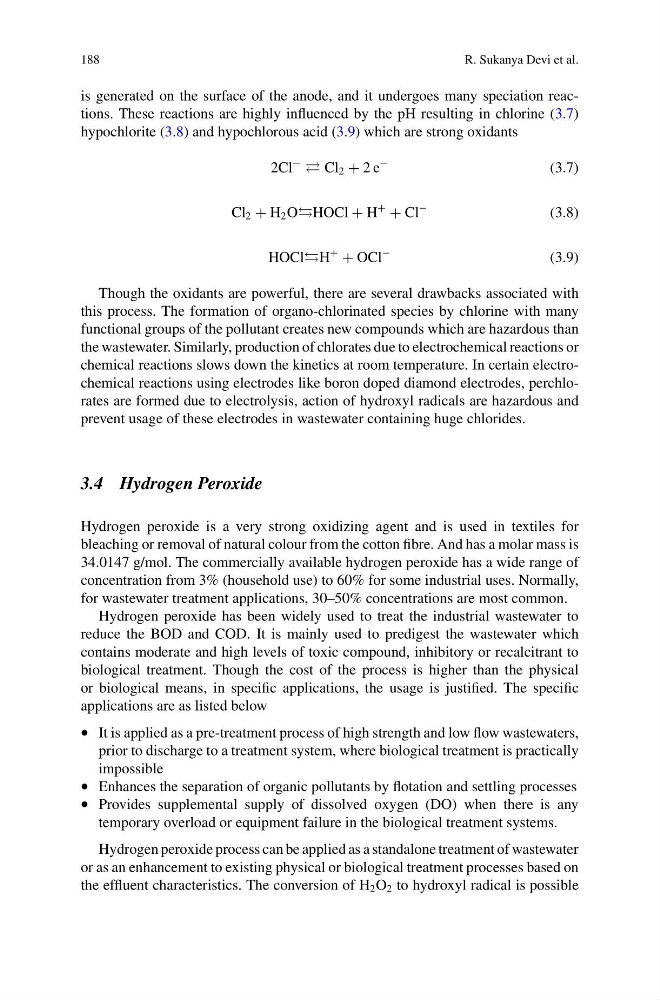
is generated on the surface of the anode, and it undergoes many speciation reactions. These reactions are highly influenced by the pH resulting in chlorine (3.7)
hypochlorite (3.8) and hypochlorous acid (3.9) which are strong oxidants
2Cl
−
Cl 2 + 2 e
−
(3.7)
Cl 2 + H 2 OHOCl + H
+
+ Cl
−
(3.8)
HOClH
+
+ OCl
−
(3.9)
Though the oxidants are powerful, there are several drawbacks associated with
this process. The formation of organo-chlorinated species by chlorine with many
functional groups of the pollutant creates new compounds which are hazardous than
the wastewater. Similarly, production of chlorates due to electrochemical reactions or
chemical reactions slows down the kinetics at room temperature. In certain electrochemical reactions using electrodes like boron doped diamond electrodes, perchlorates are formed due to electrolysis, action of hydroxyl radicals are hazardous and
prevent usage of these electrodes in wastewater containing huge chlorides.
3.4 Hydrogen Peroxide
Hydrogen peroxide is a very strong oxidizing agent and is used in textiles for
bleaching or removal of natural colour from the cotton fibre. And has a molar mass is
34.0147 g/mol. The commercially available hydrogen peroxide has a wide range of
concentration from 3% (household use) to 60% for some industrial uses. Normally,
for wastewater treatment applications, 30–50% concentrations are most common.
Hydrogen peroxide has been widely used to treat the industrial wastewater to
reduce the BOD and COD. It is mainly used to predigest the wastewater which
contains moderate and high levels of toxic compound, inhibitory or recalcitrant to
biological treatment. Though the cost of the process is higher than the physical
or biological means, in specific applications, the usage is justified. The specific
applications are as listed below
• It is applied as a pre-treatment process of high strength and low flow wastewaters,
prior to discharge to a treatment system, where biological treatment is practically
impossible
• Enhances the separation of organic pollutants by flotation and settling processes
• Provides supplemental supply of dissolved oxygen (DO) when there is any
temporary overload or equipment failure in the biological treatment systems.
Hydrogen peroxide process can be applied as a standalone treatment of wastewater
or as an enhancement to existing physical or biological treatment processes based on
the effluent characteristics. The conversion of H 2 O 2 to hydroxyl radical is possible
R. Sukanya Devi et al.
is generated on the surface of the anode, and it undergoes many speciation reactions. These reactions are highly influenced by the pH resulting in chlorine (3.7)
hypochlorite (3.8) and hypochlorous acid (3.9) which are strong oxidants
2Cl
−
Cl 2 + 2 e
−
(3.7)
Cl 2 + H 2 OHOCl + H
+
+ Cl
−
(3.8)
HOClH
+
+ OCl
−
(3.9)
Though the oxidants are powerful, there are several drawbacks associated with
this process. The formation of organo-chlorinated species by chlorine with many
functional groups of the pollutant creates new compounds which are hazardous than
the wastewater. Similarly, production of chlorates due to electrochemical reactions or
chemical reactions slows down the kinetics at room temperature. In certain electrochemical reactions using electrodes like boron doped diamond electrodes, perchlorates are formed due to electrolysis, action of hydroxyl radicals are hazardous and
prevent usage of these electrodes in wastewater containing huge chlorides.
3.4 Hydrogen Peroxide
Hydrogen peroxide is a very strong oxidizing agent and is used in textiles for
bleaching or removal of natural colour from the cotton fibre. And has a molar mass is
34.0147 g/mol. The commercially available hydrogen peroxide has a wide range of
concentration from 3% (household use) to 60% for some industrial uses. Normally,
for wastewater treatment applications, 30–50% concentrations are most common.
Hydrogen peroxide has been widely used to treat the industrial wastewater to
reduce the BOD and COD. It is mainly used to predigest the wastewater which
contains moderate and high levels of toxic compound, inhibitory or recalcitrant to
biological treatment. Though the cost of the process is higher than the physical
or biological means, in specific applications, the usage is justified. The specific
applications are as listed below
• It is applied as a pre-treatment process of high strength and low flow wastewaters,
prior to discharge to a treatment system, where biological treatment is practically
impossible
• Enhances the separation of organic pollutants by flotation and settling processes
• Provides supplemental supply of dissolved oxygen (DO) when there is any
temporary overload or equipment failure in the biological treatment systems.
Hydrogen peroxide process can be applied as a standalone treatment of wastewater
or as an enhancement to existing physical or biological treatment processes based on
the effluent characteristics. The conversion of H 2 O 2 to hydroxyl radical is possible