

Advanced Oxidation Processes (AOP)—Effective Innovative …
185
3.3.1 Direct Electrochemical Oxidation Process
In direct electrochemical oxidation process, the hydroxyl radicals are formed at the
surface of the electrode. In direct electrochemical oxidation process, the organic
pollutants are oxidized once they are adsorbed by the anodic surface without
discharge of any other substance other than the electron which is called as the
clean reagent. These surface-controlled reactions are also known as anodic oxidation
process which take place the near surface of the anode, and hence, the electrode plays
an important role in the process [42].
A ads − 2 e
−
→ P ads
where A ads is the pollutant adsorbed by the anode and Pads is the oxidized adsorbed
pollutant. Direct electrochemical oxidation process has a lower kinetics that is highly
dependent on the electrocatalytic activity of the anode. Higher reaction rates can
be obtained by using metals such as Pt and Pd and also metal oxides like iridium
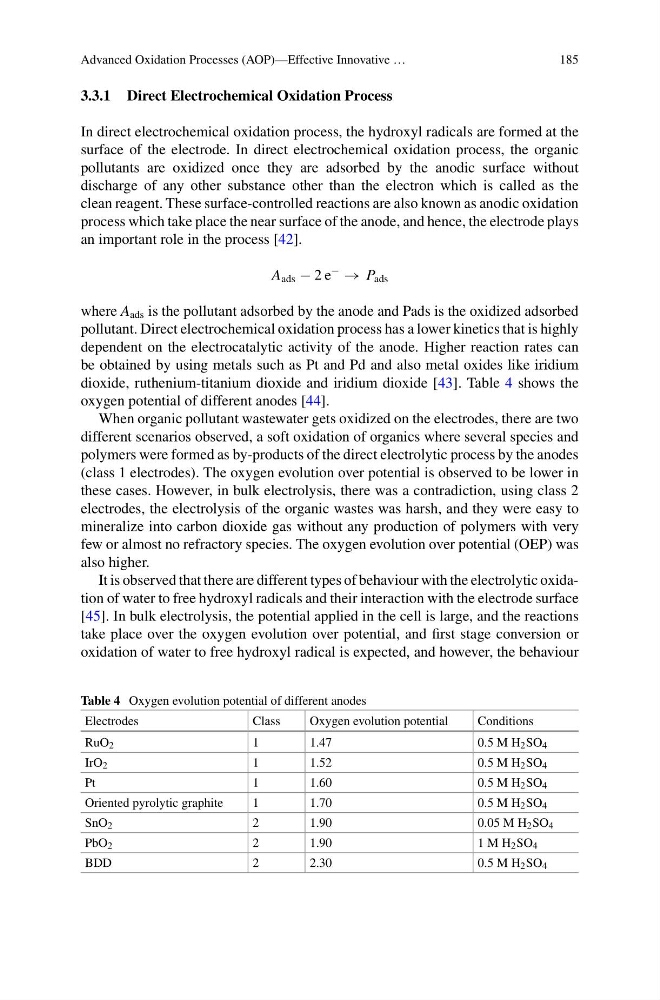
dioxide, ruthenium-titanium dioxide and iridium dioxide [43]. Table 4 shows the
oxygen potential of different anodes [44].
When organic pollutant wastewater gets oxidized on the electrodes, there are two
different scenarios observed, a soft oxidation of organics where several species and
polymers were formed as by-products of the direct electrolytic process by the anodes
(class 1 electrodes). The oxygen evolution over potential is observed to be lower in
these cases. However, in bulk electrolysis, there was a contradiction, using class 2
electrodes, the electrolysis of the organic wastes was harsh, and they were easy to
mineralize into carbon dioxide gas without any production of polymers with very
few or almost no refractory species. The oxygen evolution over potential (OEP) was
also higher.
It is observed that there are different types of behaviour with the electrolytic oxidation of water to free hydroxyl radicals and their interaction with the electrode surface
[45]. In bulk electrolysis, the potential applied in the cell is large, and the reactions
take place over the oxygen evolution over potential, and first stage conversion or
oxidation of water to free hydroxyl radical is expected, and however, the behaviour
Table 4 Oxygen evolution potential of different anodes
Electrodes
Class
Oxygen evolution potential
Conditions
RuO 2
1
1.47
0.5 M H 2 SO 4
IrO 2
1
1.52
0.5 M H 2 SO 4
Pt
1
1.60
0.5 M H 2 SO 4
Oriented pyrolytic graphite
1
1.70
0.5 M H 2 SO 4
SnO 2
2
1.90
0.05 M H 2 SO 4
PbO 2
2
1.90
1 M H 2 SO 4
BDD
2
2.30
0.5 M H 2 SO 4
185
3.3.1 Direct Electrochemical Oxidation Process
In direct electrochemical oxidation process, the hydroxyl radicals are formed at the
surface of the electrode. In direct electrochemical oxidation process, the organic
pollutants are oxidized once they are adsorbed by the anodic surface without
discharge of any other substance other than the electron which is called as the
clean reagent. These surface-controlled reactions are also known as anodic oxidation
process which take place the near surface of the anode, and hence, the electrode plays
an important role in the process [42].
A ads − 2 e
−
→ P ads
where A ads is the pollutant adsorbed by the anode and Pads is the oxidized adsorbed
pollutant. Direct electrochemical oxidation process has a lower kinetics that is highly
dependent on the electrocatalytic activity of the anode. Higher reaction rates can
be obtained by using metals such as Pt and Pd and also metal oxides like iridium
dioxide, ruthenium-titanium dioxide and iridium dioxide [43]. Table 4 shows the
oxygen potential of different anodes [44].
When organic pollutant wastewater gets oxidized on the electrodes, there are two
different scenarios observed, a soft oxidation of organics where several species and
polymers were formed as by-products of the direct electrolytic process by the anodes
(class 1 electrodes). The oxygen evolution over potential is observed to be lower in
these cases. However, in bulk electrolysis, there was a contradiction, using class 2
electrodes, the electrolysis of the organic wastes was harsh, and they were easy to
mineralize into carbon dioxide gas without any production of polymers with very
few or almost no refractory species. The oxygen evolution over potential (OEP) was
also higher.
It is observed that there are different types of behaviour with the electrolytic oxidation of water to free hydroxyl radicals and their interaction with the electrode surface
[45]. In bulk electrolysis, the potential applied in the cell is large, and the reactions
take place over the oxygen evolution over potential, and first stage conversion or
oxidation of water to free hydroxyl radical is expected, and however, the behaviour
Table 4 Oxygen evolution potential of different anodes
Electrodes
Class
Oxygen evolution potential
Conditions
RuO 2
1
1.47
0.5 M H 2 SO 4
IrO 2
1
1.52
0.5 M H 2 SO 4
Pt
1
1.60
0.5 M H 2 SO 4
Oriented pyrolytic graphite
1
1.70
0.5 M H 2 SO 4
SnO 2
2
1.90
0.05 M H 2 SO 4
PbO 2
2
1.90
1 M H 2 SO 4
BDD
2
2.30
0.5 M H 2 SO 4