

178
R. Sukanya Devi et al.
degrade the organic pollutants present in air and water. These are effectively studied in
treatment of wastewater from domestic sewage and widely on the industrial effluents.
These systems mainly generate oxidizing agents, and these agents react with the
pollutant and degrade them. There are various ways and means to produce the most
effective oxidizing agents, and this chapter will unveil the types of advanced oxidation
processes and their effectiveness. There may be a single process used to degrade the
effluent or combination of several oxidation process for effective degradation of the
pollutants.
2 Advanced Oxidation Processes
Oxidation is the loss of electrons by a molecule, atom or ion during any chemical
reaction, and the opposite reaction of gaining electrons by a molecule, atom or ion
is termed as reduction. In general, oxidation and reduction occur together, with one
species losing electron and the other gaining electron, and this process is termed as
redox reaction. Hydrogen peroxide and sodium hydrosulphite are classic examples
for the use as oxidizing agent and reducing agent, respectively, in textile wet process.
Though hydrogen peroxide is a good oxidizing agent, the reaction rate is dependent
on the thermodynamics, and the process kinetics is slower [27, 28]. The reaction rate
can be increased by generation of free radicals like hydroxyl radicals (*OH), and the
reaction rates are much higher than the oxidizing agents generated by H 2 O 2 .
Advanced oxidation processes are an effective alternative for the treatment
of contaminated wastewater (underground as well as from industry) resources
containing non-biodegradable harmful substances as well as to purify and disinfect
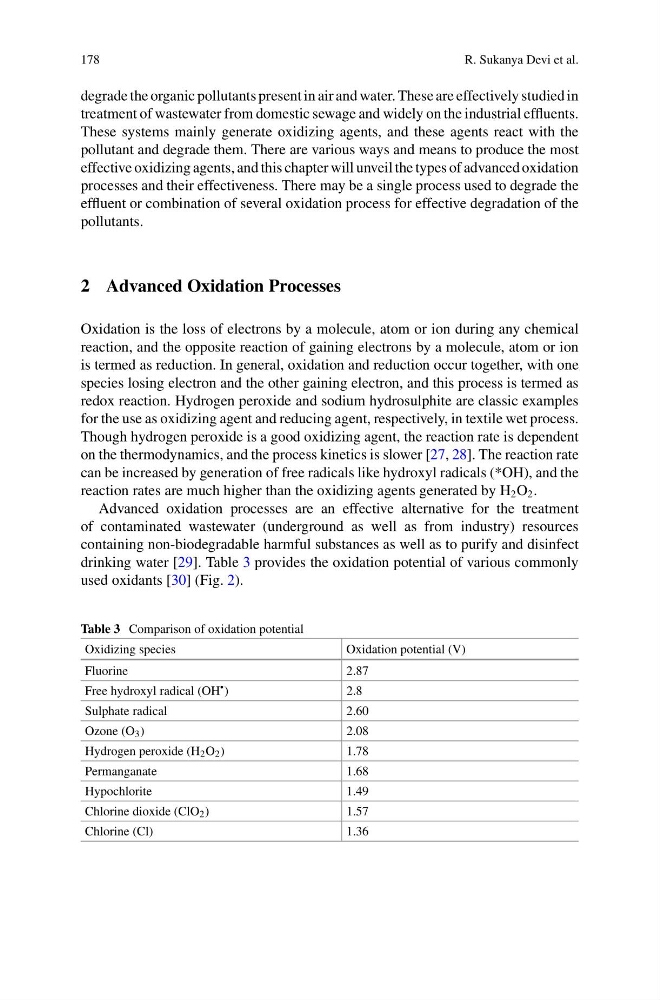
drinking water [29]. Table 3 provides the oxidation potential of various commonly
used oxidants [30] (Fig. 2).
Table 3 Comparison of oxidation potential
Oxidizing species
Oxidation potential (V)
Fluorine
2.87
Free hydroxyl radical (OH • )
2.8
Sulphate radical
2.60
Ozone (O 3 )
2.08
Hydrogen peroxide (H 2 O 2 )
1.78
Permanganate
1.68
Hypochlorite
1.49
Chlorine dioxide (ClO 2 )
1.57
Chlorine (Cl)
1.36
R. Sukanya Devi et al.
degrade the organic pollutants present in air and water. These are effectively studied in
treatment of wastewater from domestic sewage and widely on the industrial effluents.
These systems mainly generate oxidizing agents, and these agents react with the
pollutant and degrade them. There are various ways and means to produce the most
effective oxidizing agents, and this chapter will unveil the types of advanced oxidation
processes and their effectiveness. There may be a single process used to degrade the
effluent or combination of several oxidation process for effective degradation of the
pollutants.
2 Advanced Oxidation Processes
Oxidation is the loss of electrons by a molecule, atom or ion during any chemical
reaction, and the opposite reaction of gaining electrons by a molecule, atom or ion
is termed as reduction. In general, oxidation and reduction occur together, with one
species losing electron and the other gaining electron, and this process is termed as
redox reaction. Hydrogen peroxide and sodium hydrosulphite are classic examples
for the use as oxidizing agent and reducing agent, respectively, in textile wet process.
Though hydrogen peroxide is a good oxidizing agent, the reaction rate is dependent
on the thermodynamics, and the process kinetics is slower [27, 28]. The reaction rate
can be increased by generation of free radicals like hydroxyl radicals (*OH), and the
reaction rates are much higher than the oxidizing agents generated by H 2 O 2 .
Advanced oxidation processes are an effective alternative for the treatment
of contaminated wastewater (underground as well as from industry) resources
containing non-biodegradable harmful substances as well as to purify and disinfect
drinking water [29]. Table 3 provides the oxidation potential of various commonly
used oxidants [30] (Fig. 2).
Table 3 Comparison of oxidation potential
Oxidizing species
Oxidation potential (V)
Fluorine
2.87
Free hydroxyl radical (OH • )
2.8
Sulphate radical
2.60
Ozone (O 3 )
2.08
Hydrogen peroxide (H 2 O 2 )
1.78
Permanganate
1.68
Hypochlorite
1.49
Chlorine dioxide (ClO 2 )
1.57
Chlorine (Cl)
1.36