

Photo-Catalytic-Assisted Method for Treating Industrial …
161
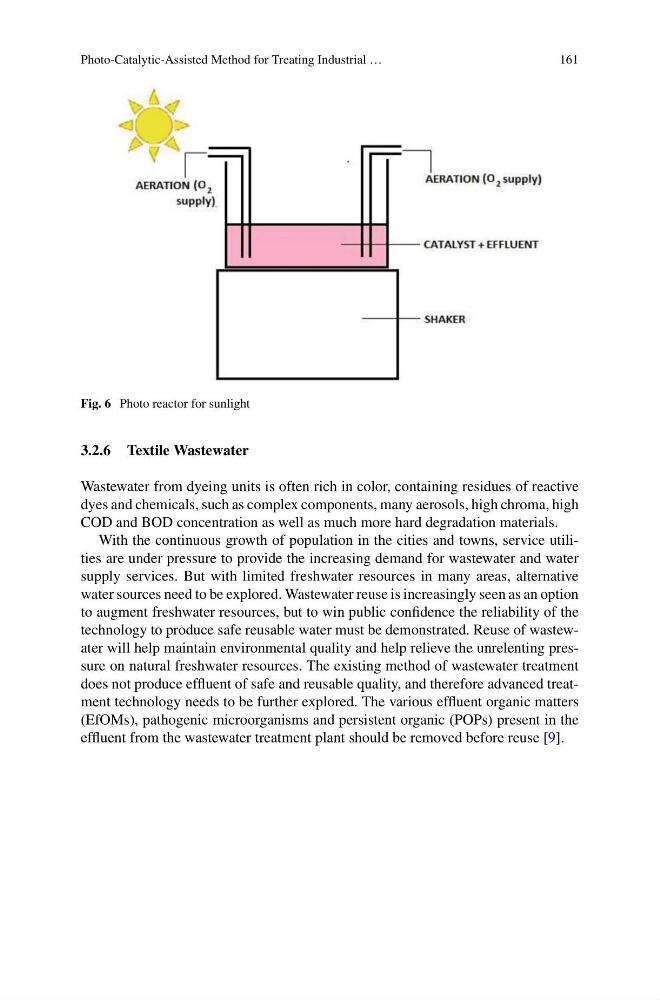
Fig. 6 Photo reactor for sunlight
3.2.6 Textile Wastewater
Wastewater from dyeing units is often rich in color, containing residues of reactive
dyes and chemicals, such as complex components, many aerosols, high chroma, high
COD and BOD concentration as well as much more hard degradation materials.
With the continuous growth of population in the cities and towns, service utilities are under pressure to provide the increasing demand for wastewater and water
supply services. But with limited freshwater resources in many areas, alternative
water sources need to be explored. Wastewater reuse is increasingly seen as an option
to augment freshwater resources, but to win public confidence the reliability of the
technology to produce safe reusable water must be demonstrated. Reuse of wastewater will help maintain environmental quality and help relieve the unrelenting pressure on natural freshwater resources. The existing method of wastewater treatment
does not produce effluent of safe and reusable quality, and therefore advanced treatment technology needs to be further explored. The various effluent organic matters
(EfOMs), pathogenic microorganisms and persistent organic (POPs) present in the
effluent from the wastewater treatment plant should be removed before reuse [9].
161
Fig. 6 Photo reactor for sunlight
3.2.6 Textile Wastewater
Wastewater from dyeing units is often rich in color, containing residues of reactive
dyes and chemicals, such as complex components, many aerosols, high chroma, high
COD and BOD concentration as well as much more hard degradation materials.
With the continuous growth of population in the cities and towns, service utilities are under pressure to provide the increasing demand for wastewater and water
supply services. But with limited freshwater resources in many areas, alternative
water sources need to be explored. Wastewater reuse is increasingly seen as an option
to augment freshwater resources, but to win public confidence the reliability of the
technology to produce safe reusable water must be demonstrated. Reuse of wastewater will help maintain environmental quality and help relieve the unrelenting pressure on natural freshwater resources. The existing method of wastewater treatment
does not produce effluent of safe and reusable quality, and therefore advanced treatment technology needs to be further explored. The various effluent organic matters
(EfOMs), pathogenic microorganisms and persistent organic (POPs) present in the
effluent from the wastewater treatment plant should be removed before reuse [9].