

156
M. Parthiban and G. Devanand
energy-sparing lights, which delivers the whole cycle monetarily and for all intents
and purposes possible [17].
3 Materials and Methods
For treating the dye house effluents, RGOT and TiO 2 have been widely used.
The effluents are treated using recently developed RGO-based binary, ternary and
quaternary nano-composites. The photo-catalytic activities of RGO-based ternary
nano-composites such as RGO/dual semiconductors, RGO/metal/semiconductor and
RGO/dual metal-free semiconductors have proven positive results, and the plausible
photo-catalytic pathway for generation of free radicals by RGO-based is helpful to
develop a new RGO-based photo-catalysts to treat dye house effluents with superior
activity and minimized production costs.
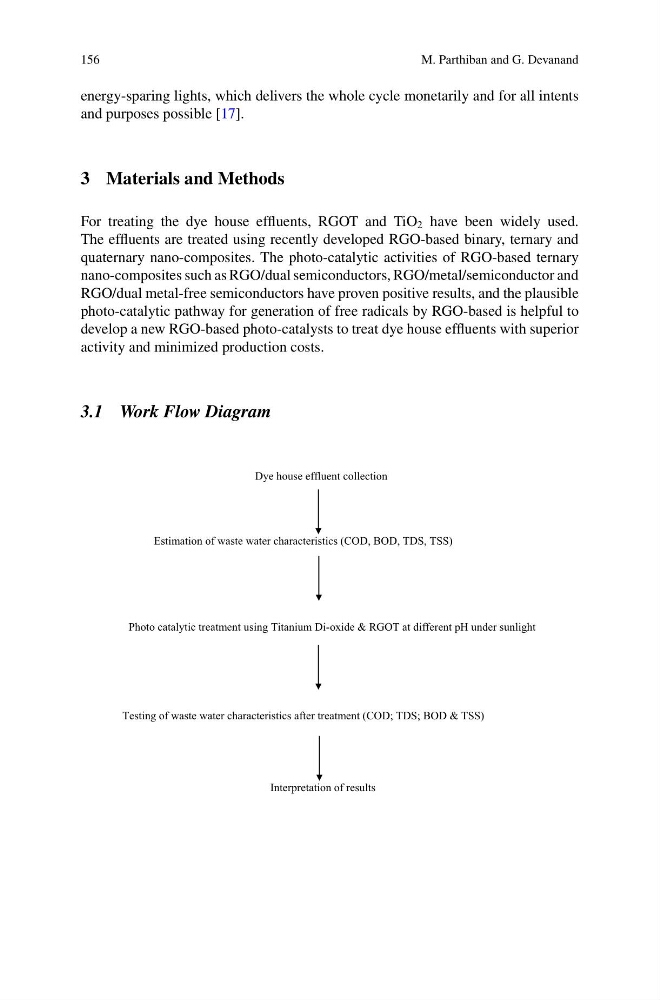
3.1 Work Flow Diagram
Dye house effluent collection
Estimation of waste water characteristics (COD, BOD, TDS, TSS)
Photo catalytic treatment using Titanium Di-oxide & RGOT at different pH under sunlight
Testing of waste water characteristics after treatment (COD; TDS; BOD & TSS)
Interpretation of results
M. Parthiban and G. Devanand
energy-sparing lights, which delivers the whole cycle monetarily and for all intents
and purposes possible [17].
3 Materials and Methods
For treating the dye house effluents, RGOT and TiO 2 have been widely used.
The effluents are treated using recently developed RGO-based binary, ternary and
quaternary nano-composites. The photo-catalytic activities of RGO-based ternary
nano-composites such as RGO/dual semiconductors, RGO/metal/semiconductor and
RGO/dual metal-free semiconductors have proven positive results, and the plausible
photo-catalytic pathway for generation of free radicals by RGO-based is helpful to
develop a new RGO-based photo-catalysts to treat dye house effluents with superior
activity and minimized production costs.
3.1 Work Flow Diagram
Dye house effluent collection
Estimation of waste water characteristics (COD, BOD, TDS, TSS)
Photo catalytic treatment using Titanium Di-oxide & RGOT at different pH under sunlight
Testing of waste water characteristics after treatment (COD; TDS; BOD & TSS)
Interpretation of results