

6
C. Gutiérrez-Bouzán et al.
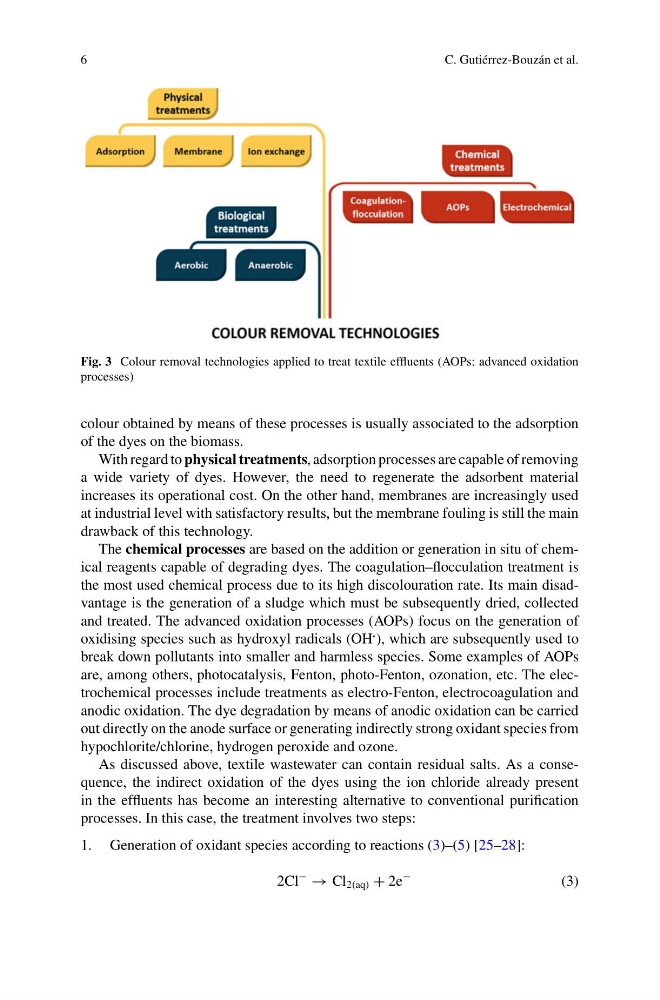
Fig. 3 Colour removal technologies applied to treat textile effluents (AOPs: advanced oxidation
processes)
colour obtained by means of these processes is usually associated to the adsorption
of the dyes on the biomass.
With regard to physical treatments, adsorption processes are capable of removing
a wide variety of dyes. However, the need to regenerate the adsorbent material
increases its operational cost. On the other hand, membranes are increasingly used
at industrial level with satisfactory results, but the membrane fouling is still the main
drawback of this technology.
The chemical processes are based on the addition or generation in situ of chemical reagents capable of degrading dyes. The coagulation–flocculation treatment is
the most used chemical process due to its high discolouration rate. Its main disadvantage is the generation of a sludge which must be subsequently dried, collected
and treated. The advanced oxidation processes (AOPs) focus on the generation of
oxidising species such as hydroxyl radicals (OH · ), which are subsequently used to
break down pollutants into smaller and harmless species. Some examples of AOPs
are, among others, photocatalysis, Fenton, photo-Fenton, ozonation, etc. The electrochemical processes include treatments as electro-Fenton, electrocoagulation and
anodic oxidation. The dye degradation by means of anodic oxidation can be carried
out directly on the anode surface or generating indirectly strong oxidant species from
hypochlorite/chlorine, hydrogen peroxide and ozone.
As discussed above, textile wastewater can contain residual salts. As a consequence, the indirect oxidation of the dyes using the ion chloride already present
in the effluents has become an interesting alternative to conventional purification
processes. In this case, the treatment involves two steps:
1. Generation of oxidant species according to reactions (3)–(5) [25–28]:
2Cl
−
→ Cl 2(aq) + 2e
−
(3)
C. Gutiérrez-Bouzán et al.
Fig. 3 Colour removal technologies applied to treat textile effluents (AOPs: advanced oxidation
processes)
colour obtained by means of these processes is usually associated to the adsorption
of the dyes on the biomass.
With regard to physical treatments, adsorption processes are capable of removing
a wide variety of dyes. However, the need to regenerate the adsorbent material
increases its operational cost. On the other hand, membranes are increasingly used
at industrial level with satisfactory results, but the membrane fouling is still the main
drawback of this technology.
The chemical processes are based on the addition or generation in situ of chemical reagents capable of degrading dyes. The coagulation–flocculation treatment is
the most used chemical process due to its high discolouration rate. Its main disadvantage is the generation of a sludge which must be subsequently dried, collected
and treated. The advanced oxidation processes (AOPs) focus on the generation of
oxidising species such as hydroxyl radicals (OH · ), which are subsequently used to
break down pollutants into smaller and harmless species. Some examples of AOPs
are, among others, photocatalysis, Fenton, photo-Fenton, ozonation, etc. The electrochemical processes include treatments as electro-Fenton, electrocoagulation and
anodic oxidation. The dye degradation by means of anodic oxidation can be carried
out directly on the anode surface or generating indirectly strong oxidant species from
hypochlorite/chlorine, hydrogen peroxide and ozone.
As discussed above, textile wastewater can contain residual salts. As a consequence, the indirect oxidation of the dyes using the ion chloride already present
in the effluents has become an interesting alternative to conventional purification
processes. In this case, the treatment involves two steps:
1. Generation of oxidant species according to reactions (3)–(5) [25–28]:
2Cl
−
→ Cl 2(aq) + 2e
−
(3)