

Dyestuff Adsorbing Natural Composites for Wastewater Treatments
129
0
0.5
1
1.5
2
2.5
3
3.5
0
2 0
4 0
6 0
8 0
1 0 0
Adsorbance (au)
Concentraon
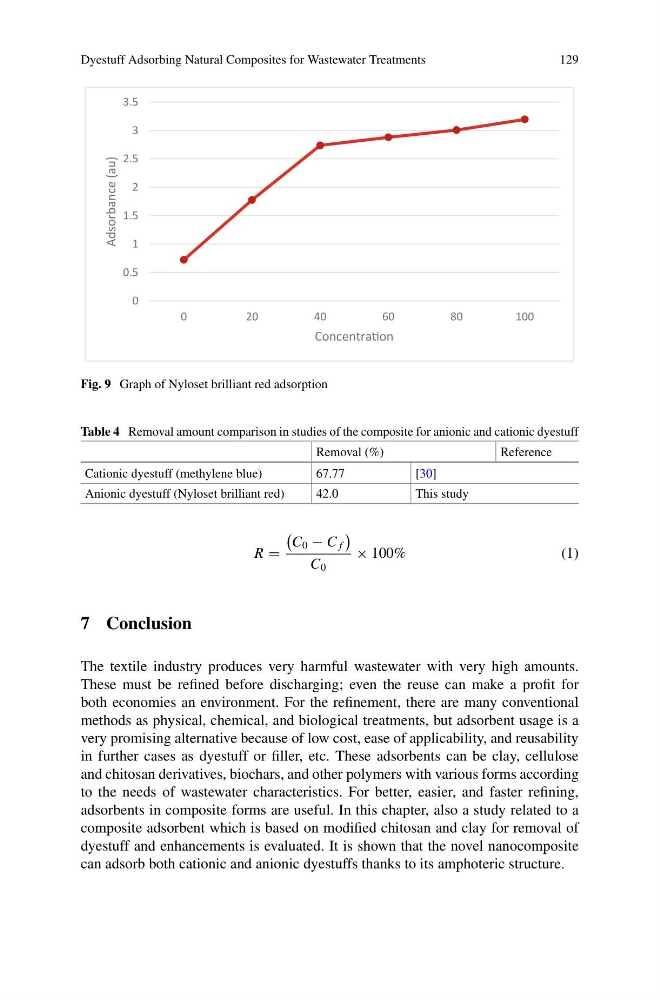
Fig. 9 Graph of Nyloset brilliant red adsorption
Table 4 Removal amount comparison in studies of the composite for anionic and cationic dyestuff
Removal (%)
Reference
Cationic dyestuff (methylene blue)
67.77
[30]
Anionic dyestuff (Nyloset brilliant red)
42.0
This study
R =
C 0 − C f
C 0
× 100%
(1)
7 Conclusion
The textile industry produces very harmful wastewater with very high amounts.
These must be refined before discharging; even the reuse can make a profit for
both economies an environment. For the refinement, there are many conventional
methods as physical, chemical, and biological treatments, but adsorbent usage is a
very promising alternative because of low cost, ease of applicability, and reusability
in further cases as dyestuff or filler, etc. These adsorbents can be clay, cellulose
and chitosan derivatives, biochars, and other polymers with various forms according
to the needs of wastewater characteristics. For better, easier, and faster refining,
adsorbents in composite forms are useful. In this chapter, also a study related to a
composite adsorbent which is based on modified chitosan and clay for removal of
dyestuff and enhancements is evaluated. It is shown that the novel nanocomposite
can adsorb both cationic and anionic dyestuffs thanks to its amphoteric structure.
129
0
0.5
1
1.5
2
2.5
3
3.5
0
2 0
4 0
6 0
8 0
1 0 0
Adsorbance (au)
Concentraon
Fig. 9 Graph of Nyloset brilliant red adsorption
Table 4 Removal amount comparison in studies of the composite for anionic and cationic dyestuff
Removal (%)
Reference
Cationic dyestuff (methylene blue)
67.77
[30]
Anionic dyestuff (Nyloset brilliant red)
42.0
This study
R =
C 0 − C f
C 0
× 100%
(1)
7 Conclusion
The textile industry produces very harmful wastewater with very high amounts.
These must be refined before discharging; even the reuse can make a profit for
both economies an environment. For the refinement, there are many conventional
methods as physical, chemical, and biological treatments, but adsorbent usage is a
very promising alternative because of low cost, ease of applicability, and reusability
in further cases as dyestuff or filler, etc. These adsorbents can be clay, cellulose
and chitosan derivatives, biochars, and other polymers with various forms according
to the needs of wastewater characteristics. For better, easier, and faster refining,
adsorbents in composite forms are useful. In this chapter, also a study related to a
composite adsorbent which is based on modified chitosan and clay for removal of
dyestuff and enhancements is evaluated. It is shown that the novel nanocomposite
can adsorb both cationic and anionic dyestuffs thanks to its amphoteric structure.