

Dyestuff Adsorbing Natural Composites for Wastewater Treatments
127
adsorbent. Biopolymers are also good alternatives for using them as hydrogel form
or in a composite structure, but adsorption characteristics must be enhanced. Also,
biopolymers are the best option for further usages because they are ready to form or
reshape in different conditions, but their adsorption is limited.
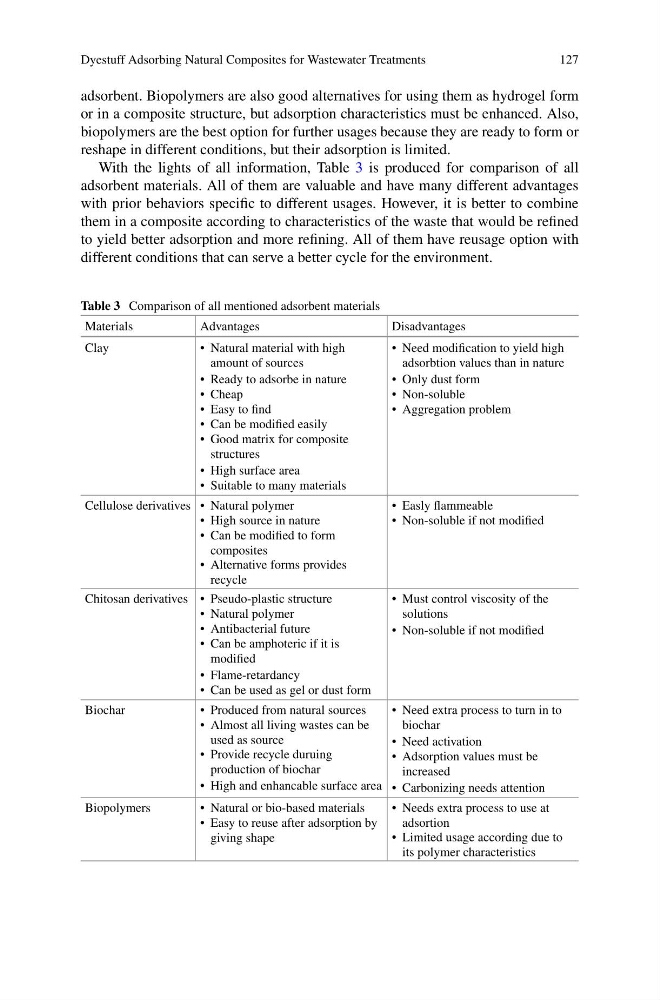
With the lights of all information, Table 3 is produced for comparison of all
adsorbent materials. All of them are valuable and have many different advantages
with prior behaviors specific to different usages. However, it is better to combine
them in a composite according to characteristics of the waste that would be refined
to yield better adsorption and more refining. All of them have reusage option with
different conditions that can serve a better cycle for the environment.
Table 3 Comparison of all mentioned adsorbent materials
Materials
Advantages
Disadvantages
Clay
• Natural material with high
amount of sources
• Ready to adsorbe in nature
• Cheap
• Easy to find
• Can be modified easily
• Good matrix for composite
structures
• High surface area
• Suitable to many materials
• Need modification to yield high
adsorbtion values than in nature
• Only dust form
• Non-soluble
• Aggregation problem
Cellulose derivatives • Natural polymer
• High source in nature
• Can be modified to form
composites
• Alternative forms provides
recycle
• Easly flammeable
• Non-soluble if not modified
Chitosan derivatives • Pseudo-plastic structure
• Natural polymer
• Antibacterial future
• Can be amphoteric if it is
modified
• Flame-retardancy
• Can be used as gel or dust form
• Must control viscosity of the
solutions
• Non-soluble if not modified
Biochar
• Produced from natural sources
• Almost all living wastes can be
used as source
• Provide recycle duruing
production of biochar
• High and enhancable surface area
• Need extra process to turn in to
biochar
• Need activation
• Adsorption values must be
increased
• Carbonizing needs attention
Biopolymers
• Natural or bio-based materials
• Easy to reuse after adsorption by
giving shape
• Needs extra process to use at
adsortion
• Limited usage according due to
its polymer characteristics
127
adsorbent. Biopolymers are also good alternatives for using them as hydrogel form
or in a composite structure, but adsorption characteristics must be enhanced. Also,
biopolymers are the best option for further usages because they are ready to form or
reshape in different conditions, but their adsorption is limited.
With the lights of all information, Table 3 is produced for comparison of all
adsorbent materials. All of them are valuable and have many different advantages
with prior behaviors specific to different usages. However, it is better to combine
them in a composite according to characteristics of the waste that would be refined
to yield better adsorption and more refining. All of them have reusage option with
different conditions that can serve a better cycle for the environment.
Table 3 Comparison of all mentioned adsorbent materials
Materials
Advantages
Disadvantages
Clay
• Natural material with high
amount of sources
• Ready to adsorbe in nature
• Cheap
• Easy to find
• Can be modified easily
• Good matrix for composite
structures
• High surface area
• Suitable to many materials
• Need modification to yield high
adsorbtion values than in nature
• Only dust form
• Non-soluble
• Aggregation problem
Cellulose derivatives • Natural polymer
• High source in nature
• Can be modified to form
composites
• Alternative forms provides
recycle
• Easly flammeable
• Non-soluble if not modified
Chitosan derivatives • Pseudo-plastic structure
• Natural polymer
• Antibacterial future
• Can be amphoteric if it is
modified
• Flame-retardancy
• Can be used as gel or dust form
• Must control viscosity of the
solutions
• Non-soluble if not modified
Biochar
• Produced from natural sources
• Almost all living wastes can be
used as source
• Provide recycle duruing
production of biochar
• High and enhancable surface area
• Need extra process to turn in to
biochar
• Need activation
• Adsorption values must be
increased
• Carbonizing needs attention
Biopolymers
• Natural or bio-based materials
• Easy to reuse after adsorption by
giving shape
• Needs extra process to use at
adsortion
• Limited usage according due to
its polymer characteristics