

Dyestuff Adsorbing Natural Composites for Wastewater Treatments
123
according to Langmuir and Freundlich models, and it was understood that the
composite could be used many times with the same dye adsorption capacity [70].
5.4 Activated Biochars and Alternative Biomaterials
Biomass is turned into a carbon-based end product by the pyrolysis process, and as
a result, biochar is formed. It has some advantages as being a low-cost product and
providing a recycle for the waste of agriculture and forest, so it adds value to waste
[71]. Biomass is decomposed in oxygen-free media with very high temperatures as
350–650 °C. Biochar is produced in a charcoal form with volatile gases in two forms.
The first one is gas that could turn into bio-oil with condensation, and the second
one is gas as CO, CO 2 , CH 4 , and H2 that cannot turn into bio-oil. Pyrolysis can be
categorized as slow, intermediate, and fast due to its heating rate, maximum temperature, and time, and with differences, characteristics of biochar can be changed. The
slow one is more advantages because of being simple and suitable for agricultural
products and small production amounts, but other options can be selected according
to the needs of the end product and usage area [72]. To enhance the properties of
biochar as pore and surface area increasing, functional group adding, and enhancing
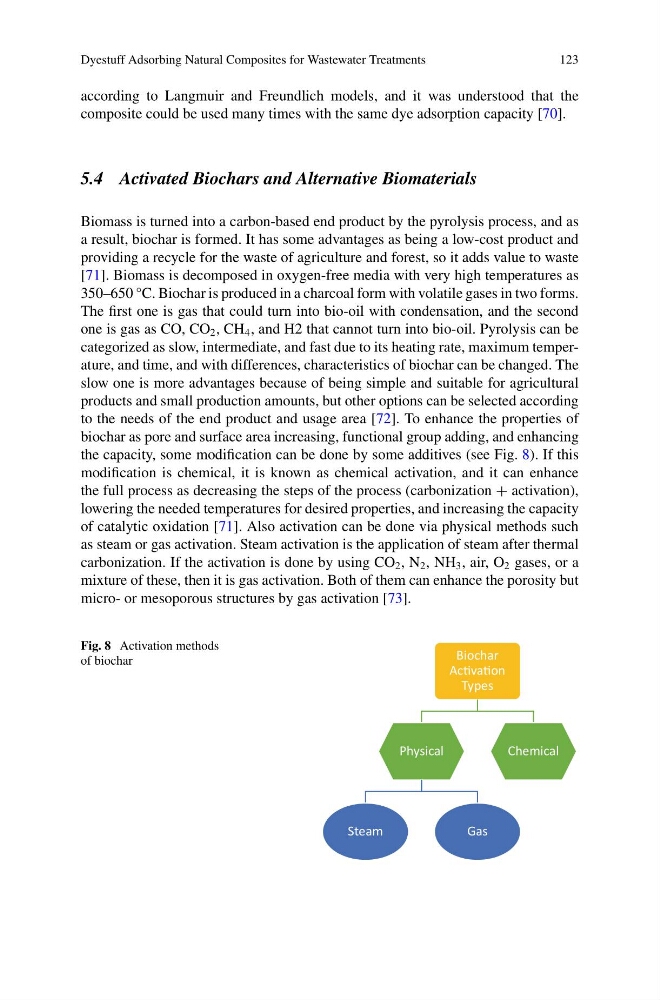
the capacity, some modification can be done by some additives (see Fig. 8). If this
modification is chemical, it is known as chemical activation, and it can enhance
the full process as decreasing the steps of the process (carbonization + activation),
lowering the needed temperatures for desired properties, and increasing the capacity
of catalytic oxidation [71]. Also activation can be done via physical methods such
as steam or gas activation. Steam activation is the application of steam after thermal
carbonization. If the activation is done by using CO 2 , N 2 , NH 3 , air, O 2 gases, or a
mixture of these, then it is gas activation. Both of them can enhance the porosity but
micro- or mesoporous structures by gas activation [73].
Fig. 8 Activation methods
of biochar
Biochar
Acvaon
Types
Physical
Steam
Gas
Chemical
123
according to Langmuir and Freundlich models, and it was understood that the
composite could be used many times with the same dye adsorption capacity [70].
5.4 Activated Biochars and Alternative Biomaterials
Biomass is turned into a carbon-based end product by the pyrolysis process, and as
a result, biochar is formed. It has some advantages as being a low-cost product and
providing a recycle for the waste of agriculture and forest, so it adds value to waste
[71]. Biomass is decomposed in oxygen-free media with very high temperatures as
350–650 °C. Biochar is produced in a charcoal form with volatile gases in two forms.
The first one is gas that could turn into bio-oil with condensation, and the second
one is gas as CO, CO 2 , CH 4 , and H2 that cannot turn into bio-oil. Pyrolysis can be
categorized as slow, intermediate, and fast due to its heating rate, maximum temperature, and time, and with differences, characteristics of biochar can be changed. The
slow one is more advantages because of being simple and suitable for agricultural
products and small production amounts, but other options can be selected according
to the needs of the end product and usage area [72]. To enhance the properties of
biochar as pore and surface area increasing, functional group adding, and enhancing
the capacity, some modification can be done by some additives (see Fig. 8). If this
modification is chemical, it is known as chemical activation, and it can enhance
the full process as decreasing the steps of the process (carbonization + activation),
lowering the needed temperatures for desired properties, and increasing the capacity
of catalytic oxidation [71]. Also activation can be done via physical methods such
as steam or gas activation. Steam activation is the application of steam after thermal
carbonization. If the activation is done by using CO 2 , N 2 , NH 3 , air, O 2 gases, or a
mixture of these, then it is gas activation. Both of them can enhance the porosity but
micro- or mesoporous structures by gas activation [73].
Fig. 8 Activation methods
of biochar
Biochar
Acvaon
Types
Physical
Steam
Gas
Chemical