

Dyestuff Adsorbing Natural Composites for Wastewater Treatments
121
done. FTIR, XRD, TEM, SEM, TG, and UV-vis tests are done to figure out the best
absorbency of Congo red dye. As a result, the best absorbency occurred at a weight
ratio of CMC to OMMT was 1:1, having a reaction temperature of 60 °C and a
reaction time of 6 h [53].
5.3 Chitosan and Its Derivatives
Chitosan is a soluble form of chitin which has the second biggest polymer supply
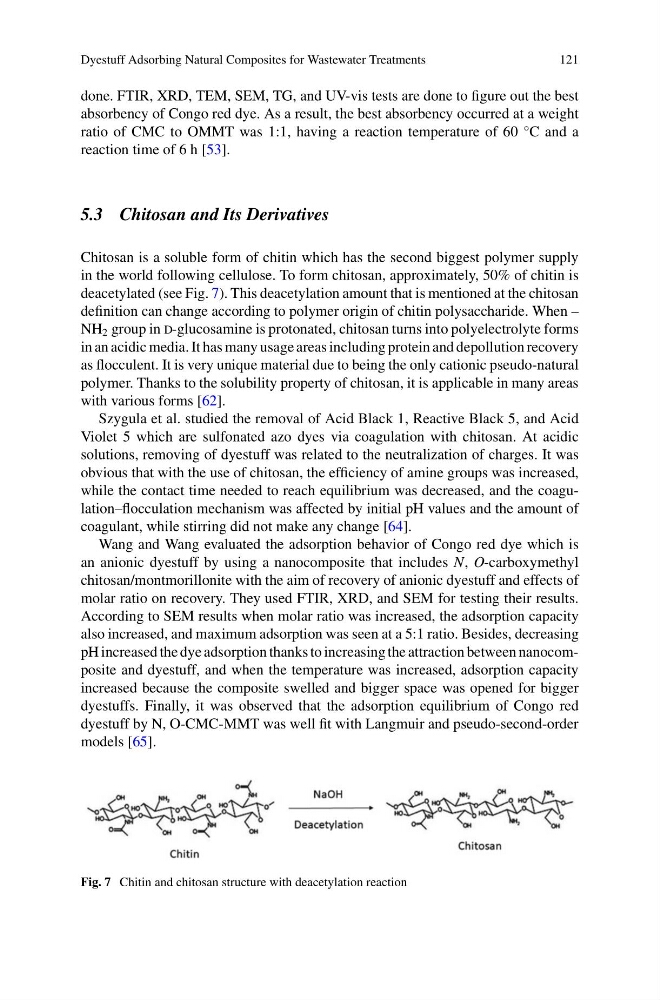
in the world following cellulose. To form chitosan, approximately, 50% of chitin is
deacetylated (see Fig. 7). This deacetylation amount that is mentioned at the chitosan
definition can change according to polymer origin of chitin polysaccharide. When –
NH 2 group in d-glucosamine is protonated, chitosan turns into polyelectrolyte forms
in an acidic media. It has many usage areas including protein and depollution recovery
as flocculent. It is very unique material due to being the only cationic pseudo-natural
polymer. Thanks to the solubility property of chitosan, it is applicable in many areas
with various forms [62].
Szygula et al. studied the removal of Acid Black 1, Reactive Black 5, and Acid
Violet 5 which are sulfonated azo dyes via coagulation with chitosan. At acidic
solutions, removing of dyestuff was related to the neutralization of charges. It was
obvious that with the use of chitosan, the efficiency of amine groups was increased,
while the contact time needed to reach equilibrium was decreased, and the coagulation–flocculation mechanism was affected by initial pH values and the amount of
coagulant, while stirring did not make any change [64].
Wang and Wang evaluated the adsorption behavior of Congo red dye which is
an anionic dyestuff by using a nanocomposite that includes N, O-carboxymethyl
chitosan/montmorillonite with the aim of recovery of anionic dyestuff and effects of
molar ratio on recovery. They used FTIR, XRD, and SEM for testing their results.
According to SEM results when molar ratio was increased, the adsorption capacity
also increased, and maximum adsorption was seen at a 5:1 ratio. Besides, decreasing
pH increased the dye adsorption thanks to increasing the attraction between nanocomposite and dyestuff, and when the temperature was increased, adsorption capacity
increased because the composite swelled and bigger space was opened for bigger
dyestuffs. Finally, it was observed that the adsorption equilibrium of Congo red
dyestuff by N, O-CMC-MMT was well fit with Langmuir and pseudo-second-order
models [65].
Fig. 7 Chitin and chitosan structure with deacetylation reaction
121
done. FTIR, XRD, TEM, SEM, TG, and UV-vis tests are done to figure out the best
absorbency of Congo red dye. As a result, the best absorbency occurred at a weight
ratio of CMC to OMMT was 1:1, having a reaction temperature of 60 °C and a
reaction time of 6 h [53].
5.3 Chitosan and Its Derivatives
Chitosan is a soluble form of chitin which has the second biggest polymer supply
in the world following cellulose. To form chitosan, approximately, 50% of chitin is
deacetylated (see Fig. 7). This deacetylation amount that is mentioned at the chitosan
definition can change according to polymer origin of chitin polysaccharide. When –
NH 2 group in d-glucosamine is protonated, chitosan turns into polyelectrolyte forms
in an acidic media. It has many usage areas including protein and depollution recovery
as flocculent. It is very unique material due to being the only cationic pseudo-natural
polymer. Thanks to the solubility property of chitosan, it is applicable in many areas
with various forms [62].
Szygula et al. studied the removal of Acid Black 1, Reactive Black 5, and Acid
Violet 5 which are sulfonated azo dyes via coagulation with chitosan. At acidic
solutions, removing of dyestuff was related to the neutralization of charges. It was
obvious that with the use of chitosan, the efficiency of amine groups was increased,
while the contact time needed to reach equilibrium was decreased, and the coagulation–flocculation mechanism was affected by initial pH values and the amount of
coagulant, while stirring did not make any change [64].
Wang and Wang evaluated the adsorption behavior of Congo red dye which is
an anionic dyestuff by using a nanocomposite that includes N, O-carboxymethyl
chitosan/montmorillonite with the aim of recovery of anionic dyestuff and effects of
molar ratio on recovery. They used FTIR, XRD, and SEM for testing their results.
According to SEM results when molar ratio was increased, the adsorption capacity
also increased, and maximum adsorption was seen at a 5:1 ratio. Besides, decreasing
pH increased the dye adsorption thanks to increasing the attraction between nanocomposite and dyestuff, and when the temperature was increased, adsorption capacity
increased because the composite swelled and bigger space was opened for bigger
dyestuffs. Finally, it was observed that the adsorption equilibrium of Congo red
dyestuff by N, O-CMC-MMT was well fit with Langmuir and pseudo-second-order
models [65].
Fig. 7 Chitin and chitosan structure with deacetylation reaction