

Dyestuff Adsorbing Natural Composites for Wastewater Treatments
113
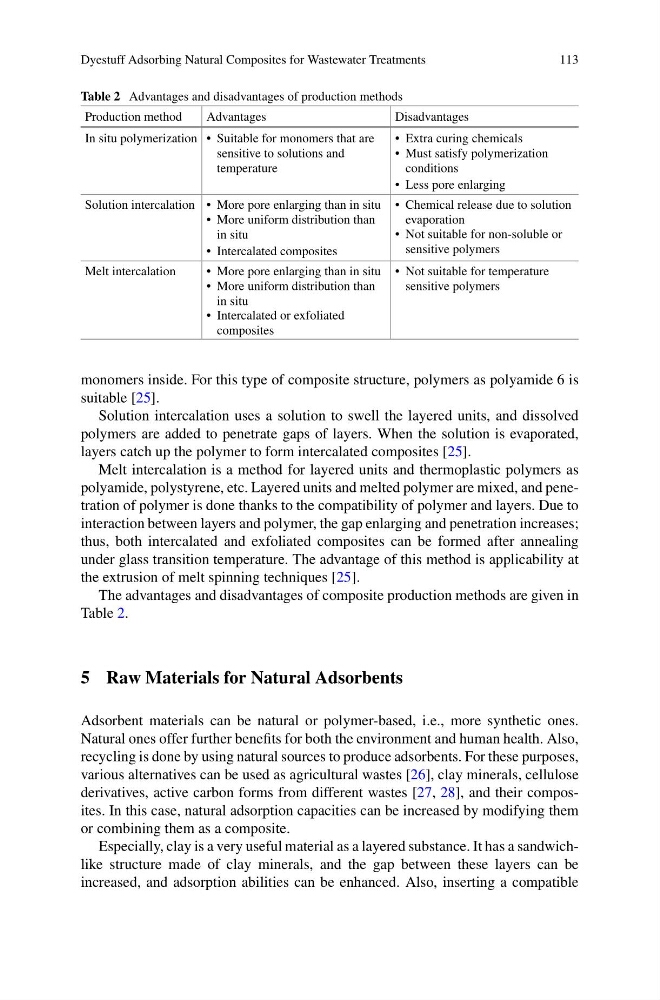
Table 2 Advantages and disadvantages of production methods
Production method
Advantages
Disadvantages
In situ polymerization • Suitable for monomers that are
sensitive to solutions and
temperature
• Extra curing chemicals
• Must satisfy polymerization
conditions
• Less pore enlarging
Solution intercalation • More pore enlarging than in situ
• More uniform distribution than
in situ
• Intercalated composites
• Chemical release due to solution
evaporation
• Not suitable for non-soluble or
sensitive polymers
Melt intercalation
• More pore enlarging than in situ
• More uniform distribution than
in situ
• Intercalated or exfoliated
composites
• Not suitable for temperature
sensitive polymers
monomers inside. For this type of composite structure, polymers as polyamide 6 is
suitable [25].
Solution intercalation uses a solution to swell the layered units, and dissolved
polymers are added to penetrate gaps of layers. When the solution is evaporated,
layers catch up the polymer to form intercalated composites [25].
Melt intercalation is a method for layered units and thermoplastic polymers as
polyamide, polystyrene, etc. Layered units and melted polymer are mixed, and penetration of polymer is done thanks to the compatibility of polymer and layers. Due to
interaction between layers and polymer, the gap enlarging and penetration increases;
thus, both intercalated and exfoliated composites can be formed after annealing
under glass transition temperature. The advantage of this method is applicability at
the extrusion of melt spinning techniques [25].
The advantages and disadvantages of composite production methods are given in
Table 2.
5 Raw Materials for Natural Adsorbents
Adsorbent materials can be natural or polymer-based, i.e., more synthetic ones.
Natural ones offer further benefits for both the environment and human health. Also,
recycling is done by using natural sources to produce adsorbents. For these purposes,
various alternatives can be used as agricultural wastes [26], clay minerals, cellulose
derivatives, active carbon forms from different wastes [27, 28], and their composites. In this case, natural adsorption capacities can be increased by modifying them
or combining them as a composite.
Especially, clay is a very useful material as a layered substance. It has a sandwichlike structure made of clay minerals, and the gap between these layers can be
increased, and adsorption abilities can be enhanced. Also, inserting a compatible
113
Table 2 Advantages and disadvantages of production methods
Production method
Advantages
Disadvantages
In situ polymerization • Suitable for monomers that are
sensitive to solutions and
temperature
• Extra curing chemicals
• Must satisfy polymerization
conditions
• Less pore enlarging
Solution intercalation • More pore enlarging than in situ
• More uniform distribution than
in situ
• Intercalated composites
• Chemical release due to solution
evaporation
• Not suitable for non-soluble or
sensitive polymers
Melt intercalation
• More pore enlarging than in situ
• More uniform distribution than
in situ
• Intercalated or exfoliated
composites
• Not suitable for temperature
sensitive polymers
monomers inside. For this type of composite structure, polymers as polyamide 6 is
suitable [25].
Solution intercalation uses a solution to swell the layered units, and dissolved
polymers are added to penetrate gaps of layers. When the solution is evaporated,
layers catch up the polymer to form intercalated composites [25].
Melt intercalation is a method for layered units and thermoplastic polymers as
polyamide, polystyrene, etc. Layered units and melted polymer are mixed, and penetration of polymer is done thanks to the compatibility of polymer and layers. Due to
interaction between layers and polymer, the gap enlarging and penetration increases;
thus, both intercalated and exfoliated composites can be formed after annealing
under glass transition temperature. The advantage of this method is applicability at
the extrusion of melt spinning techniques [25].
The advantages and disadvantages of composite production methods are given in
Table 2.
5 Raw Materials for Natural Adsorbents
Adsorbent materials can be natural or polymer-based, i.e., more synthetic ones.
Natural ones offer further benefits for both the environment and human health. Also,
recycling is done by using natural sources to produce adsorbents. For these purposes,
various alternatives can be used as agricultural wastes [26], clay minerals, cellulose
derivatives, active carbon forms from different wastes [27, 28], and their composites. In this case, natural adsorption capacities can be increased by modifying them
or combining them as a composite.
Especially, clay is a very useful material as a layered substance. It has a sandwichlike structure made of clay minerals, and the gap between these layers can be
increased, and adsorption abilities can be enhanced. Also, inserting a compatible