

4
C. Gutiérrez-Bouzán et al.
2 The Problem of Residual Dyes and Salts
The textile industry has a major relevance in developing countries [13]. Nevertheless,
it requires an intensive use of water in many processes (a mean of 200–400 L per
kg of product) [14] which results in a high generation of wastewater containing salts
and a wide range of organic compounds. The amount of produced wastewater and its
content of pollutant or harmful compounds is highly dependent on the type of fibre
and the process applied [15]. Thus, it is estimated that the dyeing produces about 8%
of the total textile wastewater. A high proportion of dyeing effluents is produced by
cotton processes as this fibre is the most consumed natural fibre [16]. Cotton dyeing
can be performed with many types of dyes but reactive ones are the class mostly
used because they have a wide range of shades and brilliant colours [17, 18]. They
have also good wet fastness properties because they react with hydroxyl groups of
cellulosic fibres, being fixed to them by means of a covalent bond. For instance,
reaction 1 illustrates the fixation of the halotriazine reactive group to the cellulose:
Dye − X + Cel − O
−
→ Dye − O − Cel + X
−
(1)
However, dyeing of cellulose fibres with reactive dyes has a great inconvenient:
meanwhile dyes react with fibres, they also react with water. That is to say, a secondary
reaction of hydrolysis (reaction 2) is produced during the fixation of dye.
Dye − X + OH
−
→ Dye − OH + X
−
(2)
Then, hydrolysed reactive dyes (Dye-OH) are not able to react with the fibre and
should be removed. About 20–40% of reactive dyes could be hydrolysed during the
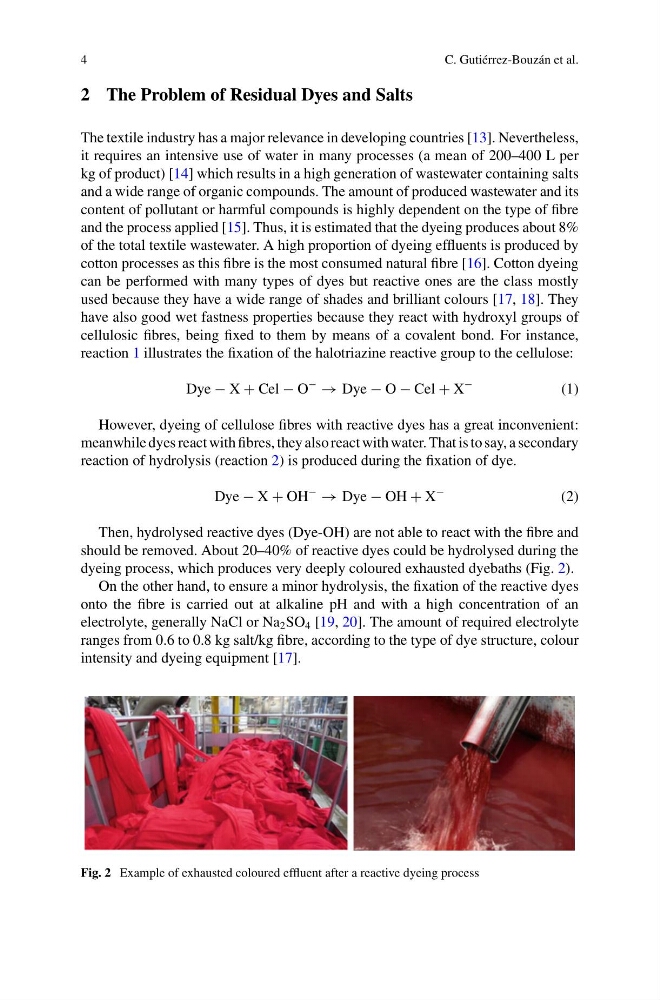
dyeing process, which produces very deeply coloured exhausted dyebaths (Fig. 2).
On the other hand, to ensure a minor hydrolysis, the fixation of the reactive dyes
onto the fibre is carried out at alkaline pH and with a high concentration of an
electrolyte, generally NaCl or Na 2 SO 4 [19, 20]. The amount of required electrolyte
ranges from 0.6 to 0.8 kg salt/kg fibre, according to the type of dye structure, colour
intensity and dyeing equipment [17].
Fig. 2 Example of exhausted coloured effluent after a reactive dyeing process
C. Gutiérrez-Bouzán et al.
2 The Problem of Residual Dyes and Salts
The textile industry has a major relevance in developing countries [13]. Nevertheless,
it requires an intensive use of water in many processes (a mean of 200–400 L per
kg of product) [14] which results in a high generation of wastewater containing salts
and a wide range of organic compounds. The amount of produced wastewater and its
content of pollutant or harmful compounds is highly dependent on the type of fibre
and the process applied [15]. Thus, it is estimated that the dyeing produces about 8%
of the total textile wastewater. A high proportion of dyeing effluents is produced by
cotton processes as this fibre is the most consumed natural fibre [16]. Cotton dyeing
can be performed with many types of dyes but reactive ones are the class mostly
used because they have a wide range of shades and brilliant colours [17, 18]. They
have also good wet fastness properties because they react with hydroxyl groups of
cellulosic fibres, being fixed to them by means of a covalent bond. For instance,
reaction 1 illustrates the fixation of the halotriazine reactive group to the cellulose:
Dye − X + Cel − O
−
→ Dye − O − Cel + X
−
(1)
However, dyeing of cellulose fibres with reactive dyes has a great inconvenient:
meanwhile dyes react with fibres, they also react with water. That is to say, a secondary
reaction of hydrolysis (reaction 2) is produced during the fixation of dye.
Dye − X + OH
−
→ Dye − OH + X
−
(2)
Then, hydrolysed reactive dyes (Dye-OH) are not able to react with the fibre and
should be removed. About 20–40% of reactive dyes could be hydrolysed during the
dyeing process, which produces very deeply coloured exhausted dyebaths (Fig. 2).
On the other hand, to ensure a minor hydrolysis, the fixation of the reactive dyes
onto the fibre is carried out at alkaline pH and with a high concentration of an
electrolyte, generally NaCl or Na 2 SO 4 [19, 20]. The amount of required electrolyte
ranges from 0.6 to 0.8 kg salt/kg fibre, according to the type of dye structure, colour
intensity and dyeing equipment [17].
Fig. 2 Example of exhausted coloured effluent after a reactive dyeing process