

92
R. Sivaranjanee and P. Senthil Kumar
Membrane
Separation
Techniques
Microfiltration
10 -1 to 10 1
Ultrafiltration
10 -2 to 10 -1
Nanofiltration
10 -3 to 10 -2
Reverse
Osmosis
10 -4 to 10 -3
Electro
Dialysis
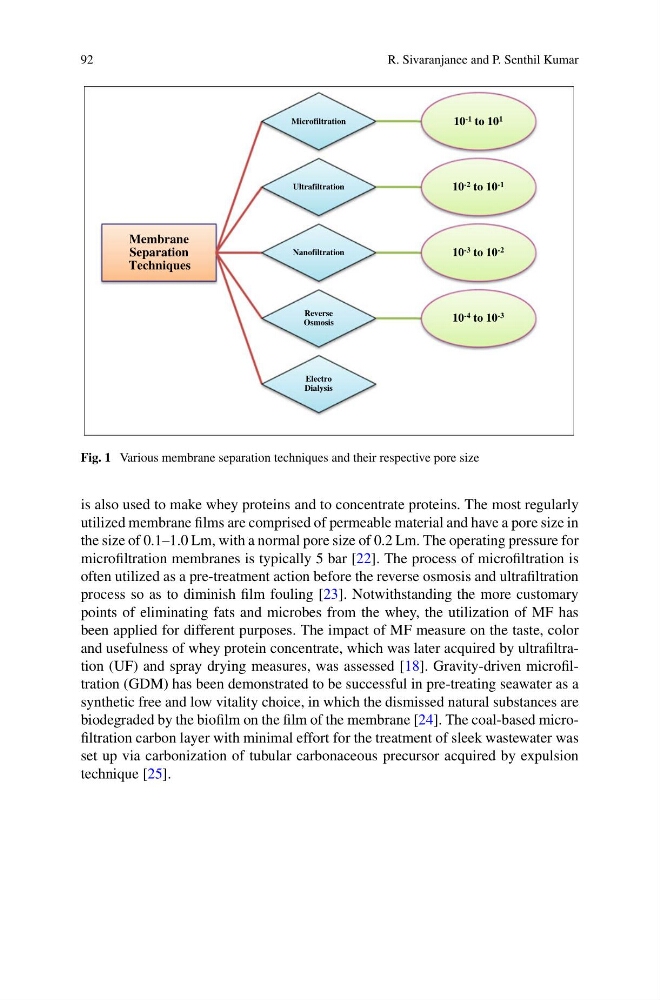
Fig. 1 Various membrane separation techniques and their respective pore size
is also used to make whey proteins and to concentrate proteins. The most regularly
utilized membrane films are comprised of permeable material and have a pore size in
the size of 0.1–1.0 Lm, with a normal pore size of 0.2 Lm. The operating pressure for
microfiltration membranes is typically 5 bar [22]. The process of microfiltration is
often utilized as a pre-treatment action before the reverse osmosis and ultrafiltration
process so as to diminish film fouling [23]. Notwithstanding the more customary
points of eliminating fats and microbes from the whey, the utilization of MF has
been applied for different purposes. The impact of MF measure on the taste, color
and usefulness of whey protein concentrate, which was later acquired by ultrafiltration (UF) and spray drying measures, was assessed [18]. Gravity-driven microfiltration (GDM) has been demonstrated to be successful in pre-treating seawater as a
synthetic free and low vitality choice, in which the dismissed natural substances are
biodegraded by the biofilm on the film of the membrane [24]. The coal-based microfiltration carbon layer with minimal effort for the treatment of sleek wastewater was
set up via carbonization of tubular carbonaceous precursor acquired by expulsion
technique [25].
R. Sivaranjanee and P. Senthil Kumar
Membrane
Separation
Techniques
Microfiltration
10 -1 to 10 1
Ultrafiltration
10 -2 to 10 -1
Nanofiltration
10 -3 to 10 -2
Reverse
Osmosis
10 -4 to 10 -3
Electro
Dialysis
Fig. 1 Various membrane separation techniques and their respective pore size
is also used to make whey proteins and to concentrate proteins. The most regularly
utilized membrane films are comprised of permeable material and have a pore size in
the size of 0.1–1.0 Lm, with a normal pore size of 0.2 Lm. The operating pressure for
microfiltration membranes is typically 5 bar [22]. The process of microfiltration is
often utilized as a pre-treatment action before the reverse osmosis and ultrafiltration
process so as to diminish film fouling [23]. Notwithstanding the more customary
points of eliminating fats and microbes from the whey, the utilization of MF has
been applied for different purposes. The impact of MF measure on the taste, color
and usefulness of whey protein concentrate, which was later acquired by ultrafiltration (UF) and spray drying measures, was assessed [18]. Gravity-driven microfiltration (GDM) has been demonstrated to be successful in pre-treating seawater as a
synthetic free and low vitality choice, in which the dismissed natural substances are
biodegraded by the biofilm on the film of the membrane [24]. The coal-based microfiltration carbon layer with minimal effort for the treatment of sleek wastewater was
set up via carbonization of tubular carbonaceous precursor acquired by expulsion
technique [25].