

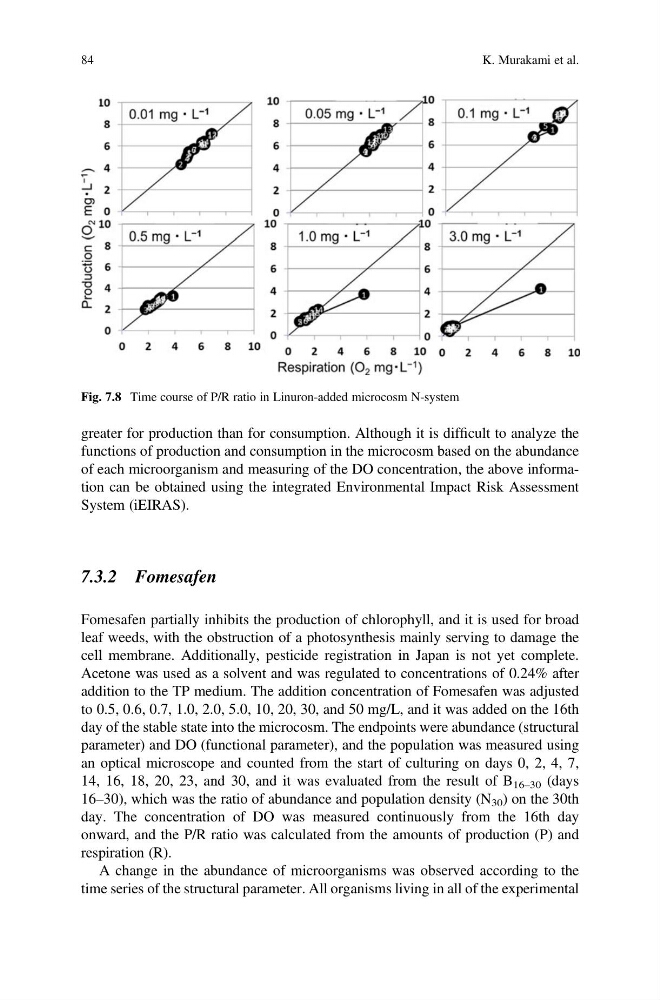
greater for production than for consumption. Although it is difficult to analyze the
functions of production and consumption in the microcosm based on the abundance
of each microorganism and measuring of the DO concentration, the above information can be obtained using the integrated Environmental Impact Risk Assessment
System (iEIRAS).
7.3.2 Fomesafen
Fomesafen partially inhibits the production of chlorophyll, and it is used for broad
leaf weeds, with the obstruction of a photosynthesis mainly serving to damage the
cell membrane. Additionally, pesticide registration in Japan is not yet complete.
Acetone was used as a solvent and was regulated to concentrations of 0.24% after
addition to the TP medium. The addition concentration of Fomesafen was adjusted
to 0.5, 0.6, 0.7, 1.0, 2.0, 5.0, 10, 20, 30, and 50 mg/L, and it was added on the 16th
day of the stable state into the microcosm. The endpoints were abundance (structural
parameter) and DO (functional parameter), and the population was measured using
an optical microscope and counted from the start of culturing on days 0, 2, 4, 7,
14, 16, 18, 20, 23, and 30, and it was evaluated from the result of B 16–30 (days
16–30), which was the ratio of abundance and population density (N 30 ) on the 30th
day. The concentration of DO was measured continuously from the 16th day
onward, and the P/R ratio was calculated from the amounts of production (P) and
respiration (R).
A change in the abundance of microorganisms was observed according to the
time series of the structural parameter. All organisms living in all of the experimental
Fig. 7.8 Time course of P/R ratio in Linuron-added microcosm N-system
84
K. Murakami et al.
functions of production and consumption in the microcosm based on the abundance
of each microorganism and measuring of the DO concentration, the above information can be obtained using the integrated Environmental Impact Risk Assessment
System (iEIRAS).
7.3.2 Fomesafen
Fomesafen partially inhibits the production of chlorophyll, and it is used for broad
leaf weeds, with the obstruction of a photosynthesis mainly serving to damage the
cell membrane. Additionally, pesticide registration in Japan is not yet complete.
Acetone was used as a solvent and was regulated to concentrations of 0.24% after
addition to the TP medium. The addition concentration of Fomesafen was adjusted
to 0.5, 0.6, 0.7, 1.0, 2.0, 5.0, 10, 20, 30, and 50 mg/L, and it was added on the 16th
day of the stable state into the microcosm. The endpoints were abundance (structural
parameter) and DO (functional parameter), and the population was measured using
an optical microscope and counted from the start of culturing on days 0, 2, 4, 7,
14, 16, 18, 20, 23, and 30, and it was evaluated from the result of B 16–30 (days
16–30), which was the ratio of abundance and population density (N 30 ) on the 30th
day. The concentration of DO was measured continuously from the 16th day
onward, and the P/R ratio was calculated from the amounts of production (P) and
respiration (R).
A change in the abundance of microorganisms was observed according to the
time series of the structural parameter. All organisms living in all of the experimental
Fig. 7.8 Time course of P/R ratio in Linuron-added microcosm N-system
84
K. Murakami et al.