

(Whatman, UK) or GF-75 (Advantec, Japan). The filter paper should be rounded
lightly, returned to the centrifuge tube, and combined with the precipitate. A
potassium phosphate buffer (0.1 M, pH 7.0) is then added before being sonicated
three times for 30 s. The prepared culture should be frozen at À20
C and then
melted to room temperature. In the case in which the culture is preserved once and
measured later, it should either be preserved at 4
C after complete extraction or at
À20
C with the precipitate and filter combined. However, the preservation method
must be uniform for all samples. After centrifugal separation (i.e., at 12,000
r.p.m. for 10 min), the filter and cell debris should be removed, and the spectrum
of the supernatant should be measured with a spectrophotometer. The concentrations
of C-PC, C-PE, and APC may then be calculated from the following equation
(Bennet and Bogorad 1973) (Table 6.1):
A λ ¼ absorbance in wavelength λ nm
C-PC ¼ A 615 À 0:474 A 652
ð
Þ =5:34
APC ¼ A 652 À 0:208 A 615
ð
Þ =5:09
C-PE ¼ A 562 À 2:41 C-PC À 0:849 APC
ð
Þ =9:62
6.1.7 Bacteria
After taking 0.5–1 mL of samples and performing sonication (30 s), the abundance of living bacteria should be measured, according to the colony calculation
method using the peptone-yeast (PY) extract nutrient medium, by adjusting the
number of bacteria through serial dilution. The cultivation period for colony
forming unit (CFU) counting is set to 5 days at 30
C. A 30–300 CFU/plate
(ideal: 100 CFU/plate) plate should be chosen, and 2–3 pieces should be
measured. The unit of measure is CFU/mL. In the case of using an antibiotic as
a test material, it is desirable to assay the drug-resistant bacteria for the antibiotic
concerned. In the case of a detailed analysis, the biomass calculation described
here is necessary; however, in typical evaluations, measurements of the P/R ratio
are generally used.
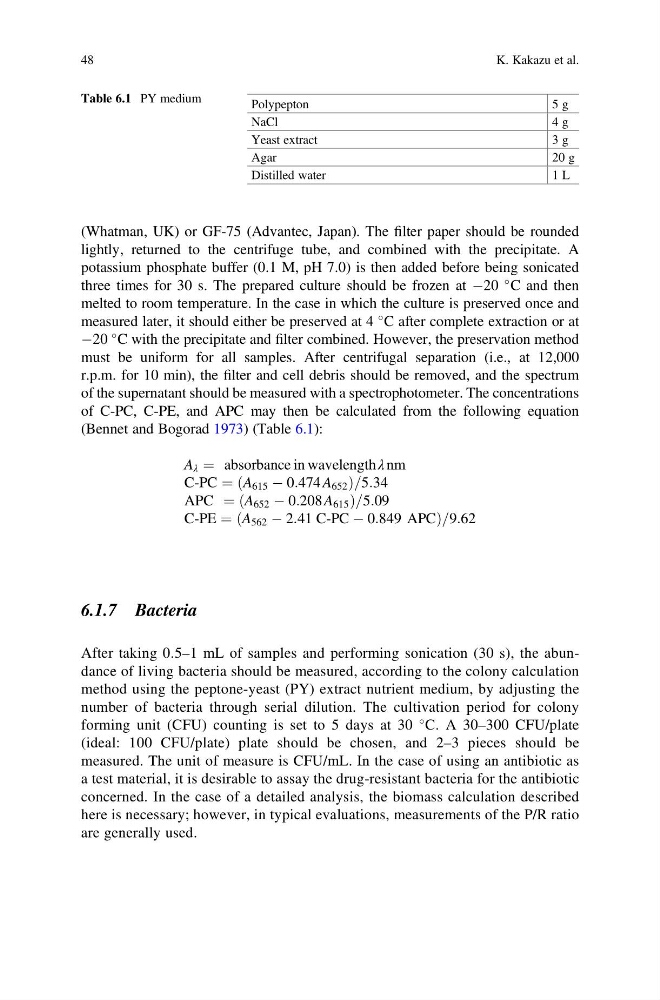
Table 6.1 PY medium
Polypepton
5 g
NaCl
4 g
Yeast extract
3 g
Agar
20 g
Distilled water
1 L
48
K. Kakazu et al.
lightly, returned to the centrifuge tube, and combined with the precipitate. A
potassium phosphate buffer (0.1 M, pH 7.0) is then added before being sonicated
three times for 30 s. The prepared culture should be frozen at À20
C and then
melted to room temperature. In the case in which the culture is preserved once and
measured later, it should either be preserved at 4
C after complete extraction or at
À20
C with the precipitate and filter combined. However, the preservation method
must be uniform for all samples. After centrifugal separation (i.e., at 12,000
r.p.m. for 10 min), the filter and cell debris should be removed, and the spectrum
of the supernatant should be measured with a spectrophotometer. The concentrations
of C-PC, C-PE, and APC may then be calculated from the following equation
(Bennet and Bogorad 1973) (Table 6.1):
A λ ¼ absorbance in wavelength λ nm
C-PC ¼ A 615 À 0:474 A 652
ð
Þ =5:34
APC ¼ A 652 À 0:208 A 615
ð
Þ =5:09
C-PE ¼ A 562 À 2:41 C-PC À 0:849 APC
ð
Þ =9:62
6.1.7 Bacteria
After taking 0.5–1 mL of samples and performing sonication (30 s), the abundance of living bacteria should be measured, according to the colony calculation
method using the peptone-yeast (PY) extract nutrient medium, by adjusting the
number of bacteria through serial dilution. The cultivation period for colony
forming unit (CFU) counting is set to 5 days at 30
C. A 30–300 CFU/plate
(ideal: 100 CFU/plate) plate should be chosen, and 2–3 pieces should be
measured. The unit of measure is CFU/mL. In the case of using an antibiotic as
a test material, it is desirable to assay the drug-resistant bacteria for the antibiotic
concerned. In the case of a detailed analysis, the biomass calculation described
here is necessary; however, in typical evaluations, measurements of the P/R ratio
are generally used.
Table 6.1 PY medium
Polypepton
5 g
NaCl
4 g
Yeast extract
3 g
Agar
20 g
Distilled water
1 L
48
K. Kakazu et al.