

and is underestimated; or experimental conditions in the field test (mesocosm), such
as soil adsorption and continuous vs. intermittent administration. In the future,
further investigation into the causality of the two outliers will be necessary. For
example, to investigate chlorpyrifos in the natural experiment (mesocosm test) with
an intermittent administration system, the following two approaches could be
compared:
(i) Single administration with soil: due to adsorption in the soil and hydrolysis, the
concentration in water sharply decreases, but a high soil/water interface concentration is continuously maintained by desorption from the soil.
(ii) (ii) Single administration without soil: there is a first-order decrease in the
concentration of water in the microcosm, and, in turn, the toxicity is low.
Paraquat is known to be easily adsorbed in the soil. The value of paraquat
multiplied by the coefficient of assessment can predict the conditions in the natural
ecosystem, but there is no correlation between the microcosm test and the mesocosm
test. Based on these results, even though the environmental risk assessment of
chemical substances can be evaluated in the microcosm, it is necessary to establish
an OECD international standard by defining the limitations of the test. The results
obtained in this study were presented at the 3rd JACI LRI research meeting on
August 28, 2014, and are shown in this book.
0.00001
0.0001
0.001
0.01
0.1
1
Microcosm
ECETOC
HC5
PNOEC / MEAN OF NOECs IN ECOSYSTEMS
Copper(2+)
Pentachlorophenol
Phenol
Nonylpenol
SDS
4-chlorophenol
methoxychlor
dibutyl phthalate
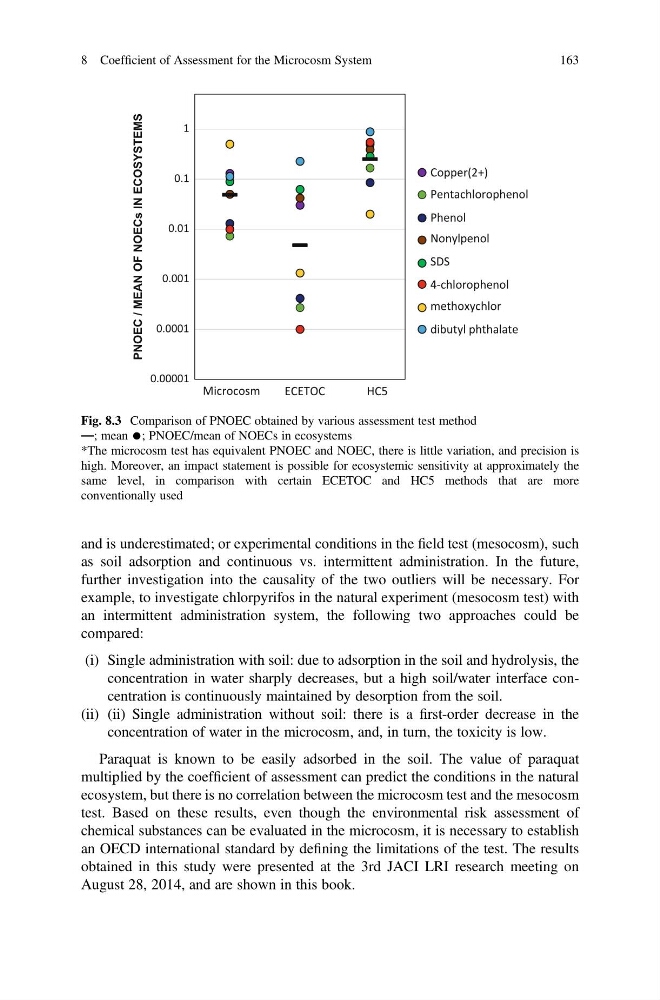
Fig. 8.3 Comparison of PNOEC obtained by various assessment test method
━; mean ●; PNOEC/mean of NOECs in ecosystems
*The microcosm test has equivalent PNOEC and NOEC, there is little variation, and precision is
high. Moreover, an impact statement is possible for ecosystemic sensitivity at approximately the
same level, in comparison with certain ECETOC and HC5 methods that are more
conventionally used
8 Coefficient of Assessment for the Microcosm System
163
as soil adsorption and continuous vs. intermittent administration. In the future,
further investigation into the causality of the two outliers will be necessary. For
example, to investigate chlorpyrifos in the natural experiment (mesocosm test) with
an intermittent administration system, the following two approaches could be
compared:
(i) Single administration with soil: due to adsorption in the soil and hydrolysis, the
concentration in water sharply decreases, but a high soil/water interface concentration is continuously maintained by desorption from the soil.
(ii) (ii) Single administration without soil: there is a first-order decrease in the
concentration of water in the microcosm, and, in turn, the toxicity is low.
Paraquat is known to be easily adsorbed in the soil. The value of paraquat
multiplied by the coefficient of assessment can predict the conditions in the natural
ecosystem, but there is no correlation between the microcosm test and the mesocosm
test. Based on these results, even though the environmental risk assessment of
chemical substances can be evaluated in the microcosm, it is necessary to establish
an OECD international standard by defining the limitations of the test. The results
obtained in this study were presented at the 3rd JACI LRI research meeting on
August 28, 2014, and are shown in this book.
0.00001
0.0001
0.001
0.01
0.1
1
Microcosm
ECETOC
HC5
PNOEC / MEAN OF NOECs IN ECOSYSTEMS
Copper(2+)
Pentachlorophenol
Phenol
Nonylpenol
SDS
4-chlorophenol
methoxychlor
dibutyl phthalate
Fig. 8.3 Comparison of PNOEC obtained by various assessment test method
━; mean ●; PNOEC/mean of NOECs in ecosystems
*The microcosm test has equivalent PNOEC and NOEC, there is little variation, and precision is
high. Moreover, an impact statement is possible for ecosystemic sensitivity at approximately the
same level, in comparison with certain ECETOC and HC5 methods that are more
conventionally used
8 Coefficient of Assessment for the Microcosm System
163