

natural lake model ecosystem, that is, a naturally derived microcosm, which was
made from natural lake water including natural microorganisms and nutrients.
7.12.2 Bacillus thuringiensis subsp. kurstaki
The environmental impact risk assessment of microbial pesticides, which constitute
the lowest prey species in the microcosmic food chain, was studied. Bacillus
thuringiensis subsp. kurstaki, as a bacterial pesticide, was added at 1, 10, and
100 times the abundance of indigenous bacteria in the microcosm, and the influence
on the structure and function of the ecosystem was examined. Bacillus thuringiensis
subsp. kurstaki rapidly decreased at 1, 10, or 100 times the inoculation concentrations
in viable counts using the selective media method, following microcosm inoculation,
and the number of microorganisms (in particular, its primary consumer, the protozoan
ciliate Cyclidium glaucoma) in the microcosm increased. Bacillus thuringiensis subsp.
kurstaki has been shown to be a suitable food source for constituent heterotrophic
groups such as protozoan ciliates, including Cyclidium glaucoma, Philodina
erythrophthalma, and Aeolosoma hemprichi in prey-predator interaction tests, which
were considered to be dominated by these predatory actions. By comparison in N 30 , no
significant difference was observed between the system with Bacillus thuringiensis
subsp. kurstaki added and the system without it (control system).
7.12.3 Pseudomonas fluorescens IID5115
Pseudomonas fluorescens IID5115, as a bacterial pesticide, was added at 1, 10, and
100 times the abundance of indigenous bacteria in the microcosm, and its influence
on the structure and function of the ecosystem was examined. Pseudomonas
fluorescens IID5115 rapidly decreased at 1-, 10-, or 100-times inoculation concentrations in viable counts using the selective media method after microcosm inoculation, and the abundance of microorganisms (in particular, its primary consumer,
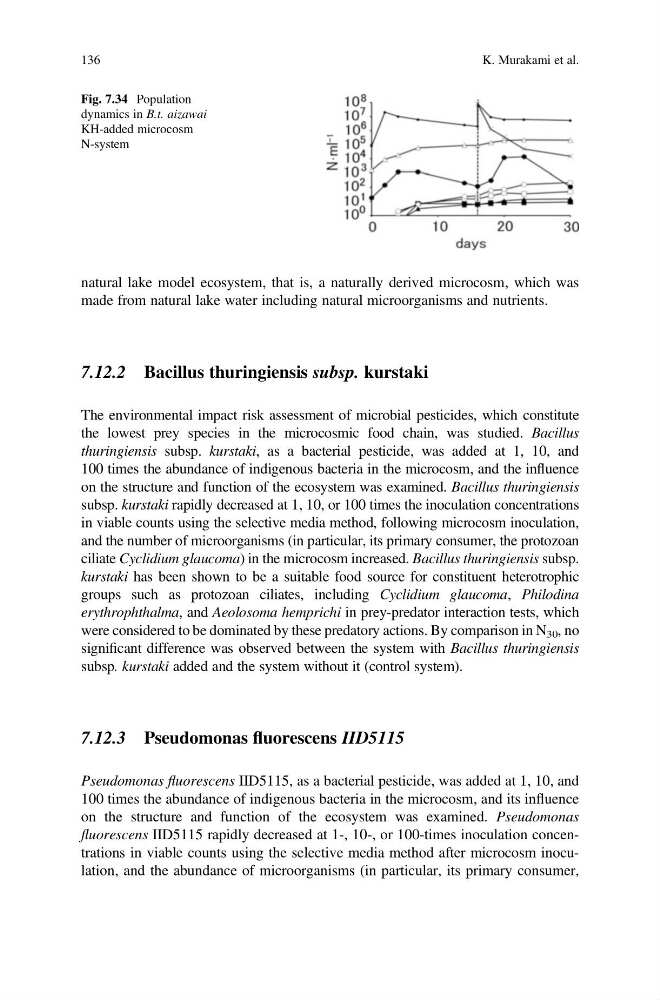
Fig. 7.34 Population
dynamics in B.t. aizawai
KH-added microcosm
N-system
136
K. Murakami et al.
made from natural lake water including natural microorganisms and nutrients.
7.12.2 Bacillus thuringiensis subsp. kurstaki
The environmental impact risk assessment of microbial pesticides, which constitute
the lowest prey species in the microcosmic food chain, was studied. Bacillus
thuringiensis subsp. kurstaki, as a bacterial pesticide, was added at 1, 10, and
100 times the abundance of indigenous bacteria in the microcosm, and the influence
on the structure and function of the ecosystem was examined. Bacillus thuringiensis
subsp. kurstaki rapidly decreased at 1, 10, or 100 times the inoculation concentrations
in viable counts using the selective media method, following microcosm inoculation,
and the number of microorganisms (in particular, its primary consumer, the protozoan
ciliate Cyclidium glaucoma) in the microcosm increased. Bacillus thuringiensis subsp.
kurstaki has been shown to be a suitable food source for constituent heterotrophic
groups such as protozoan ciliates, including Cyclidium glaucoma, Philodina
erythrophthalma, and Aeolosoma hemprichi in prey-predator interaction tests, which
were considered to be dominated by these predatory actions. By comparison in N 30 , no
significant difference was observed between the system with Bacillus thuringiensis
subsp. kurstaki added and the system without it (control system).
7.12.3 Pseudomonas fluorescens IID5115
Pseudomonas fluorescens IID5115, as a bacterial pesticide, was added at 1, 10, and
100 times the abundance of indigenous bacteria in the microcosm, and its influence
on the structure and function of the ecosystem was examined. Pseudomonas
fluorescens IID5115 rapidly decreased at 1-, 10-, or 100-times inoculation concentrations in viable counts using the selective media method after microcosm inoculation, and the abundance of microorganisms (in particular, its primary consumer,
Fig. 7.34 Population
dynamics in B.t. aizawai
KH-added microcosm
N-system
136
K. Murakami et al.