

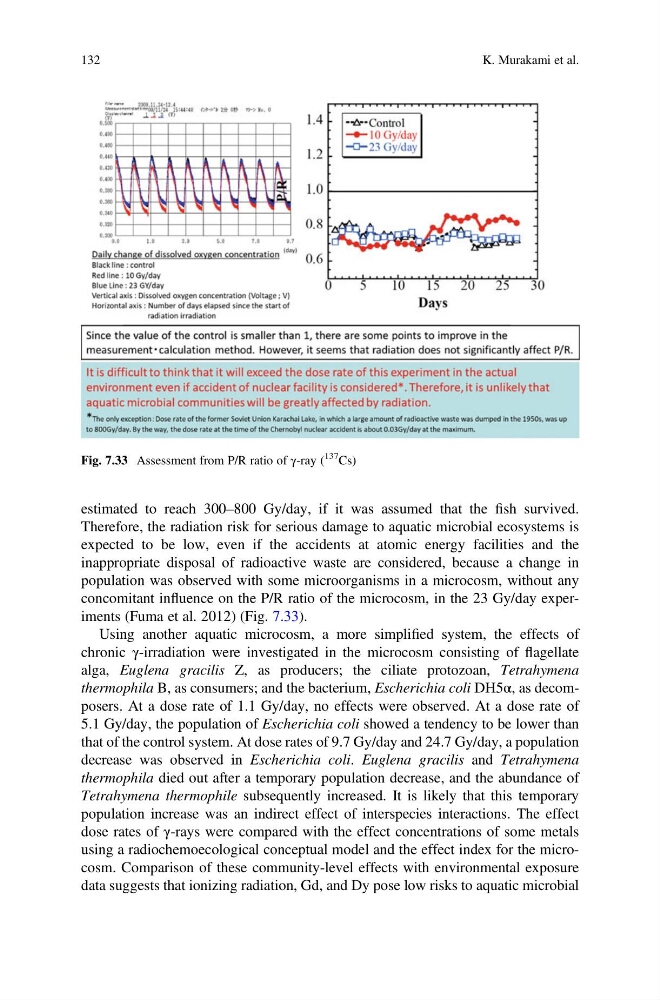
estimated to reach 300–800 Gy/day, if it was assumed that the fish survived.
Therefore, the radiation risk for serious damage to aquatic microbial ecosystems is
expected to be low, even if the accidents at atomic energy facilities and the
inappropriate disposal of radioactive waste are considered, because a change in
population was observed with some microorganisms in a microcosm, without any
concomitant influence on the P/R ratio of the microcosm, in the 23 Gy/day experiments (Fuma et al. 2012) (Fig. 7.33).
Using another aquatic microcosm, a more simplified system, the effects of
chronic γ-irradiation were investigated in the microcosm consisting of flagellate
alga, Euglena gracilis Z, as producers; the ciliate protozoan, Tetrahymena
thermophila B, as consumers; and the bacterium, Escherichia coli DH5α, as decomposers. At a dose rate of 1.1 Gy/day, no effects were observed. At a dose rate of
5.1 Gy/day, the population of Escherichia coli showed a tendency to be lower than
that of the control system. At dose rates of 9.7 Gy/day and 24.7 Gy/day, a population
decrease was observed in Escherichia coli. Euglena gracilis and Tetrahymena
thermophila died out after a temporary population decrease, and the abundance of
Tetrahymena thermophile subsequently increased. It is likely that this temporary
population increase was an indirect effect of interspecies interactions. The effect
dose rates of γ-rays were compared with the effect concentrations of some metals
using a radiochemoecological conceptual model and the effect index for the microcosm. Comparison of these community-level effects with environmental exposure
data suggests that ionizing radiation, Gd, and Dy pose low risks to aquatic microbial
Fig. 7.33 Assessment from P/R ratio of γ-ray (
137
Cs)
132
K. Murakami et al.
Therefore, the radiation risk for serious damage to aquatic microbial ecosystems is
expected to be low, even if the accidents at atomic energy facilities and the
inappropriate disposal of radioactive waste are considered, because a change in
population was observed with some microorganisms in a microcosm, without any
concomitant influence on the P/R ratio of the microcosm, in the 23 Gy/day experiments (Fuma et al. 2012) (Fig. 7.33).
Using another aquatic microcosm, a more simplified system, the effects of
chronic γ-irradiation were investigated in the microcosm consisting of flagellate
alga, Euglena gracilis Z, as producers; the ciliate protozoan, Tetrahymena
thermophila B, as consumers; and the bacterium, Escherichia coli DH5α, as decomposers. At a dose rate of 1.1 Gy/day, no effects were observed. At a dose rate of
5.1 Gy/day, the population of Escherichia coli showed a tendency to be lower than
that of the control system. At dose rates of 9.7 Gy/day and 24.7 Gy/day, a population
decrease was observed in Escherichia coli. Euglena gracilis and Tetrahymena
thermophila died out after a temporary population decrease, and the abundance of
Tetrahymena thermophile subsequently increased. It is likely that this temporary
population increase was an indirect effect of interspecies interactions. The effect
dose rates of γ-rays were compared with the effect concentrations of some metals
using a radiochemoecological conceptual model and the effect index for the microcosm. Comparison of these community-level effects with environmental exposure
data suggests that ionizing radiation, Gd, and Dy pose low risks to aquatic microbial
Fig. 7.33 Assessment from P/R ratio of γ-ray (
137
Cs)
132
K. Murakami et al.