

ratio of the abundance and population density (N 30 ) on the 30th day. The DO
concentration was measured continuously from the 16th day, and the P/R ratio
was calculated from the amounts of production (P) and respiration (R).
As a structural parameter, a decrease was observed at a concentration of 8 mg/L of
I 2 in the populations of Cyclidium glaucoma, Lecane sp., Scenedesmus quadricauda,
and Tolypothrix sp., but no microorganisms in the microcosm perished. Extinction
was observed for Cyclidium glaucoma, Philodina erythrophthalma, and Aeolosoma
hemprichi at an I 2 concentration of 10 mg/L, and the populations of Scenedesmus
quadricauda and Tolypothrix sp. also decreased. Additionally, the tendency for only
Lecane sp. to increase in comparison with other zooplanktons in N 30 was recognized.
These were influences upon the microcosm due to the inhibition of photosynthesis by
I 2 , and it was thought that extinction did not occur because the phytoplankton had a
high ability to acclimate. As a functional parameter, bioactivity was observed at an I 2
concentration of 8 mg/L, and the P/R ratio was relatively stable. Activity decreased
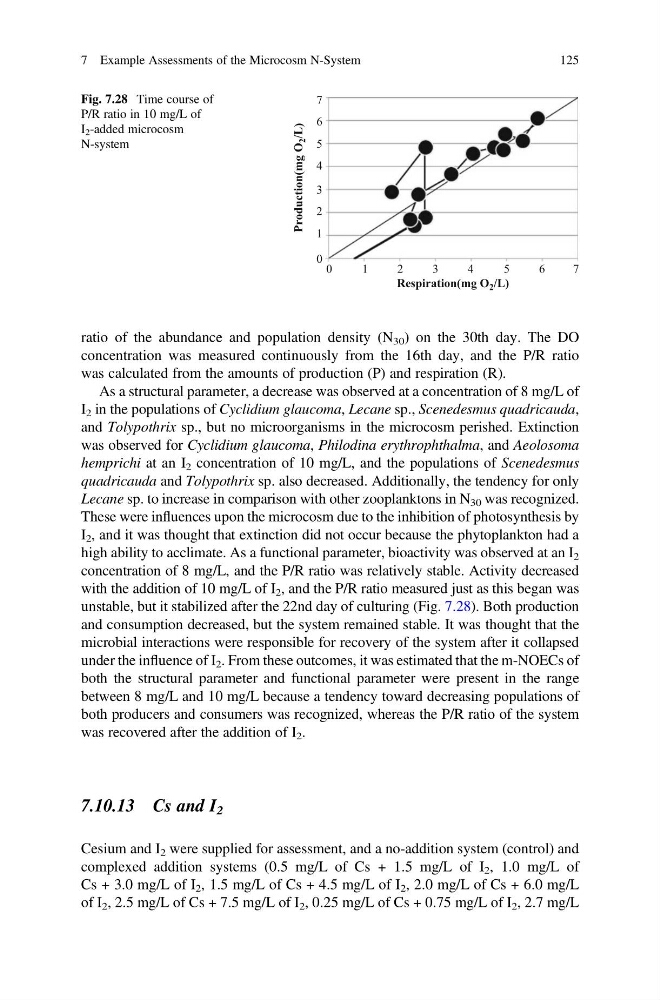
with the addition of 10 mg/L of I 2 , and the P/R ratio measured just as this began was
unstable, but it stabilized after the 22nd day of culturing (Fig. 7.28). Both production
and consumption decreased, but the system remained stable. It was thought that the
microbial interactions were responsible for recovery of the system after it collapsed
under the influence of I 2 . From these outcomes, it was estimated that the m-NOECs of
both the structural parameter and functional parameter were present in the range
between 8 mg/L and 10 mg/L because a tendency toward decreasing populations of
both producers and consumers was recognized, whereas the P/R ratio of the system
was recovered after the addition of I 2 .
7.10.13 Cs and I 2
Cesium and I 2 were supplied for assessment, and a no-addition system (control) and
complexed addition systems (0.5 mg/L of Cs + 1.5 mg/L of I 2 , 1.0 mg/L of
Cs + 3.0 mg/L of I 2 , 1.5 mg/L of Cs + 4.5 mg/L of I 2 , 2.0 mg/L of Cs + 6.0 mg/L
of I 2 , 2.5 mg/L of Cs + 7.5 mg/L of I 2 , 0.25 mg/L of Cs + 0.75 mg/L of I 2 , 2.7 mg/L
Respiration(mg O 2 /L)
Production(mg O
2 /L)
0
1
2
3
4
5
6
7
7
6
5
4
3
2
1
0
Fig. 7.28 Time course of
P/R ratio in 10 mg/L of
I 2 -added microcosm
N-system
7 Example Assessments of the Microcosm N-System
125
concentration was measured continuously from the 16th day, and the P/R ratio
was calculated from the amounts of production (P) and respiration (R).
As a structural parameter, a decrease was observed at a concentration of 8 mg/L of
I 2 in the populations of Cyclidium glaucoma, Lecane sp., Scenedesmus quadricauda,
and Tolypothrix sp., but no microorganisms in the microcosm perished. Extinction
was observed for Cyclidium glaucoma, Philodina erythrophthalma, and Aeolosoma
hemprichi at an I 2 concentration of 10 mg/L, and the populations of Scenedesmus
quadricauda and Tolypothrix sp. also decreased. Additionally, the tendency for only
Lecane sp. to increase in comparison with other zooplanktons in N 30 was recognized.
These were influences upon the microcosm due to the inhibition of photosynthesis by
I 2 , and it was thought that extinction did not occur because the phytoplankton had a
high ability to acclimate. As a functional parameter, bioactivity was observed at an I 2
concentration of 8 mg/L, and the P/R ratio was relatively stable. Activity decreased
with the addition of 10 mg/L of I 2 , and the P/R ratio measured just as this began was
unstable, but it stabilized after the 22nd day of culturing (Fig. 7.28). Both production
and consumption decreased, but the system remained stable. It was thought that the
microbial interactions were responsible for recovery of the system after it collapsed
under the influence of I 2 . From these outcomes, it was estimated that the m-NOECs of
both the structural parameter and functional parameter were present in the range
between 8 mg/L and 10 mg/L because a tendency toward decreasing populations of
both producers and consumers was recognized, whereas the P/R ratio of the system
was recovered after the addition of I 2 .
7.10.13 Cs and I 2
Cesium and I 2 were supplied for assessment, and a no-addition system (control) and
complexed addition systems (0.5 mg/L of Cs + 1.5 mg/L of I 2 , 1.0 mg/L of
Cs + 3.0 mg/L of I 2 , 1.5 mg/L of Cs + 4.5 mg/L of I 2 , 2.0 mg/L of Cs + 6.0 mg/L
of I 2 , 2.5 mg/L of Cs + 7.5 mg/L of I 2 , 0.25 mg/L of Cs + 0.75 mg/L of I 2 , 2.7 mg/L
Respiration(mg O 2 /L)
Production(mg O
2 /L)
0
1
2
3
4
5
6
7
7
6
5
4
3
2
1
0
Fig. 7.28 Time course of
P/R ratio in 10 mg/L of
I 2 -added microcosm
N-system
7 Example Assessments of the Microcosm N-System
125