

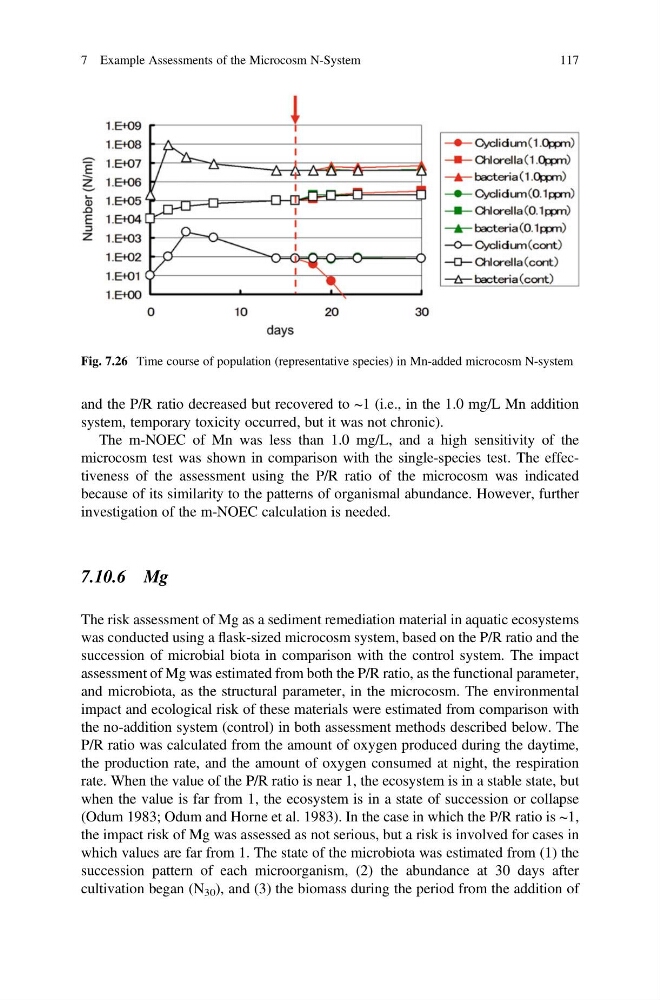
and the P/R ratio decreased but recovered to ~1 (i.e., in the 1.0 mg/L Mn addition
system, temporary toxicity occurred, but it was not chronic).
The m-NOEC of Mn was less than 1.0 mg/L, and a high sensitivity of the
microcosm test was shown in comparison with the single-species test. The effectiveness of the assessment using the P/R ratio of the microcosm was indicated
because of its similarity to the patterns of organismal abundance. However, further
investigation of the m-NOEC calculation is needed.
7.10.6 Mg
The risk assessment of Mg as a sediment remediation material in aquatic ecosystems
was conducted using a flask-sized microcosm system, based on the P/R ratio and the
succession of microbial biota in comparison with the control system. The impact
assessment of Mg was estimated from both the P/R ratio, as the functional parameter,
and microbiota, as the structural parameter, in the microcosm. The environmental
impact and ecological risk of these materials were estimated from comparison with
the no-addition system (control) in both assessment methods described below. The
P/R ratio was calculated from the amount of oxygen produced during the daytime,
the production rate, and the amount of oxygen consumed at night, the respiration
rate. When the value of the P/R ratio is near 1, the ecosystem is in a stable state, but
when the value is far from 1, the ecosystem is in a state of succession or collapse
(Odum 1983; Odum and Horne et al. 1983). In the case in which the P/R ratio is ~1,
the impact risk of Mg was assessed as not serious, but a risk is involved for cases in
which values are far from 1. The state of the microbiota was estimated from (1) the
succession pattern of each microorganism, (2) the abundance at 30 days after
cultivation began (N 30 ), and (3) the biomass during the period from the addition of
Fig. 7.26 Time course of population (representative species) in Mn-added microcosm N-system
7 Example Assessments of the Microcosm N-System
117
system, temporary toxicity occurred, but it was not chronic).
The m-NOEC of Mn was less than 1.0 mg/L, and a high sensitivity of the
microcosm test was shown in comparison with the single-species test. The effectiveness of the assessment using the P/R ratio of the microcosm was indicated
because of its similarity to the patterns of organismal abundance. However, further
investigation of the m-NOEC calculation is needed.
7.10.6 Mg
The risk assessment of Mg as a sediment remediation material in aquatic ecosystems
was conducted using a flask-sized microcosm system, based on the P/R ratio and the
succession of microbial biota in comparison with the control system. The impact
assessment of Mg was estimated from both the P/R ratio, as the functional parameter,
and microbiota, as the structural parameter, in the microcosm. The environmental
impact and ecological risk of these materials were estimated from comparison with
the no-addition system (control) in both assessment methods described below. The
P/R ratio was calculated from the amount of oxygen produced during the daytime,
the production rate, and the amount of oxygen consumed at night, the respiration
rate. When the value of the P/R ratio is near 1, the ecosystem is in a stable state, but
when the value is far from 1, the ecosystem is in a state of succession or collapse
(Odum 1983; Odum and Horne et al. 1983). In the case in which the P/R ratio is ~1,
the impact risk of Mg was assessed as not serious, but a risk is involved for cases in
which values are far from 1. The state of the microbiota was estimated from (1) the
succession pattern of each microorganism, (2) the abundance at 30 days after
cultivation began (N 30 ), and (3) the biomass during the period from the addition of
Fig. 7.26 Time course of population (representative species) in Mn-added microcosm N-system
7 Example Assessments of the Microcosm N-System
117