

7.8 Organic Matter and Organic Solvents
The effect of organic loading of the flask-sized microcosm system was investigated
and assessed from the succession pattern of microbiota, the abundance in the stable
state (N 30 ), and the biomass in the organic-loaded period (B 16–30 ) to obtain basic
information from bioremediation, which uses certain essential microorganisms to
improve polluted environments.
7.8.1 Polypeptone
Polypeptone, as a bacterial nutrient source, was added to the microcosm at a
concentration of 5 g/L. The bacterial population density increased with absorption
of polypeptone, and the culture medium was colored yellow by the 2nd day. The
density of CFUs of bacteria increased to 10
9 N/mL, and CO 2 emissions also
increased. Chlorella sp. and Tolypothrix sp. decreased in their population sizes
immediately. Microanimals, such as Cyclidium glaucoma and Philodina
erythrophthalma, became extinct, and only bacteria survived in the flask. The rate
of succession in the microcosm increased in the 0.1 g/L addition system in comparison with the 0.5 g/L addition system.
Polypeptone, the substrate of the bacteria in the microcosm, was added as an
organic matter load 16 days after the start of microcosm culturing. The addition
quantity (quantity of the load) was assumed to be one, two, five, or ten times (i.e.,
1Â, 2Â, 5Â, or 10Â) the quantity of existence in the microcosm on the 16th day after
culturing began. In the 1Â polypeptone loading system, bacteria multiplied rapidly
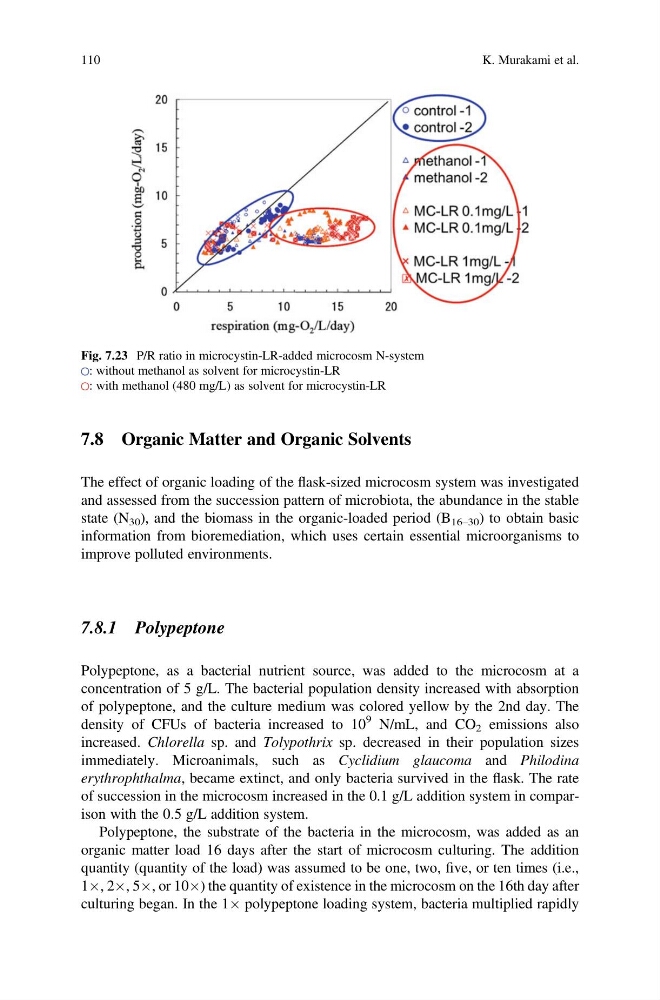
Fig. 7.23 P/R ratio in microcystin-LR-added microcosm N-system
: without methanol as solvent for microcystin-LR
: with methanol (480 mg/L) as solvent for microcystin-LR
110
K. Murakami et al.
The effect of organic loading of the flask-sized microcosm system was investigated
and assessed from the succession pattern of microbiota, the abundance in the stable
state (N 30 ), and the biomass in the organic-loaded period (B 16–30 ) to obtain basic
information from bioremediation, which uses certain essential microorganisms to
improve polluted environments.
7.8.1 Polypeptone
Polypeptone, as a bacterial nutrient source, was added to the microcosm at a
concentration of 5 g/L. The bacterial population density increased with absorption
of polypeptone, and the culture medium was colored yellow by the 2nd day. The
density of CFUs of bacteria increased to 10
9 N/mL, and CO 2 emissions also
increased. Chlorella sp. and Tolypothrix sp. decreased in their population sizes
immediately. Microanimals, such as Cyclidium glaucoma and Philodina
erythrophthalma, became extinct, and only bacteria survived in the flask. The rate
of succession in the microcosm increased in the 0.1 g/L addition system in comparison with the 0.5 g/L addition system.
Polypeptone, the substrate of the bacteria in the microcosm, was added as an
organic matter load 16 days after the start of microcosm culturing. The addition
quantity (quantity of the load) was assumed to be one, two, five, or ten times (i.e.,
1Â, 2Â, 5Â, or 10Â) the quantity of existence in the microcosm on the 16th day after
culturing began. In the 1Â polypeptone loading system, bacteria multiplied rapidly
Fig. 7.23 P/R ratio in microcystin-LR-added microcosm N-system
: without methanol as solvent for microcystin-LR
: with methanol (480 mg/L) as solvent for microcystin-LR
110
K. Murakami et al.