

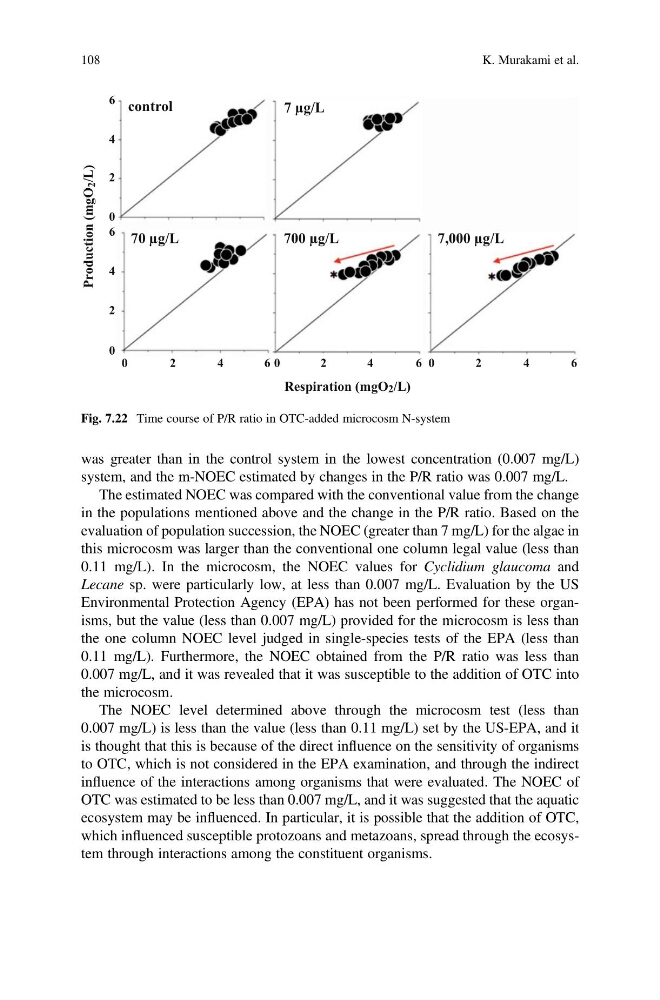
was greater than in the control system in the lowest concentration (0.007 mg/L)
system, and the m-NOEC estimated by changes in the P/R ratio was 0.007 mg/L.
The estimated NOEC was compared with the conventional value from the change
in the populations mentioned above and the change in the P/R ratio. Based on the
evaluation of population succession, the NOEC (greater than 7 mg/L) for the algae in
this microcosm was larger than the conventional one column legal value (less than
0.11 mg/L). In the microcosm, the NOEC values for Cyclidium glaucoma and
Lecane sp. were particularly low, at less than 0.007 mg/L. Evaluation by the US
Environmental Protection Agency (EPA) has not been performed for these organisms, but the value (less than 0.007 mg/L) provided for the microcosm is less than
the one column NOEC level judged in single-species tests of the EPA (less than
0.11 mg/L). Furthermore, the NOEC obtained from the P/R ratio was less than
0.007 mg/L, and it was revealed that it was susceptible to the addition of OTC into
the microcosm.
The NOEC level determined above through the microcosm test (less than
0.007 mg/L) is less than the value (less than 0.11 mg/L) set by the US-EPA, and it
is thought that this is because of the direct influence on the sensitivity of organisms
to OTC, which is not considered in the EPA examination, and through the indirect
influence of the interactions among organisms that were evaluated. The NOEC of
OTC was estimated to be less than 0.007 mg/L, and it was suggested that the aquatic
ecosystem may be influenced. In particular, it is possible that the addition of OTC,
which influenced susceptible protozoans and metazoans, spread through the ecosystem through interactions among the constituent organisms.
Respiration (mgO2/L)
Production (mgO
2 /L)
control
7 μg/L
70 μg/L
700 μg/L
7,000 μg/L
0
2
4
6
0
2
4
6
0
2
4
60
2
4
6 0
2
4
6
Fig. 7.22 Time course of P/R ratio in OTC-added microcosm N-system
108
K. Murakami et al.
system, and the m-NOEC estimated by changes in the P/R ratio was 0.007 mg/L.
The estimated NOEC was compared with the conventional value from the change
in the populations mentioned above and the change in the P/R ratio. Based on the
evaluation of population succession, the NOEC (greater than 7 mg/L) for the algae in
this microcosm was larger than the conventional one column legal value (less than
0.11 mg/L). In the microcosm, the NOEC values for Cyclidium glaucoma and
Lecane sp. were particularly low, at less than 0.007 mg/L. Evaluation by the US
Environmental Protection Agency (EPA) has not been performed for these organisms, but the value (less than 0.007 mg/L) provided for the microcosm is less than
the one column NOEC level judged in single-species tests of the EPA (less than
0.11 mg/L). Furthermore, the NOEC obtained from the P/R ratio was less than
0.007 mg/L, and it was revealed that it was susceptible to the addition of OTC into
the microcosm.
The NOEC level determined above through the microcosm test (less than
0.007 mg/L) is less than the value (less than 0.11 mg/L) set by the US-EPA, and it
is thought that this is because of the direct influence on the sensitivity of organisms
to OTC, which is not considered in the EPA examination, and through the indirect
influence of the interactions among organisms that were evaluated. The NOEC of
OTC was estimated to be less than 0.007 mg/L, and it was suggested that the aquatic
ecosystem may be influenced. In particular, it is possible that the addition of OTC,
which influenced susceptible protozoans and metazoans, spread through the ecosystem through interactions among the constituent organisms.
Respiration (mgO2/L)
Production (mgO
2 /L)
control
7 μg/L
70 μg/L
700 μg/L
7,000 μg/L
0
2
4
6
0
2
4
6
0
2
4
60
2
4
6 0
2
4
6
Fig. 7.22 Time course of P/R ratio in OTC-added microcosm N-system
108
K. Murakami et al.