

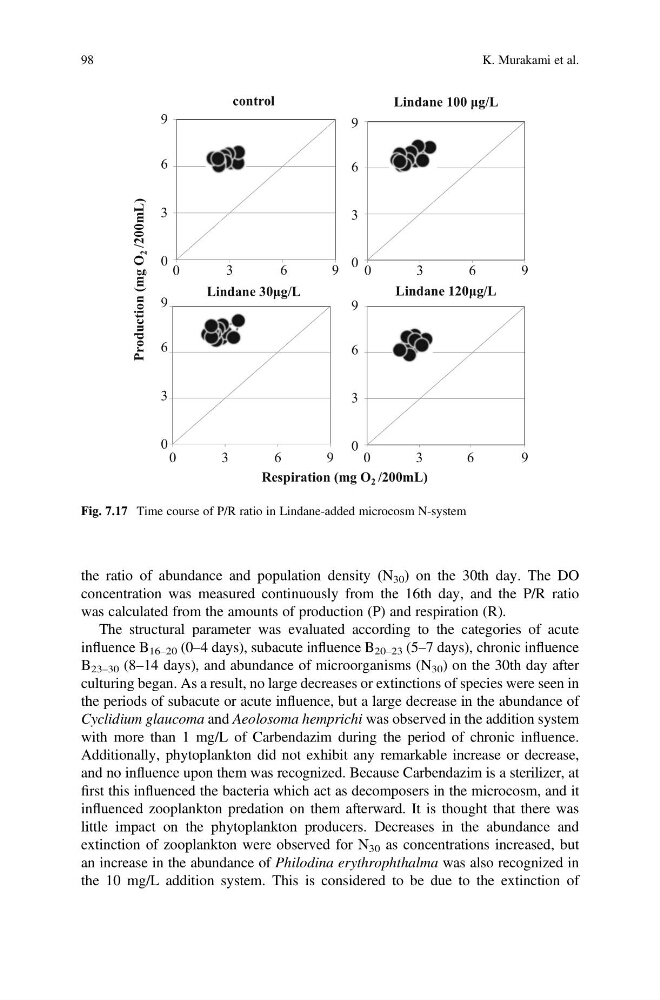
the ratio of abundance and population density (N 30 ) on the 30th day. The DO
concentration was measured continuously from the 16th day, and the P/R ratio
was calculated from the amounts of production (P) and respiration (R).
The structural parameter was evaluated according to the categories of acute
influence B 16–20 (0–4 days), subacute influence B 20–23 (5–7 days), chronic influence
B 23–30 (8–14 days), and abundance of microorganisms (N 30 ) on the 30th day after
culturing began. As a result, no large decreases or extinctions of species were seen in
the periods of subacute or acute influence, but a large decrease in the abundance of
Cyclidium glaucoma and Aeolosoma hemprichi was observed in the addition system
with more than 1 mg/L of Carbendazim during the period of chronic influence.
Additionally, phytoplankton did not exhibit any remarkable increase or decrease,
and no influence upon them was recognized. Because Carbendazim is a sterilizer, at
first this influenced the bacteria which act as decomposers in the microcosm, and it
influenced zooplankton predation on them afterward. It is thought that there was
little impact on the phytoplankton producers. Decreases in the abundance and
extinction of zooplankton were observed for N 30 as concentrations increased, but
an increase in the abundance of Philodina erythrophthalma was also recognized in
the 10 mg/L addition system. This is considered to be due to the extinction of
Production (mg O
2 /200mL)
Respiration (mg O 2 /200mL)
control
9
6
3
0
9
6
3
0
Lindane 100 μg/L
9
6
3
0
9
6
3
0
Lindane 30μg/L
9
6
3
0
9
6
3
0
Lindane 120μg/L
9
6
3
0
9
6
3
0
Fig. 7.17 Time course of P/R ratio in Lindane-added microcosm N-system
98
K. Murakami et al.
concentration was measured continuously from the 16th day, and the P/R ratio
was calculated from the amounts of production (P) and respiration (R).
The structural parameter was evaluated according to the categories of acute
influence B 16–20 (0–4 days), subacute influence B 20–23 (5–7 days), chronic influence
B 23–30 (8–14 days), and abundance of microorganisms (N 30 ) on the 30th day after
culturing began. As a result, no large decreases or extinctions of species were seen in
the periods of subacute or acute influence, but a large decrease in the abundance of
Cyclidium glaucoma and Aeolosoma hemprichi was observed in the addition system
with more than 1 mg/L of Carbendazim during the period of chronic influence.
Additionally, phytoplankton did not exhibit any remarkable increase or decrease,
and no influence upon them was recognized. Because Carbendazim is a sterilizer, at
first this influenced the bacteria which act as decomposers in the microcosm, and it
influenced zooplankton predation on them afterward. It is thought that there was
little impact on the phytoplankton producers. Decreases in the abundance and
extinction of zooplankton were observed for N 30 as concentrations increased, but
an increase in the abundance of Philodina erythrophthalma was also recognized in
the 10 mg/L addition system. This is considered to be due to the extinction of
Production (mg O
2 /200mL)
Respiration (mg O 2 /200mL)
control
9
6
3
0
9
6
3
0
Lindane 100 μg/L
9
6
3
0
9
6
3
0
Lindane 30μg/L
9
6
3
0
9
6
3
0
Lindane 120μg/L
9
6
3
0
9
6
3
0
Fig. 7.17 Time course of P/R ratio in Lindane-added microcosm N-system
98
K. Murakami et al.