

density (N 30 ) on the 30th day. The DO concentration was measured continuously
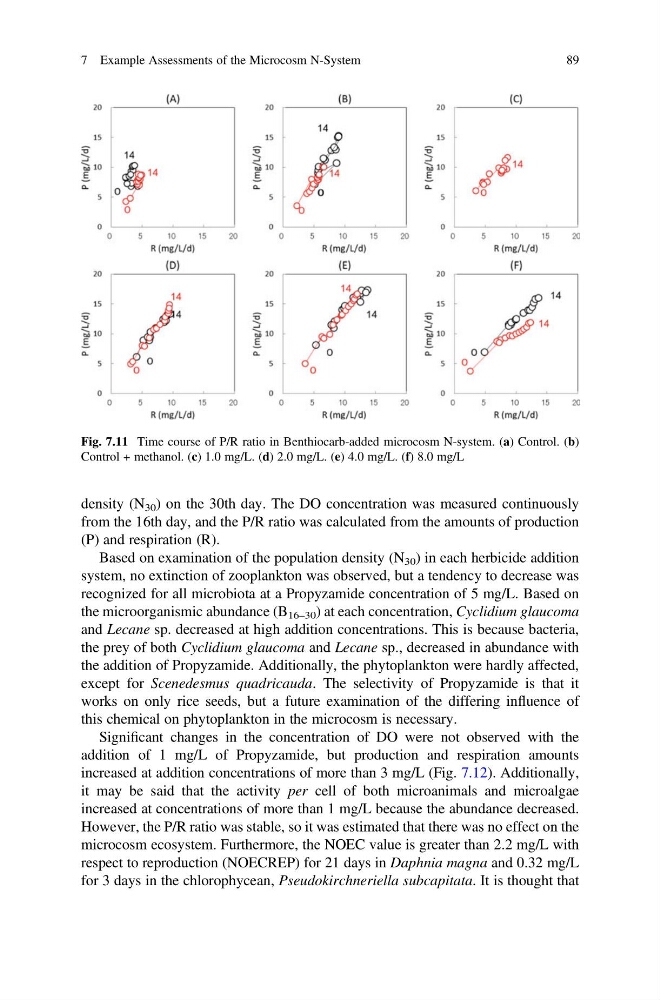
from the 16th day, and the P/R ratio was calculated from the amounts of production
(P) and respiration (R).
Based on examination of the population density (N 30 ) in each herbicide addition
system, no extinction of zooplankton was observed, but a tendency to decrease was
recognized for all microbiota at a Propyzamide concentration of 5 mg/L. Based on
the microorganismic abundance (B 16–30 ) at each concentration, Cyclidium glaucoma
and Lecane sp. decreased at high addition concentrations. This is because bacteria,
the prey of both Cyclidium glaucoma and Lecane sp., decreased in abundance with
the addition of Propyzamide. Additionally, the phytoplankton were hardly affected,
except for Scenedesmus quadricauda. The selectivity of Propyzamide is that it
works on only rice seeds, but a future examination of the differing influence of
this chemical on phytoplankton in the microcosm is necessary.
Significant changes in the concentration of DO were not observed with the
addition of 1 mg/L of Propyzamide, but production and respiration amounts
increased at addition concentrations of more than 3 mg/L (Fig. 7.12). Additionally,
it may be said that the activity per cell of both microanimals and microalgae
increased at concentrations of more than 1 mg/L because the abundance decreased.
However, the P/R ratio was stable, so it was estimated that there was no effect on the
microcosm ecosystem. Furthermore, the NOEC value is greater than 2.2 mg/L with
respect to reproduction (NOECREP) for 21 days in Daphnia magna and 0.32 mg/L
for 3 days in the chlorophycean, Pseudokirchneriella subcapitata. It is thought that
Fig. 7.11 Time course of P/R ratio in Benthiocarb-added microcosm N-system. (a) Control. (b)
Control + methanol. (c) 1.0 mg/L. (d) 2.0 mg/L. (e) 4.0 mg/L. (f) 8.0 mg/L
7 Example Assessments of the Microcosm N-System
89
from the 16th day, and the P/R ratio was calculated from the amounts of production
(P) and respiration (R).
Based on examination of the population density (N 30 ) in each herbicide addition
system, no extinction of zooplankton was observed, but a tendency to decrease was
recognized for all microbiota at a Propyzamide concentration of 5 mg/L. Based on
the microorganismic abundance (B 16–30 ) at each concentration, Cyclidium glaucoma
and Lecane sp. decreased at high addition concentrations. This is because bacteria,
the prey of both Cyclidium glaucoma and Lecane sp., decreased in abundance with
the addition of Propyzamide. Additionally, the phytoplankton were hardly affected,
except for Scenedesmus quadricauda. The selectivity of Propyzamide is that it
works on only rice seeds, but a future examination of the differing influence of
this chemical on phytoplankton in the microcosm is necessary.
Significant changes in the concentration of DO were not observed with the
addition of 1 mg/L of Propyzamide, but production and respiration amounts
increased at addition concentrations of more than 3 mg/L (Fig. 7.12). Additionally,
it may be said that the activity per cell of both microanimals and microalgae
increased at concentrations of more than 1 mg/L because the abundance decreased.
However, the P/R ratio was stable, so it was estimated that there was no effect on the
microcosm ecosystem. Furthermore, the NOEC value is greater than 2.2 mg/L with
respect to reproduction (NOECREP) for 21 days in Daphnia magna and 0.32 mg/L
for 3 days in the chlorophycean, Pseudokirchneriella subcapitata. It is thought that
Fig. 7.11 Time course of P/R ratio in Benthiocarb-added microcosm N-system. (a) Control. (b)
Control + methanol. (c) 1.0 mg/L. (d) 2.0 mg/L. (e) 4.0 mg/L. (f) 8.0 mg/L
7 Example Assessments of the Microcosm N-System
89