

methanol from the 4th day after addition onward, and both the low Simazine load
(0.64 mg/L) and high load (16 mg/L) systems were defined from the 1st day after
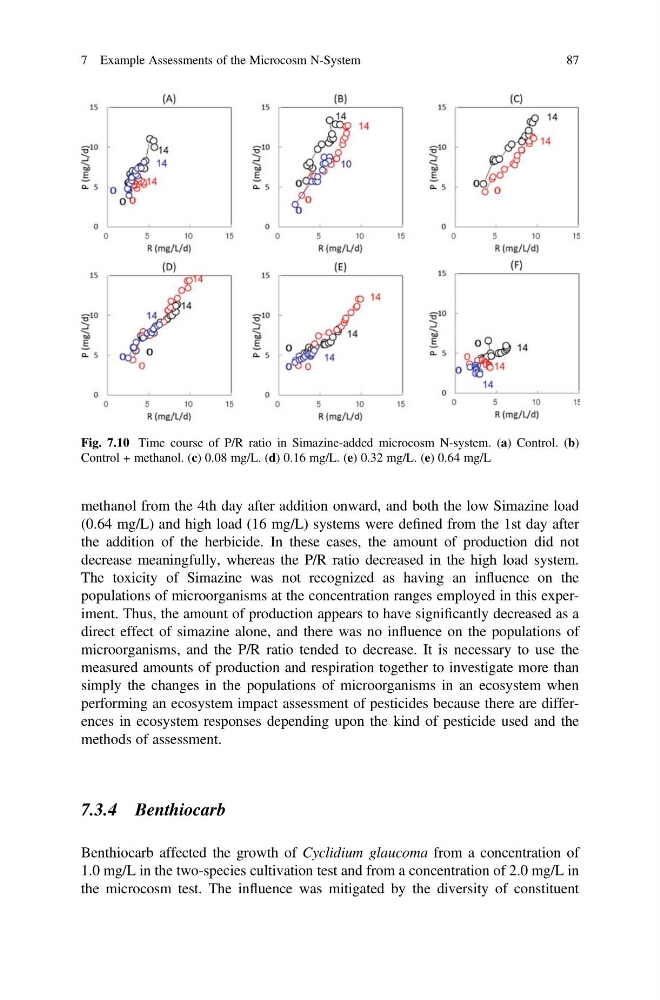
the addition of the herbicide. In these cases, the amount of production did not
decrease meaningfully, whereas the P/R ratio decreased in the high load system.
The toxicity of Simazine was not recognized as having an influence on the
populations of microorganisms at the concentration ranges employed in this experiment. Thus, the amount of production appears to have significantly decreased as a
direct effect of simazine alone, and there was no influence on the populations of
microorganisms, and the P/R ratio tended to decrease. It is necessary to use the
measured amounts of production and respiration together to investigate more than
simply the changes in the populations of microorganisms in an ecosystem when
performing an ecosystem impact assessment of pesticides because there are differences in ecosystem responses depending upon the kind of pesticide used and the
methods of assessment.
7.3.4 Benthiocarb
Benthiocarb affected the growth of Cyclidium glaucoma from a concentration of
1.0 mg/L in the two-species cultivation test and from a concentration of 2.0 mg/L in
the microcosm test. The influence was mitigated by the diversity of constituent
Fig. 7.10 Time course of P/R ratio in Simazine-added microcosm N-system. (a) Control. (b)
Control + methanol. (c) 0.08 mg/L. (d) 0.16 mg/L. (e) 0.32 mg/L. (e) 0.64 mg/L
7 Example Assessments of the Microcosm N-System
87
(0.64 mg/L) and high load (16 mg/L) systems were defined from the 1st day after
the addition of the herbicide. In these cases, the amount of production did not
decrease meaningfully, whereas the P/R ratio decreased in the high load system.
The toxicity of Simazine was not recognized as having an influence on the
populations of microorganisms at the concentration ranges employed in this experiment. Thus, the amount of production appears to have significantly decreased as a
direct effect of simazine alone, and there was no influence on the populations of
microorganisms, and the P/R ratio tended to decrease. It is necessary to use the
measured amounts of production and respiration together to investigate more than
simply the changes in the populations of microorganisms in an ecosystem when
performing an ecosystem impact assessment of pesticides because there are differences in ecosystem responses depending upon the kind of pesticide used and the
methods of assessment.
7.3.4 Benthiocarb
Benthiocarb affected the growth of Cyclidium glaucoma from a concentration of
1.0 mg/L in the two-species cultivation test and from a concentration of 2.0 mg/L in
the microcosm test. The influence was mitigated by the diversity of constituent
Fig. 7.10 Time course of P/R ratio in Simazine-added microcosm N-system. (a) Control. (b)
Control + methanol. (c) 0.08 mg/L. (d) 0.16 mg/L. (e) 0.32 mg/L. (e) 0.64 mg/L
7 Example Assessments of the Microcosm N-System
87