

3.5.1 Isolation
of Parasites from Infected
G. mellonella
1. Isolate entomopathogenic nematodes (parasites) from
G. mellonella by insect-baiting method.
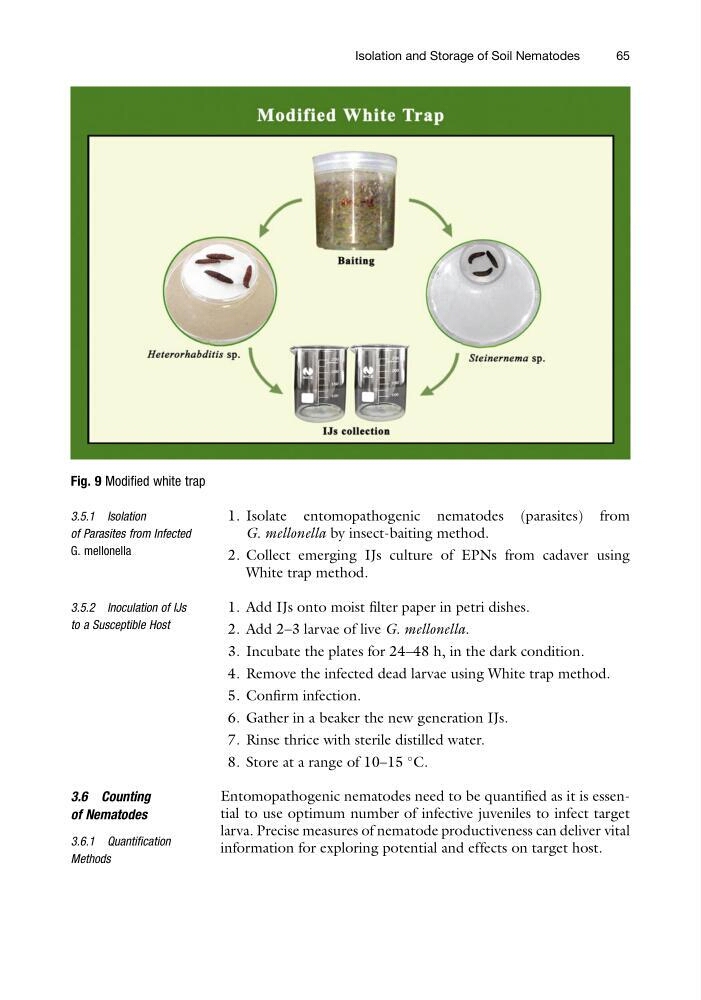
2. Collect emerging IJs culture of EPNs from cadaver using
White trap method.
3.5.2 Inoculation of IJs
to a Susceptible Host
1. Add IJs onto moist filter paper in petri dishes.
2. Add 2–3 larvae of live G. mellonella.
3. Incubate the plates for 24–48 h, in the dark condition.
4. Remove the infected dead larvae using White trap method.
5. Confirm infection.
6. Gather in a beaker the new generation IJs.
7. Rinse thrice with sterile distilled water.
8. Store at a range of 10–15
C.
3.6 Counting
of Nematodes
3.6.1 Quantification
Methods
Entomopathogenic nematodes need to be quantified as it is essential to use optimum number of infective juveniles to infect target
larva. Precise measures of nematode productiveness can deliver vital
information for exploring potential and effects on target host.
Fig. 9 Modified white trap
Isolation and Storage of Soil Nematodes
65
of Parasites from Infected
G. mellonella
1. Isolate entomopathogenic nematodes (parasites) from
G. mellonella by insect-baiting method.
2. Collect emerging IJs culture of EPNs from cadaver using
White trap method.
3.5.2 Inoculation of IJs
to a Susceptible Host
1. Add IJs onto moist filter paper in petri dishes.
2. Add 2–3 larvae of live G. mellonella.
3. Incubate the plates for 24–48 h, in the dark condition.
4. Remove the infected dead larvae using White trap method.
5. Confirm infection.
6. Gather in a beaker the new generation IJs.
7. Rinse thrice with sterile distilled water.
8. Store at a range of 10–15
C.
3.6 Counting
of Nematodes
3.6.1 Quantification
Methods
Entomopathogenic nematodes need to be quantified as it is essential to use optimum number of infective juveniles to infect target
larva. Precise measures of nematode productiveness can deliver vital
information for exploring potential and effects on target host.
Fig. 9 Modified white trap
Isolation and Storage of Soil Nematodes
65