

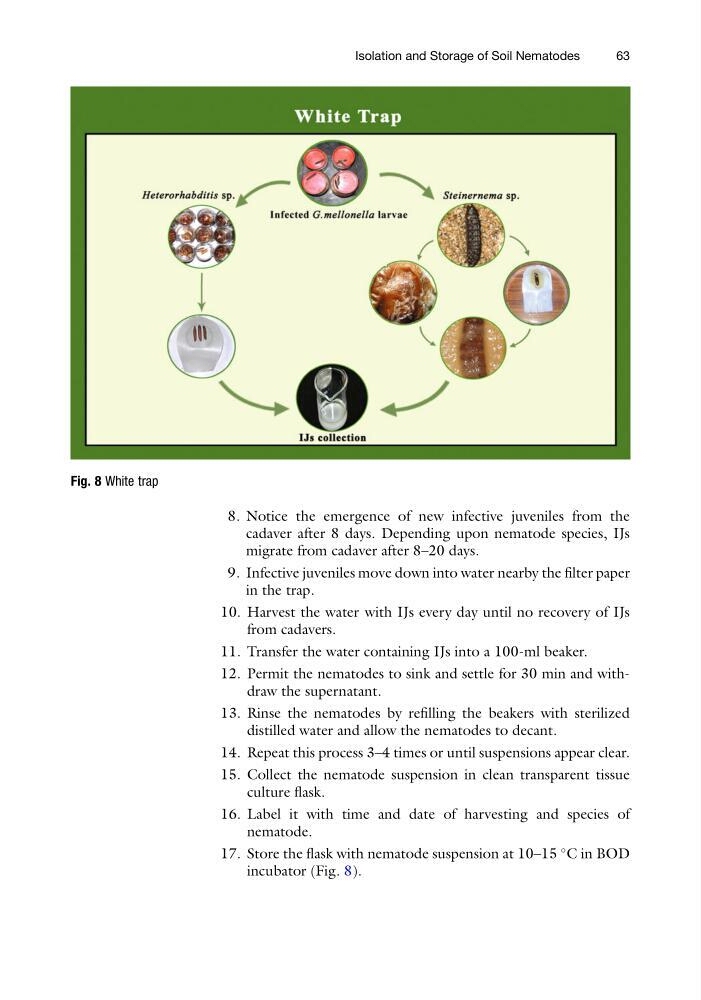
8. Notice the emergence of new infective juveniles from the
cadaver after 8 days. Depending upon nematode species, IJs
migrate from cadaver after 8–20 days.
9. Infective juveniles move down into water nearby the filter paper
in the trap.
10. Harvest the water with IJs every day until no recovery of IJs
from cadavers.
11. Transfer the water containing IJs into a 100-ml beaker.
12. Permit the nematodes to sink and settle for 30 min and withdraw the supernatant.
13. Rinse the nematodes by refilling the beakers with sterilized
distilled water and allow the nematodes to decant.
14. Repeat this process 3–4 times or until suspensions appear clear.
15. Collect the nematode suspension in clean transparent tissue
culture flask.
16. Label it with time and date of harvesting and species of
nematode.
17. Store the flask with nematode suspension at 10–15
C in BOD
incubator (Fig. 8).
Fig. 8 White trap
Isolation and Storage of Soil Nematodes
63
cadaver after 8 days. Depending upon nematode species, IJs
migrate from cadaver after 8–20 days.
9. Infective juveniles move down into water nearby the filter paper
in the trap.
10. Harvest the water with IJs every day until no recovery of IJs
from cadavers.
11. Transfer the water containing IJs into a 100-ml beaker.
12. Permit the nematodes to sink and settle for 30 min and withdraw the supernatant.
13. Rinse the nematodes by refilling the beakers with sterilized
distilled water and allow the nematodes to decant.
14. Repeat this process 3–4 times or until suspensions appear clear.
15. Collect the nematode suspension in clean transparent tissue
culture flask.
16. Label it with time and date of harvesting and species of
nematode.
17. Store the flask with nematode suspension at 10–15
C in BOD
incubator (Fig. 8).
Fig. 8 White trap
Isolation and Storage of Soil Nematodes
63