

Procedure
1. Collect eggs from primary source and raise them in plastic
containers (15 Â 30.5 Â 6 cm).
2. Add the mixed diet to the bottom of the plastic container to
make available a burrowing surface and food supply for the
mealworms.
3. Provide fruit and vegetables like banana peels, cucumbers,
carrots, cauliflower, celery, and broccoli which serves as a
source of water once a week.
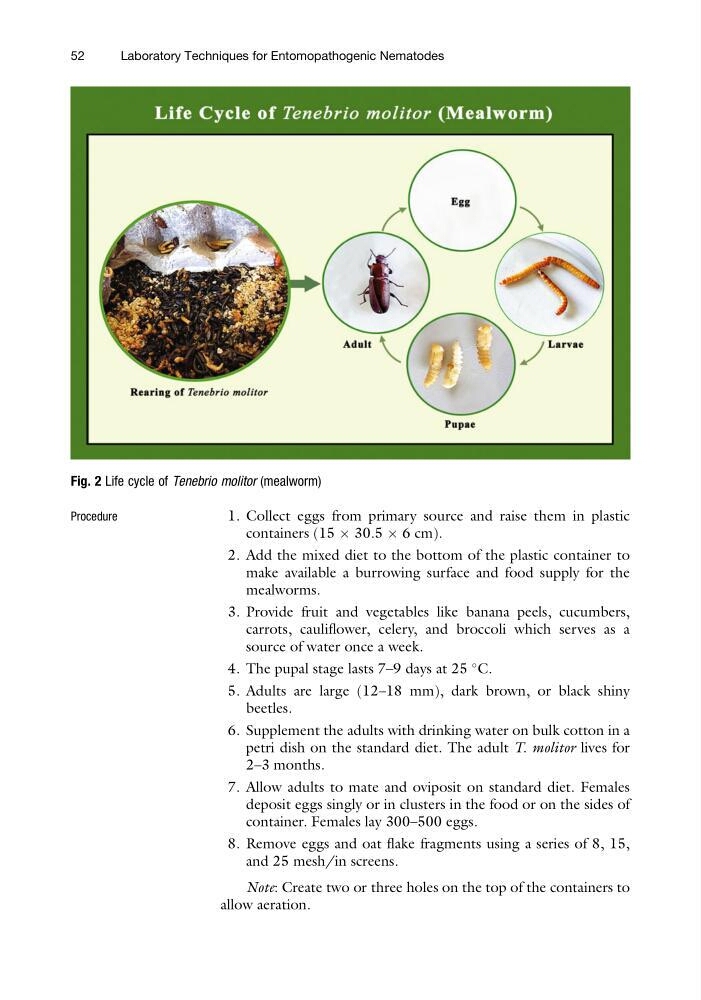
4. The pupal stage lasts 7–9 days at 25
C.
5. Adults are large (12–18 mm), dark brown, or black shiny
beetles.
6. Supplement the adults with drinking water on bulk cotton in a
petri dish on the standard diet. The adult T. molitor lives for
2–3 months.
7. Allow adults to mate and oviposit on standard diet. Females
deposit eggs singly or in clusters in the food or on the sides of
container. Females lay 300–500 eggs.
8. Remove eggs and oat flake fragments using a series of 8, 15,
and 25 mesh/in screens.
Note: Create two or three holes on the top of the containers to
allow aeration.
Fig. 2 Life cycle of Tenebrio molitor (mealworm)
52
Laboratory Techniques for Entomopathogenic Nematodes
1. Collect eggs from primary source and raise them in plastic
containers (15 Â 30.5 Â 6 cm).
2. Add the mixed diet to the bottom of the plastic container to
make available a burrowing surface and food supply for the
mealworms.
3. Provide fruit and vegetables like banana peels, cucumbers,
carrots, cauliflower, celery, and broccoli which serves as a
source of water once a week.
4. The pupal stage lasts 7–9 days at 25
C.
5. Adults are large (12–18 mm), dark brown, or black shiny
beetles.
6. Supplement the adults with drinking water on bulk cotton in a
petri dish on the standard diet. The adult T. molitor lives for
2–3 months.
7. Allow adults to mate and oviposit on standard diet. Females
deposit eggs singly or in clusters in the food or on the sides of
container. Females lay 300–500 eggs.
8. Remove eggs and oat flake fragments using a series of 8, 15,
and 25 mesh/in screens.
Note: Create two or three holes on the top of the containers to
allow aeration.
Fig. 2 Life cycle of Tenebrio molitor (mealworm)
52
Laboratory Techniques for Entomopathogenic Nematodes