

l
Nematodes assist the bacteria to find suitable hosts and
invade them.
l
The development and multiplication of the nematode depends
on the conditions created by the bacterium in the insect host.
l
The bacteria further produce anti-immune proteins to help the
nematode in evading host defenses, and antimicrobials to subdue competitors [71].
l
The nematode–bacterium complex is a significant natural enemy
of soil insects and holds an important part as biological
insecticides [72].
1 Steinernema and Their Xenorhabdus Symbiont
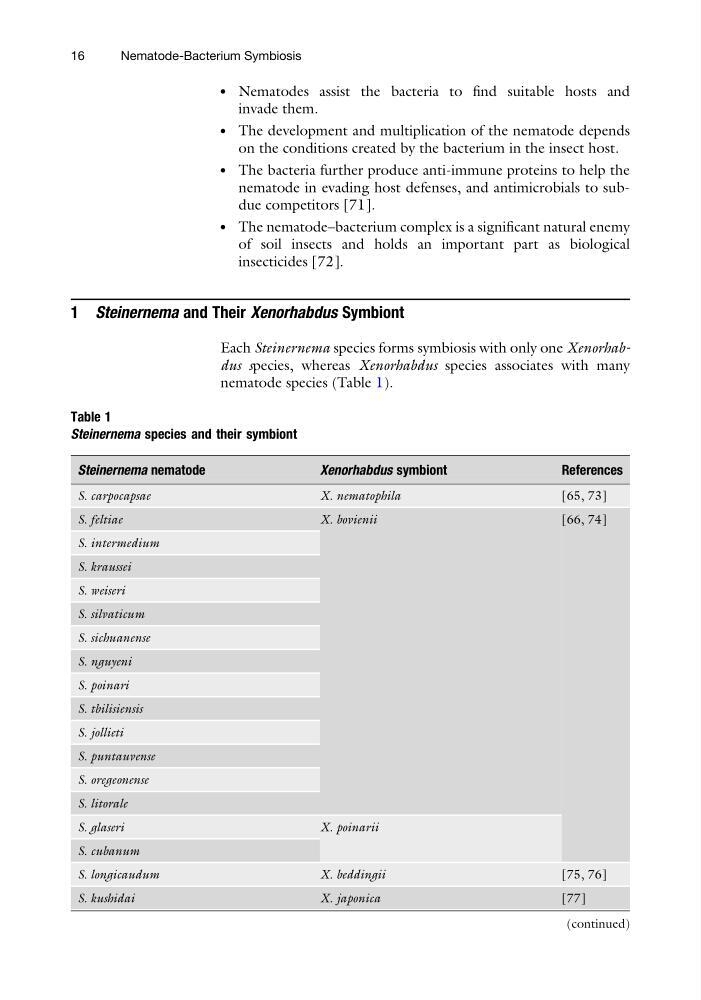
Each Steinernema species forms symbiosis with only one Xenorhabdus species, whereas Xenorhabdus species associates with many
nematode species (Table 1).
Table 1
Steinernema species and their symbiont
Steinernema nematode
Xenorhabdus symbiont
References
S. carpocapsae
X. nematophila
[65, 73]
S. feltiae
X. bovienii
[66, 74]
S. intermedium
S. kraussei
S. weiseri
S. silvaticum
S. sichuanense
S. nguyeni
S. poinari
S. tbilisiensis
S. jollieti
S. puntauvense
S. oregeonense
S. litorale
S. glaseri
X. poinarii
S. cubanum
S. longicaudum
X. beddingii
[75, 76]
S. kushidai
X. japonica
[77]
(continued)
16
Nematode-Bacterium Symbiosis
Nematodes assist the bacteria to find suitable hosts and
invade them.
l
The development and multiplication of the nematode depends
on the conditions created by the bacterium in the insect host.
l
The bacteria further produce anti-immune proteins to help the
nematode in evading host defenses, and antimicrobials to subdue competitors [71].
l
The nematode–bacterium complex is a significant natural enemy
of soil insects and holds an important part as biological
insecticides [72].
1 Steinernema and Their Xenorhabdus Symbiont
Each Steinernema species forms symbiosis with only one Xenorhabdus species, whereas Xenorhabdus species associates with many
nematode species (Table 1).
Table 1
Steinernema species and their symbiont
Steinernema nematode
Xenorhabdus symbiont
References
S. carpocapsae
X. nematophila
[65, 73]
S. feltiae
X. bovienii
[66, 74]
S. intermedium
S. kraussei
S. weiseri
S. silvaticum
S. sichuanense
S. nguyeni
S. poinari
S. tbilisiensis
S. jollieti
S. puntauvense
S. oregeonense
S. litorale
S. glaseri
X. poinarii
S. cubanum
S. longicaudum
X. beddingii
[75, 76]
S. kushidai
X. japonica
[77]
(continued)
16
Nematode-Bacterium Symbiosis