

stimulant (e.g., glucose, malt extract, molasses, or sucrose). This
method of application produces a better distribution of the EPNs in
the soil.
3 Quality Control Measures
The consistency of nematodes should be evaluated before and after
formulation, as well as their viability and infectivity. Various bioassay protocols are available, but experiments using many nematodes
are deemed unfit for quality control purposes due to host–parasitic
interactions such as recruiting. One-on-one (one nematode to one
Galleria larva) and sand-well assays are common quality management methods. One-on-one assay (steinernematids) and five-onone assay (heterorhabditids) can also be used. Additional quality
management metrics take into account the measurement of energy
stores (dry weight or total lipid content) as a measure of longevity.
3.1 Survivability
Tests
1. To perform the survivability of recovered IJs, take IJs after
30, 40, and 60 days of storage period.
2. To determine the survivability, take 1 ml of suspension in petri
dish plate and check each IJ by probing with a needle under
dissecting microscope, and if the IJ does not respond to the
probe, it is considered as dead.
3.2 Infectivity Tests
1. The infectivity of recovered IJ culture is tested with last instar
larvae of G. mellonella.
2. 24-Well plates are preferred and fill with 0.5 g of sterilized,
air-dried sandy loam soil.
3. In addition to that, take 50 IJs obtained from culture and add
60 μl of distilled water.
4. Add the suspensions to the surface of sand in each well followed by individual larvae.
5. Mortality of larvae is recorded after 24 or 48 h.
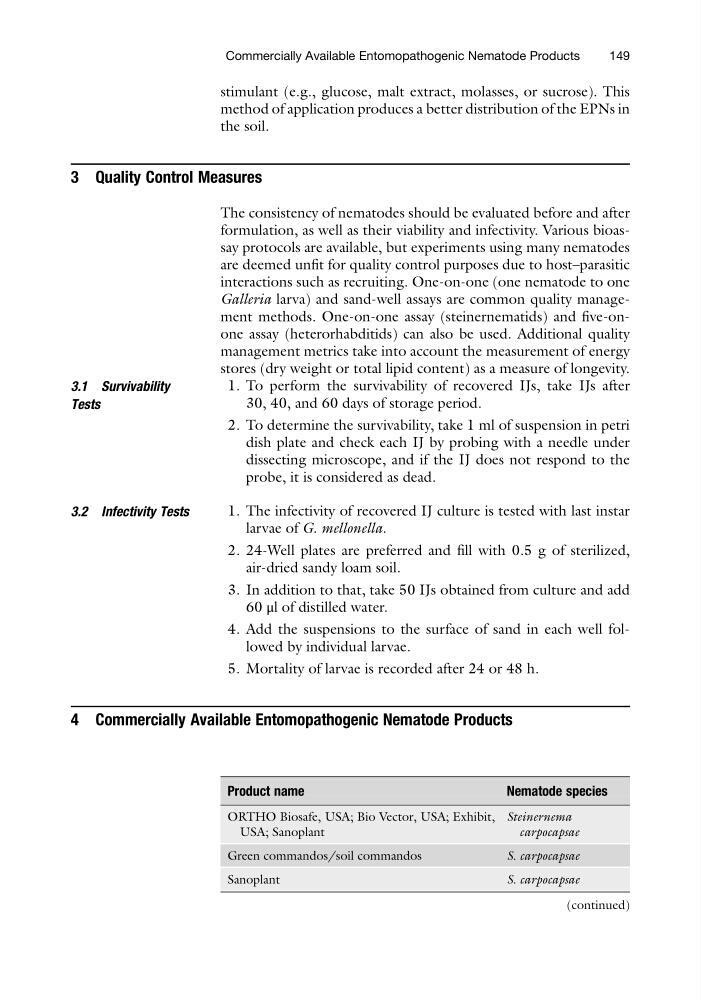
4 Commercially Available Entomopathogenic Nematode Products
Product name
Nematode species
ORTHO Biosafe, USA; Bio Vector, USA; Exhibit,
USA; Sanoplant
Steinernema
carpocapsae
Green commandos/soil commandos
S. carpocapsae
Sanoplant
S. carpocapsae
(continued)
Commercially Available Entomopathogenic Nematode Products
149
method of application produces a better distribution of the EPNs in
the soil.
3 Quality Control Measures
The consistency of nematodes should be evaluated before and after
formulation, as well as their viability and infectivity. Various bioassay protocols are available, but experiments using many nematodes
are deemed unfit for quality control purposes due to host–parasitic
interactions such as recruiting. One-on-one (one nematode to one
Galleria larva) and sand-well assays are common quality management methods. One-on-one assay (steinernematids) and five-onone assay (heterorhabditids) can also be used. Additional quality
management metrics take into account the measurement of energy
stores (dry weight or total lipid content) as a measure of longevity.
3.1 Survivability
Tests
1. To perform the survivability of recovered IJs, take IJs after
30, 40, and 60 days of storage period.
2. To determine the survivability, take 1 ml of suspension in petri
dish plate and check each IJ by probing with a needle under
dissecting microscope, and if the IJ does not respond to the
probe, it is considered as dead.
3.2 Infectivity Tests
1. The infectivity of recovered IJ culture is tested with last instar
larvae of G. mellonella.
2. 24-Well plates are preferred and fill with 0.5 g of sterilized,
air-dried sandy loam soil.
3. In addition to that, take 50 IJs obtained from culture and add
60 μl of distilled water.
4. Add the suspensions to the surface of sand in each well followed by individual larvae.
5. Mortality of larvae is recorded after 24 or 48 h.
4 Commercially Available Entomopathogenic Nematode Products
Product name
Nematode species
ORTHO Biosafe, USA; Bio Vector, USA; Exhibit,
USA; Sanoplant
Steinernema
carpocapsae
Green commandos/soil commandos
S. carpocapsae
Sanoplant
S. carpocapsae
(continued)
Commercially Available Entomopathogenic Nematode Products
149