

l
Apparatus: Incubator, dissecting microscope, eelworm counting
slide, sterile forceps, needles, loop.
Isolation of Bacteria
Through Insect Hemolymph
G. mellonella
Procedure
1. Before the initiation of isolation process, check whether IJ
suspensions of the nematodes are alive or dead under dissecting
microscope.
2. Dilute the IJ suspension in a suitable amount of sterile distilled
water (sdw).
3. Count on eelworm counting slide under dissecting
microscope.
Note: 100 IJs/ml are adequate.
4. Distribute IJ suspension consistently on a sterile Whatman
No.1 filter paper flattened on petri dishes using micropipette
containing G. mellonella.
5. Remove dead larvae after 6 or 24 h.
6. Surface sterilize with 10% sodium hypochlorite for 10 min.
7. Rinse three times with sterile distilled water.
8. Dissect dorsally at the midpoint of the fifth and sixth interstitial
segments.
9. Collect hemolymph using a sterile loop.
10. Streak on NBTA/TSA/MacConkey/NA plates.
11. Set aside the plate for incubation for 24–48 h at 28
C.
12. Check the results after 2–5 days of inoculation.
Isolation of Bacteria
Through Insect Hemolymph
S. litura
Procedure
1. Add 400 IJs on the fifth instar larvae of S. litura.
2. Incubate at 25
C for 36 h.
3. Surface-sterilize the infected hosts with 70% ethanol.
4. Cut off the first abdominal prolegs by a pair of sterile scissors.
5. Collect the exuded hemolymph.
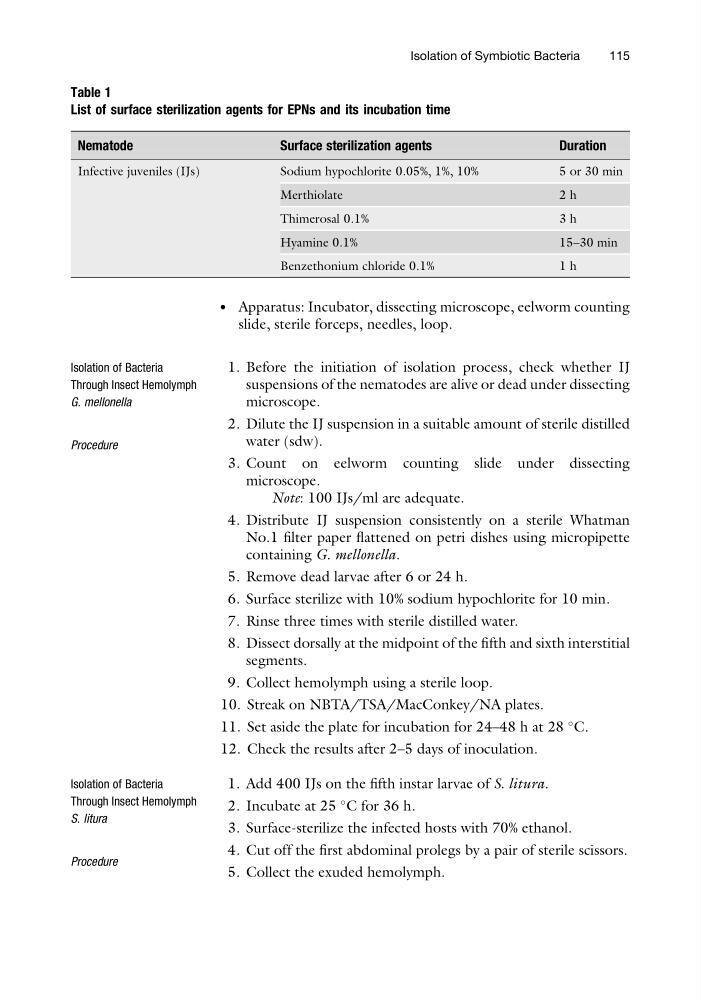
Table 1
List of surface sterilization agents for EPNs and its incubation time
Nematode
Surface sterilization agents
Duration
Infective juveniles (IJs)
Sodium hypochlorite 0.05%, 1%, 10%
5 or 30 min
Merthiolate
2 h
Thimerosal 0.1%
3 h
Hyamine 0.1%
15–30 min
Benzethonium chloride 0.1%
1 h
Isolation of Symbiotic Bacteria
115
Apparatus: Incubator, dissecting microscope, eelworm counting
slide, sterile forceps, needles, loop.
Isolation of Bacteria
Through Insect Hemolymph
G. mellonella
Procedure
1. Before the initiation of isolation process, check whether IJ
suspensions of the nematodes are alive or dead under dissecting
microscope.
2. Dilute the IJ suspension in a suitable amount of sterile distilled
water (sdw).
3. Count on eelworm counting slide under dissecting
microscope.
Note: 100 IJs/ml are adequate.
4. Distribute IJ suspension consistently on a sterile Whatman
No.1 filter paper flattened on petri dishes using micropipette
containing G. mellonella.
5. Remove dead larvae after 6 or 24 h.
6. Surface sterilize with 10% sodium hypochlorite for 10 min.
7. Rinse three times with sterile distilled water.
8. Dissect dorsally at the midpoint of the fifth and sixth interstitial
segments.
9. Collect hemolymph using a sterile loop.
10. Streak on NBTA/TSA/MacConkey/NA plates.
11. Set aside the plate for incubation for 24–48 h at 28
C.
12. Check the results after 2–5 days of inoculation.
Isolation of Bacteria
Through Insect Hemolymph
S. litura
Procedure
1. Add 400 IJs on the fifth instar larvae of S. litura.
2. Incubate at 25
C for 36 h.
3. Surface-sterilize the infected hosts with 70% ethanol.
4. Cut off the first abdominal prolegs by a pair of sterile scissors.
5. Collect the exuded hemolymph.
Table 1
List of surface sterilization agents for EPNs and its incubation time
Nematode
Surface sterilization agents
Duration
Infective juveniles (IJs)
Sodium hypochlorite 0.05%, 1%, 10%
5 or 30 min
Merthiolate
2 h
Thimerosal 0.1%
3 h
Hyamine 0.1%
15–30 min
Benzethonium chloride 0.1%
1 h
Isolation of Symbiotic Bacteria
115