

2. The special sealant is required to plaster the gasholder and to prevent damage to
the structure.
3. The fluctuated gas pressure complicates the gas utilization.
4. The construction should be with excellent structural strength (Sharma and
Giuseppe 1991).
5. Repair and maintenance of such underground plant is bit difficult.
3.7.1.5 Balloon Plants
The balloon digester was developed in Taiwan at 1960, which is mainly discovered
to solve the difficulties created with concrete and metal digesters (Karki 2005). The
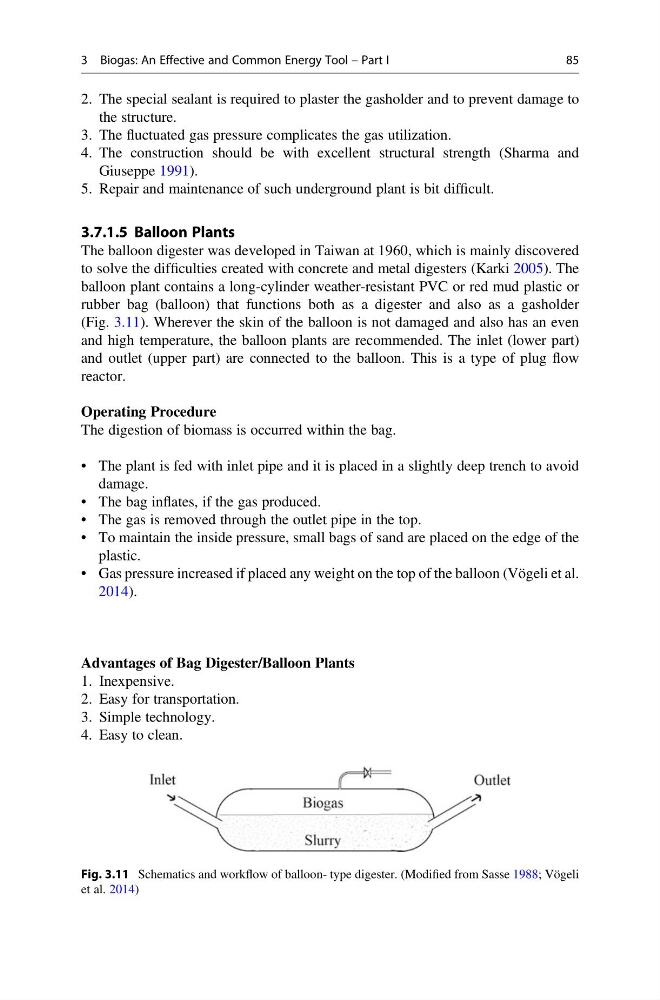
balloon plant contains a long-cylinder weather-resistant PVC or red mud plastic or
rubber bag (balloon) that functions both as a digester and also as a gasholder
(Fig. 3.11). Wherever the skin of the balloon is not damaged and also has an even
and high temperature, the balloon plants are recommended. The inlet (lower part)
and outlet (upper part) are connected to the balloon. This is a type of plug flow
reactor.
Operating Procedure
The digestion of biomass is occurred within the bag.
• The plant is fed with inlet pipe and it is placed in a slightly deep trench to avoid
damage.
• The bag inflates, if the gas produced.
• The gas is removed through the outlet pipe in the top.
• To maintain the inside pressure, small bags of sand are placed on the edge of the
plastic.
• Gas pressure increased if placed any weight on the top of the balloon (Vögeli et al.
2014).
Advantages of Bag Digester/Balloon Plants
1. Inexpensive.
2. Easy for transportation.
3. Simple technology.
4. Easy to clean.
Fig. 3.11 Schematics and workflow of balloon- type digester. (Modified from Sasse 1988; Vögeli
et al. 2014)
3 Biogas: An Effective and Common Energy Tool – Part I
85
the structure.
3. The fluctuated gas pressure complicates the gas utilization.
4. The construction should be with excellent structural strength (Sharma and
Giuseppe 1991).
5. Repair and maintenance of such underground plant is bit difficult.
3.7.1.5 Balloon Plants
The balloon digester was developed in Taiwan at 1960, which is mainly discovered
to solve the difficulties created with concrete and metal digesters (Karki 2005). The
balloon plant contains a long-cylinder weather-resistant PVC or red mud plastic or
rubber bag (balloon) that functions both as a digester and also as a gasholder
(Fig. 3.11). Wherever the skin of the balloon is not damaged and also has an even
and high temperature, the balloon plants are recommended. The inlet (lower part)
and outlet (upper part) are connected to the balloon. This is a type of plug flow
reactor.
Operating Procedure
The digestion of biomass is occurred within the bag.
• The plant is fed with inlet pipe and it is placed in a slightly deep trench to avoid
damage.
• The bag inflates, if the gas produced.
• The gas is removed through the outlet pipe in the top.
• To maintain the inside pressure, small bags of sand are placed on the edge of the
plastic.
• Gas pressure increased if placed any weight on the top of the balloon (Vögeli et al.
2014).
Advantages of Bag Digester/Balloon Plants
1. Inexpensive.
2. Easy for transportation.
3. Simple technology.
4. Easy to clean.
Fig. 3.11 Schematics and workflow of balloon- type digester. (Modified from Sasse 1988; Vögeli
et al. 2014)
3 Biogas: An Effective and Common Energy Tool – Part I
85