

3.5.1 Agro-Based Feedstock
Animal compost, energy crops, aquatic plants and farming residues are some of the
examples of agro-based feedstocks. Due to the consistency of those substrates and
the absence of H(OSiH 2 ) n OH, (OSiH 2 ) n , thus produced biogas using such substrates
would be a bit easier to treat than that produced using other type of wastes.
Animal Compost Animal compost or manure is increasingly being used in anaerobic digestion for biogas production, which is one of the principal organic wastebased feedstock. Its digestion leads to increase in available nitrogen to plants and in
the soil and can also be used as an efficient soil conditioner. The reported amount of
gas produced by different type of animal manure-based sources is ~0.29–46 ft
3 /day.
In the United States, ~80% of the available energy is used in the form of power, and
the rest is utilized used for heating purposes. Iran produces~573,600–6,059,600 m
3 /
y biogas from different manure-based sources.
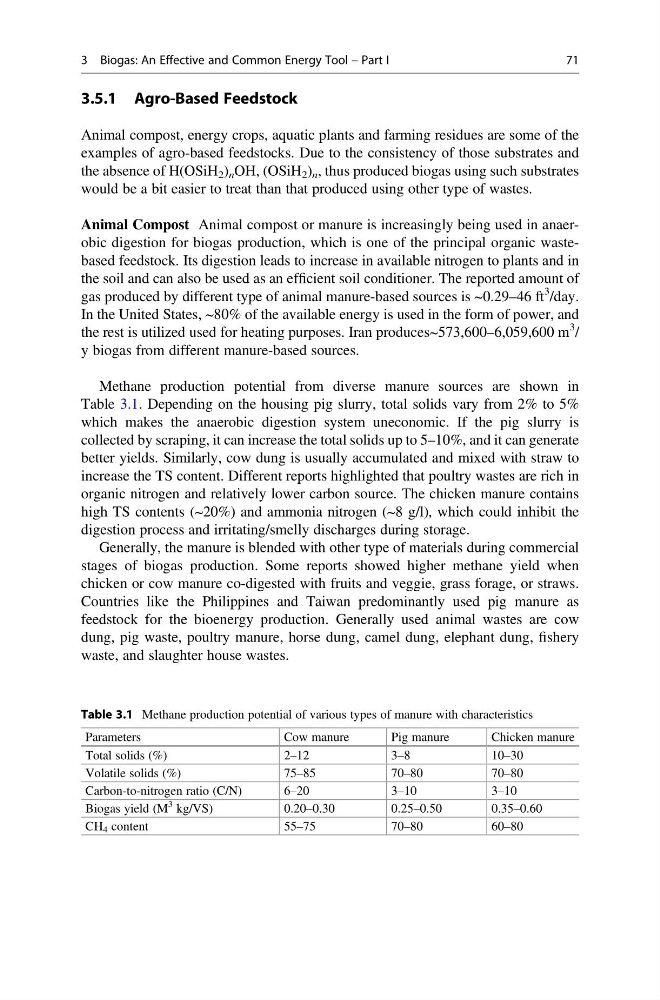
Methane production potential from diverse manure sources are shown in
Table 3.1. Depending on the housing pig slurry, total solids vary from 2% to 5%
which makes the anaerobic digestion system uneconomic. If the pig slurry is
collected by scraping, it can increase the total solids up to 5–10%, and it can generate
better yields. Similarly, cow dung is usually accumulated and mixed with straw to
increase the TS content. Different reports highlighted that poultry wastes are rich in
organic nitrogen and relatively lower carbon source. The chicken manure contains
high TS contents (~20%) and ammonia nitrogen (~8 g/l), which could inhibit the
digestion process and irritating/smelly discharges during storage.
Generally, the manure is blended with other type of materials during commercial
stages of biogas production. Some reports showed higher methane yield when
chicken or cow manure co-digested with fruits and veggie, grass forage, or straws.
Countries like the Philippines and Taiwan predominantly used pig manure as
feedstock for the bioenergy production. Generally used animal wastes are cow
dung, pig waste, poultry manure, horse dung, camel dung, elephant dung, fishery
waste, and slaughter house wastes.
Table 3.1 Methane production potential of various types of manure with characteristics
Parameters
Cow manure
Pig manure
Chicken manure
Total solids (%)
2–12
3–8
1 0 –30
Volatile solids (%)
75–85
70–80
70–80
Carbon-to-nitrogen ratio (C/N)
6–20
3–10
3–10
Biogas yield (M
3 kg/VS)
0.20–0.30
0.25–0.50
0.35–0.60
CH 4 content
55–75
70–80
60–80
3 Biogas: An Effective and Common Energy Tool – Part I
71
Animal compost, energy crops, aquatic plants and farming residues are some of the
examples of agro-based feedstocks. Due to the consistency of those substrates and
the absence of H(OSiH 2 ) n OH, (OSiH 2 ) n , thus produced biogas using such substrates
would be a bit easier to treat than that produced using other type of wastes.
Animal Compost Animal compost or manure is increasingly being used in anaerobic digestion for biogas production, which is one of the principal organic wastebased feedstock. Its digestion leads to increase in available nitrogen to plants and in
the soil and can also be used as an efficient soil conditioner. The reported amount of
gas produced by different type of animal manure-based sources is ~0.29–46 ft
3 /day.
In the United States, ~80% of the available energy is used in the form of power, and
the rest is utilized used for heating purposes. Iran produces~573,600–6,059,600 m
3 /
y biogas from different manure-based sources.
Methane production potential from diverse manure sources are shown in
Table 3.1. Depending on the housing pig slurry, total solids vary from 2% to 5%
which makes the anaerobic digestion system uneconomic. If the pig slurry is
collected by scraping, it can increase the total solids up to 5–10%, and it can generate
better yields. Similarly, cow dung is usually accumulated and mixed with straw to
increase the TS content. Different reports highlighted that poultry wastes are rich in
organic nitrogen and relatively lower carbon source. The chicken manure contains
high TS contents (~20%) and ammonia nitrogen (~8 g/l), which could inhibit the
digestion process and irritating/smelly discharges during storage.
Generally, the manure is blended with other type of materials during commercial
stages of biogas production. Some reports showed higher methane yield when
chicken or cow manure co-digested with fruits and veggie, grass forage, or straws.
Countries like the Philippines and Taiwan predominantly used pig manure as
feedstock for the bioenergy production. Generally used animal wastes are cow
dung, pig waste, poultry manure, horse dung, camel dung, elephant dung, fishery
waste, and slaughter house wastes.
Table 3.1 Methane production potential of various types of manure with characteristics
Parameters
Cow manure
Pig manure
Chicken manure
Total solids (%)
2–12
3–8
1 0 –30
Volatile solids (%)
75–85
70–80
70–80
Carbon-to-nitrogen ratio (C/N)
6–20
3–10
3–10
Biogas yield (M
3 kg/VS)
0.20–0.30
0.25–0.50
0.35–0.60
CH 4 content
55–75
70–80
60–80
3 Biogas: An Effective and Common Energy Tool – Part I
71