

employed to produce biofuels. Besides converting biomass into biofuels, their
components are individually useful for the assembly of high-value-added products.
Recalcitrance caused by the material properties slows progress toward a better
and refined conversion. Genetically engineering crops is not a new process, which
means that investing and studying ways to genetically improve the biomasses
regarding their resistance to pretreatments and conversion is already a reality.
These pretreatments are also constantly being updated to offer different ways of
altering the biomass. Biomass conversion is a modern necessity and will be increasingly vital.
Acknowledgment Authors are thankful for the support of the Brazilian Council for Research and
Development (CNPq, process 401900/2016-9) and São Paulo Research Foundation (FAPESP,
process 2017/11345-0).
References
Aguiar MM, Ferreira LFR, Monteiro RTR (2010) Use of vinasse and sugarcane bagasse for the
production of enzymes by lignocellulolytic fungi. Braz Arch Biol Technol 53(5):1245–1254
Alonso DM, Bond JQ, Dumesic JA (2010) Catalytic conversion of biomass to biofuels. Green
Chem 12(9):1493–1513
Allwright MR, Taylor G (2016) Molecular breeding for improved second generation bioenergy
crops. Trends Plant Sci 21(1):43–54
Arantes V, Saddler JN (2010) Access to cellulose limits the efficiency of enzymatic hydrolysis: the
role of amorphogenesis. Biotechnol Biofuels 3(1):4
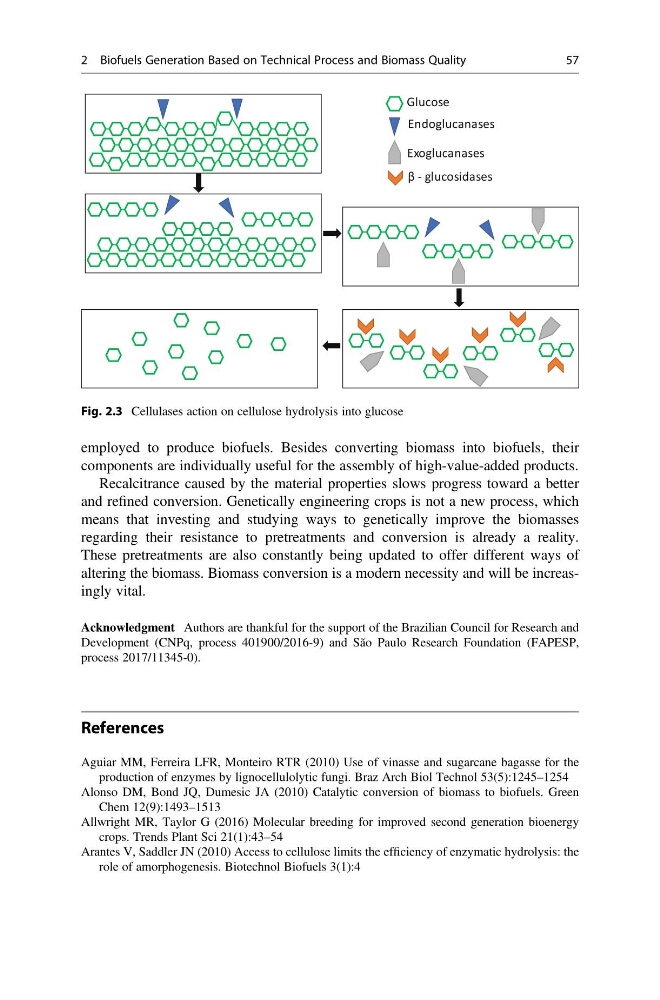
Glucose
Endoglucanases
Exoglucanases
β - glucosidases
Fig. 2.3 Cellulases action on cellulose hydrolysis into glucose
2 Biofuels Generation Based on Technical Process and Biomass Quality
57
components are individually useful for the assembly of high-value-added products.
Recalcitrance caused by the material properties slows progress toward a better
and refined conversion. Genetically engineering crops is not a new process, which
means that investing and studying ways to genetically improve the biomasses
regarding their resistance to pretreatments and conversion is already a reality.
These pretreatments are also constantly being updated to offer different ways of
altering the biomass. Biomass conversion is a modern necessity and will be increasingly vital.
Acknowledgment Authors are thankful for the support of the Brazilian Council for Research and
Development (CNPq, process 401900/2016-9) and São Paulo Research Foundation (FAPESP,
process 2017/11345-0).
References
Aguiar MM, Ferreira LFR, Monteiro RTR (2010) Use of vinasse and sugarcane bagasse for the
production of enzymes by lignocellulolytic fungi. Braz Arch Biol Technol 53(5):1245–1254
Alonso DM, Bond JQ, Dumesic JA (2010) Catalytic conversion of biomass to biofuels. Green
Chem 12(9):1493–1513
Allwright MR, Taylor G (2016) Molecular breeding for improved second generation bioenergy
crops. Trends Plant Sci 21(1):43–54
Arantes V, Saddler JN (2010) Access to cellulose limits the efficiency of enzymatic hydrolysis: the
role of amorphogenesis. Biotechnol Biofuels 3(1):4
Glucose
Endoglucanases
Exoglucanases
β - glucosidases
Fig. 2.3 Cellulases action on cellulose hydrolysis into glucose
2 Biofuels Generation Based on Technical Process and Biomass Quality
57