

2.11 Lignocellulosic Biomass Pretreatments
Without pretreatment, it is considered that just 20% of lignocellulosic biomass in
natura could be hydrolyzed, and this low percentage is because the chemical
structure is recalcitrant, which justifies the importance to carry out a pretreatment
stage on lignocellulosic material before subsequent processes (Rocha et al. 2012).
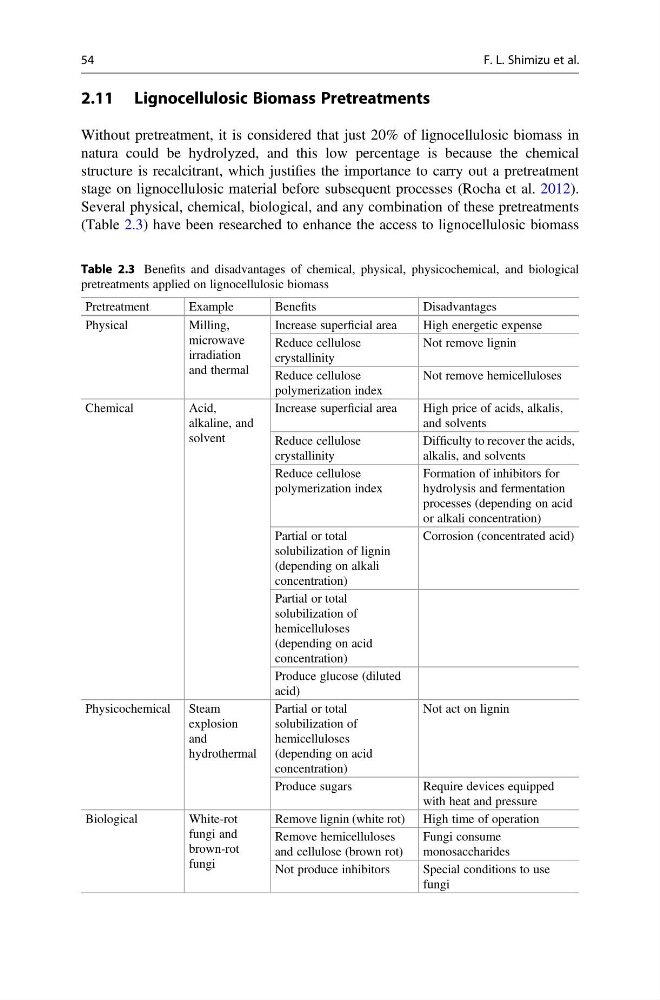
Several physical, chemical, biological, and any combination of these pretreatments
(Table 2.3) have been researched to enhance the access to lignocellulosic biomass
Table 2.3 Benefits and disadvantages of chemical, physical, physicochemical, and biological
pretreatments applied on lignocellulosic biomass
Pretreatment
Example
Benefits
Disadvantages
Physical
Milling,
microwave
irradiation
and thermal
Increase superficial area
High energetic expense
Reduce cellulose
crystallinity
Not remove lignin
Reduce cellulose
polymerization index
Not remove hemicelluloses
Chemical
Acid,
alkaline, and
solvent
Increase superficial area
High price of acids, alkalis,
and solvents
Reduce cellulose
crystallinity
Difficulty to recover the acids,
alkalis, and solvents
Reduce cellulose
polymerization index
Formation of inhibitors for
hydrolysis and fermentation
processes (depending on acid
or alkali concentration)
Partial or total
solubilization of lignin
(depending on alkali
concentration)
Corrosion (concentrated acid)
Partial or total
solubilization of
hemicelluloses
(depending on acid
concentration)
Produce glucose (diluted
acid)
Physicochemical Steam
explosion
and
hydrothermal
Partial or total
solubilization of
hemicelluloses
(depending on acid
concentration)
Not act on lignin
Produce sugars
Require devices equipped
with heat and pressure
Biological
White-rot
fungi and
brown-rot
fungi
Remove lignin (white rot) High time of operation
Remove hemicelluloses
and cellulose (brown rot)
Fungi consume
monosaccharides
Not produce inhibitors
Special conditions to use
fungi
54
F. L. Shimizu et al.
Without pretreatment, it is considered that just 20% of lignocellulosic biomass in
natura could be hydrolyzed, and this low percentage is because the chemical
structure is recalcitrant, which justifies the importance to carry out a pretreatment
stage on lignocellulosic material before subsequent processes (Rocha et al. 2012).
Several physical, chemical, biological, and any combination of these pretreatments
(Table 2.3) have been researched to enhance the access to lignocellulosic biomass
Table 2.3 Benefits and disadvantages of chemical, physical, physicochemical, and biological
pretreatments applied on lignocellulosic biomass
Pretreatment
Example
Benefits
Disadvantages
Physical
Milling,
microwave
irradiation
and thermal
Increase superficial area
High energetic expense
Reduce cellulose
crystallinity
Not remove lignin
Reduce cellulose
polymerization index
Not remove hemicelluloses
Chemical
Acid,
alkaline, and
solvent
Increase superficial area
High price of acids, alkalis,
and solvents
Reduce cellulose
crystallinity
Difficulty to recover the acids,
alkalis, and solvents
Reduce cellulose
polymerization index
Formation of inhibitors for
hydrolysis and fermentation
processes (depending on acid
or alkali concentration)
Partial or total
solubilization of lignin
(depending on alkali
concentration)
Corrosion (concentrated acid)
Partial or total
solubilization of
hemicelluloses
(depending on acid
concentration)
Produce glucose (diluted
acid)
Physicochemical Steam
explosion
and
hydrothermal
Partial or total
solubilization of
hemicelluloses
(depending on acid
concentration)
Not act on lignin
Produce sugars
Require devices equipped
with heat and pressure
Biological
White-rot
fungi and
brown-rot
fungi
Remove lignin (white rot) High time of operation
Remove hemicelluloses
and cellulose (brown rot)
Fungi consume
monosaccharides
Not produce inhibitors
Special conditions to use
fungi
54
F. L. Shimizu et al.