

During hydrotreatment, there are some variables that influence the process and
the final composition of the product, including:
– Reaction conditions
– Type of catalyst used
– Selected feedstock
Dealing with reaction temperature, DCO and DCOX are more dominant over
higher temperatures and moderate acidic catalyst than HDO reaction.
Two types of catalyst can be used for the hydrotreatment:
– Conventional bimetallic sulfide catalysts, such as NiMoS 2 , CoMoS 2 , and NiWS 2
supported on Al 2 O 3
– Monometallic catalysts, in particular Ni, Pd, Pt, and Rh (Morgan et al. 2012;
Rogers and Zheng 2016)
Nickel- and palladium-based catalysts are the most commonly used catalysts.
Metal catalysts supported on activated carbon have been also tested for upgrading
vegetable oils into hydrocarbon jet biofuels (Silva et al. 2016). Zeolite catalysts have
been also studied for the hydrotreatment of vegetable oils (Zhao et al. 2015).
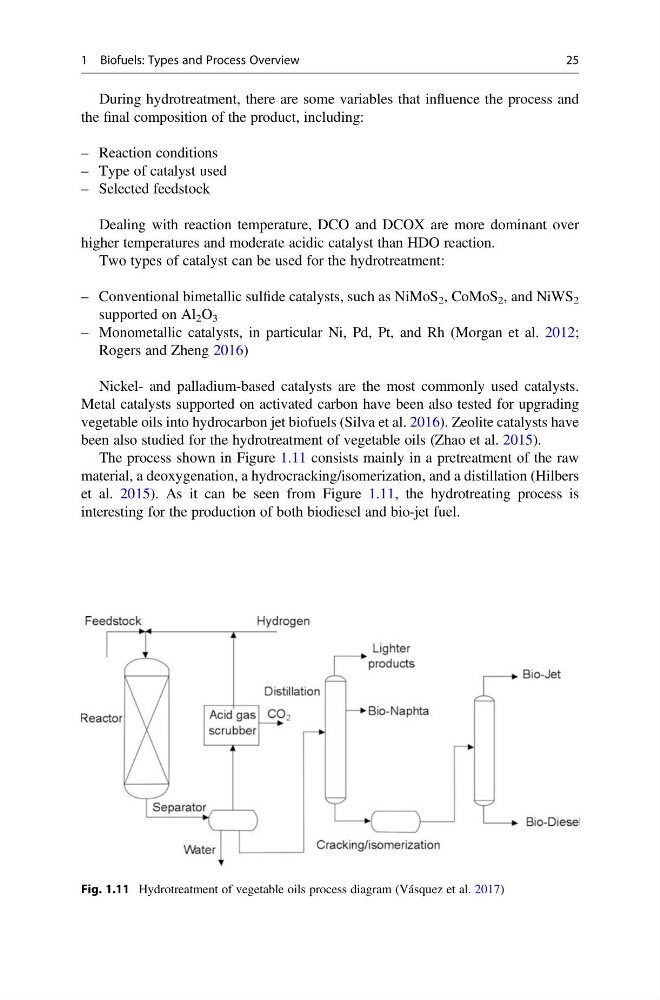
The process shown in Figure 1.11 consists mainly in a pretreatment of the raw
material, a deoxygenation, a hydrocracking/isomerization, and a distillation (Hilbers
et al. 2015). As it can be seen from Figure 1.11, the hydrotreating process is
interesting for the production of both biodiesel and bio-jet fuel.
Fig. 1.11 Hydrotreatment of vegetable oils process diagram (Vásquez et al. 2017)
1 Biofuels: Types and Process Overview
25
the final composition of the product, including:
– Reaction conditions
– Type of catalyst used
– Selected feedstock
Dealing with reaction temperature, DCO and DCOX are more dominant over
higher temperatures and moderate acidic catalyst than HDO reaction.
Two types of catalyst can be used for the hydrotreatment:
– Conventional bimetallic sulfide catalysts, such as NiMoS 2 , CoMoS 2 , and NiWS 2
supported on Al 2 O 3
– Monometallic catalysts, in particular Ni, Pd, Pt, and Rh (Morgan et al. 2012;
Rogers and Zheng 2016)
Nickel- and palladium-based catalysts are the most commonly used catalysts.
Metal catalysts supported on activated carbon have been also tested for upgrading
vegetable oils into hydrocarbon jet biofuels (Silva et al. 2016). Zeolite catalysts have
been also studied for the hydrotreatment of vegetable oils (Zhao et al. 2015).
The process shown in Figure 1.11 consists mainly in a pretreatment of the raw
material, a deoxygenation, a hydrocracking/isomerization, and a distillation (Hilbers
et al. 2015). As it can be seen from Figure 1.11, the hydrotreating process is
interesting for the production of both biodiesel and bio-jet fuel.
Fig. 1.11 Hydrotreatment of vegetable oils process diagram (Vásquez et al. 2017)
1 Biofuels: Types and Process Overview
25