

10,000 h of operation (Topp-Jorgensen 1988). The bioliq Process developed by
Karlsruhe Institute of Technology (KIT), with a capacity of 1 t/day, is a similar
process. It is in operation since 2014 and incorporates the following processing
steps: decentralized fast pyrolysis to produce a pyrolysis bio-oil/char slurry, highpressure entrained flow gasification of the pyrolysis slurry, hot gas cleaning, DME
synthesis, and gasoline synthesis (Dimitriou et al. 2018).
The DME synthesis reactor operates at 250
C (Larson et al. 2009). The gasoline
synthesis reactor is quite similar to that of the MGT process. Then the gasoline
product is separated from gas and water in a vapor-liquid separator.
1.6
Hydrotreated Vegetable Oils (HVO)
Saturating the double bonds present in a molecule through catalytic addition of
hydrogen at certain temperature and pressure is known as “hydrogenation” (Hughes
1953). In the process known as “hydrotreatment” hydrogen, alongside a catalyst, is
added after hydrogenation. After saturation is achieved, more hydrogen addition
causes the breaking of the glycerol compound, forming propane and a chain of FFA.
The carboxylic acid group of the FFA must be removed to form straight-chain
alkanes. This can be performed through three ways:
– The hydrodeoxygenation (HDO) route, in which it reacts with hydrogen to
produce a hydrocarbon with the same number of carbon atoms as the fatty acid
chain and two moles of water
– The decarboxylation (DCOX) pathway, which yields a hydrocarbon with one
carbon atom less than the fatty acid chain and a mole of CO 2
– The decarbonylation (DCO) route, which also produces a hydrocarbon with one
carbon atom less, as well as a mole of CO and water
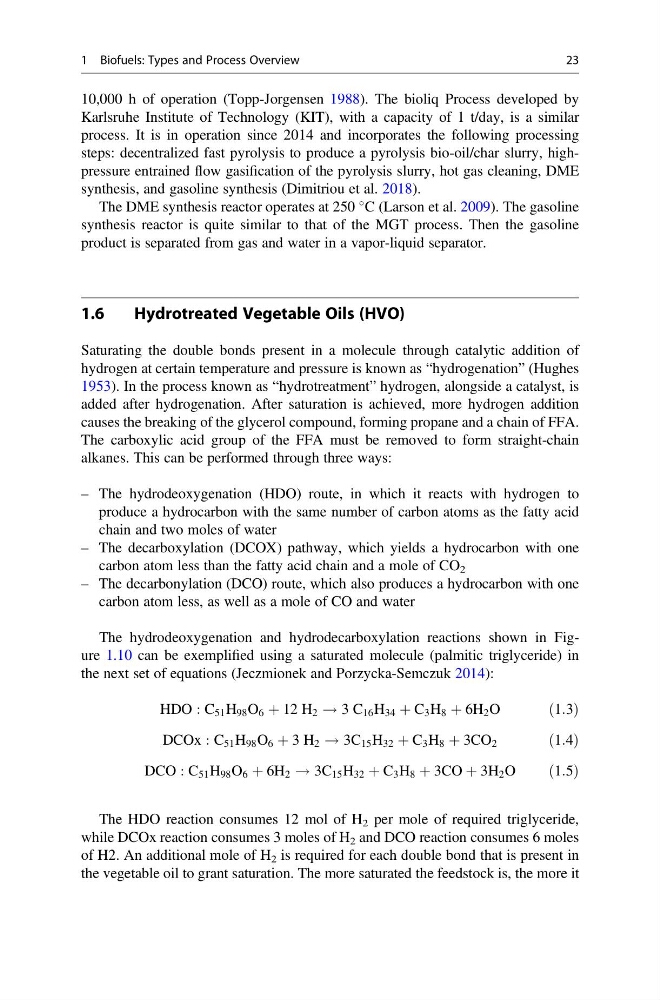
The hydrodeoxygenation and hydrodecarboxylation reactions shown in Figure 1.10 can be exemplified using a saturated molecule (palmitic triglyceride) in
the next set of equations (Jeczmionek and Porzycka-Semczuk 2014):
HDO : C 51 H 98 O 6 þ 12 H 2 ! 3 C 16 H 34 þ C 3 H 8 þ 6H 2 O
ð1:3Þ
DCOx : C 51 H 98 O 6 þ 3 H 2 ! 3C 15 H 32 þ C 3 H 8 þ 3CO 2
ð1:4Þ
DCO : C 51 H 98 O 6 þ 6H 2 ! 3C 15 H 32 þ C 3 H 8 þ 3CO þ 3H 2 O
ð1:5Þ
The HDO reaction consumes 12 mol of H 2 per mole of required triglyceride,
while DCOx reaction consumes 3 moles of H 2 and DCO reaction consumes 6 moles
of H2. An additional mole of H 2 is required for each double bond that is present in
the vegetable oil to grant saturation. The more saturated the feedstock is, the more it
1 Biofuels: Types and Process Overview
23
Karlsruhe Institute of Technology (KIT), with a capacity of 1 t/day, is a similar
process. It is in operation since 2014 and incorporates the following processing
steps: decentralized fast pyrolysis to produce a pyrolysis bio-oil/char slurry, highpressure entrained flow gasification of the pyrolysis slurry, hot gas cleaning, DME
synthesis, and gasoline synthesis (Dimitriou et al. 2018).
The DME synthesis reactor operates at 250
C (Larson et al. 2009). The gasoline
synthesis reactor is quite similar to that of the MGT process. Then the gasoline
product is separated from gas and water in a vapor-liquid separator.
1.6
Hydrotreated Vegetable Oils (HVO)
Saturating the double bonds present in a molecule through catalytic addition of
hydrogen at certain temperature and pressure is known as “hydrogenation” (Hughes
1953). In the process known as “hydrotreatment” hydrogen, alongside a catalyst, is
added after hydrogenation. After saturation is achieved, more hydrogen addition
causes the breaking of the glycerol compound, forming propane and a chain of FFA.
The carboxylic acid group of the FFA must be removed to form straight-chain
alkanes. This can be performed through three ways:
– The hydrodeoxygenation (HDO) route, in which it reacts with hydrogen to
produce a hydrocarbon with the same number of carbon atoms as the fatty acid
chain and two moles of water
– The decarboxylation (DCOX) pathway, which yields a hydrocarbon with one
carbon atom less than the fatty acid chain and a mole of CO 2
– The decarbonylation (DCO) route, which also produces a hydrocarbon with one
carbon atom less, as well as a mole of CO and water
The hydrodeoxygenation and hydrodecarboxylation reactions shown in Figure 1.10 can be exemplified using a saturated molecule (palmitic triglyceride) in
the next set of equations (Jeczmionek and Porzycka-Semczuk 2014):
HDO : C 51 H 98 O 6 þ 12 H 2 ! 3 C 16 H 34 þ C 3 H 8 þ 6H 2 O
ð1:3Þ
DCOx : C 51 H 98 O 6 þ 3 H 2 ! 3C 15 H 32 þ C 3 H 8 þ 3CO 2
ð1:4Þ
DCO : C 51 H 98 O 6 þ 6H 2 ! 3C 15 H 32 þ C 3 H 8 þ 3CO þ 3H 2 O
ð1:5Þ
The HDO reaction consumes 12 mol of H 2 per mole of required triglyceride,
while DCOx reaction consumes 3 moles of H 2 and DCO reaction consumes 6 moles
of H2. An additional mole of H 2 is required for each double bond that is present in
the vegetable oil to grant saturation. The more saturated the feedstock is, the more it
1 Biofuels: Types and Process Overview
23