

1.5.3 Biomass Gasification
The two gasification technologies best suited for large-scale BTL plants are the
circulating fluidized bed (CFB) and the entrained flow (EF) gasification (Swanson
et al. 2010; Bridgwater and Maniatis 2014; The Royal Society 2008; Boerrigter
2006; The German Energy Agency 2006). For circulating fluidized bed gasifiers,
operating temperature varies between 700 and 1100
C. EF gasifiers can operate at
much higher gasification temperatures (about 1200À1400
C); this results in higher
carbon conversion, very low tar and methane content, and thus lower gas cleaning
requirements (Van der Drift et al. 2004; Swanson et al. 2010; Boerrigter 2006). EF
gasification has the advantage that extensive experience is available from coal
entrained flow gasification plants (e.g., 2000 t/d coal-fired Shell gasifier in
Buggenum, Netherlands) (Hofbauer et al. 2009; Dimitriou et al. 2018). For both
reactors best operating conditions are oxygen-blown and pressurized (using CO2)
(Dimitriou et al. 2018). For example, oxygen at 95% purity and steam can fed into
the gasifiers operating at a pressure of 28 bar and temperatures of 870
C for the CFB
and 1400
C for the EF gasifier, respectively (Swanson et al. 2010; Dimitriou et al.
2018).
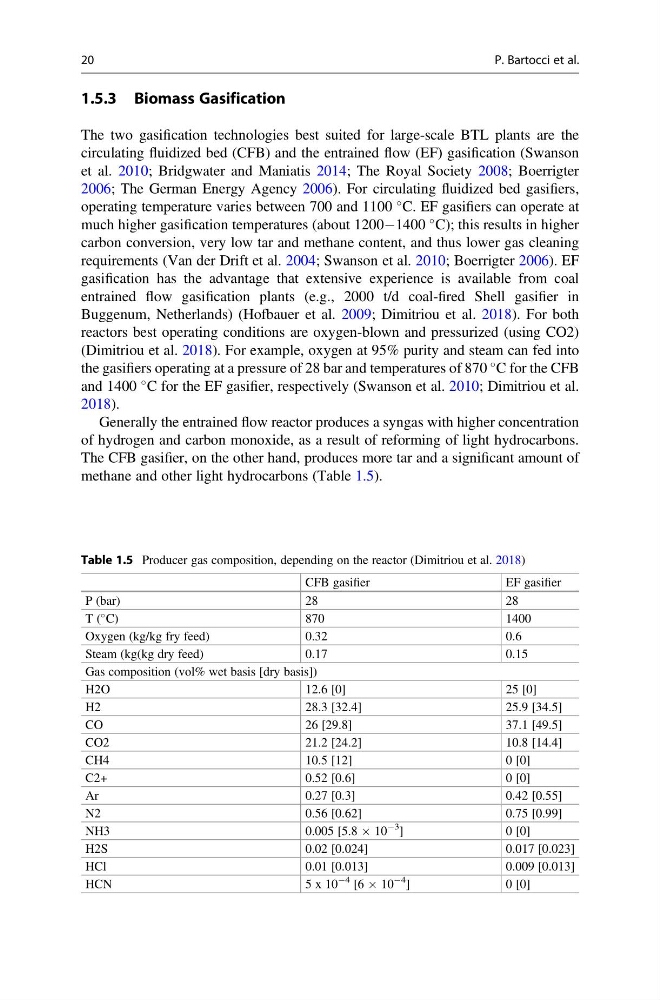
Generally the entrained flow reactor produces a syngas with higher concentration
of hydrogen and carbon monoxide, as a result of reforming of light hydrocarbons.
The CFB gasifier, on the other hand, produces more tar and a significant amount of
methane and other light hydrocarbons (Table 1.5).
Table 1.5 Producer gas composition, depending on the reactor (Dimitriou et al. 2018)
CFB gasifier
EF gasifier
P (bar)
28
28
T (
C)
870
1400
Oxygen (kg/kg fry feed)
0.32
0.6
Steam (kg(kg dry feed)
0.17
0.15
Gas composition (vol% wet basis [dry basis])
H2O
12.6 [0]
25 [0]
H2
28.3 [32.4]
25.9 [34.5]
CO
26 [29.8]
37.1 [49.5]
CO2
21.2 [24.2]
10.8 [14.4]
CH4
10.5 [12]
0 [0]
C2+
0.52 [0.6]
0 [0]
Ar
0.27 [0.3]
0.42 [0.55]
N2
0.56 [0.62]
0.75 [0.99]
NH3
0.005 [5.8 Â 10
À3
]
0 [0]
H2S
0.02 [0.024]
0.017 [0.023]
HCl
0.01 [0.013]
0.009 [0.013]
HCN
5 x 10
À4 [6 Â 10
À4
]
0 [0]
20
P. Bartocci et al.
The two gasification technologies best suited for large-scale BTL plants are the
circulating fluidized bed (CFB) and the entrained flow (EF) gasification (Swanson
et al. 2010; Bridgwater and Maniatis 2014; The Royal Society 2008; Boerrigter
2006; The German Energy Agency 2006). For circulating fluidized bed gasifiers,
operating temperature varies between 700 and 1100
C. EF gasifiers can operate at
much higher gasification temperatures (about 1200À1400
C); this results in higher
carbon conversion, very low tar and methane content, and thus lower gas cleaning
requirements (Van der Drift et al. 2004; Swanson et al. 2010; Boerrigter 2006). EF
gasification has the advantage that extensive experience is available from coal
entrained flow gasification plants (e.g., 2000 t/d coal-fired Shell gasifier in
Buggenum, Netherlands) (Hofbauer et al. 2009; Dimitriou et al. 2018). For both
reactors best operating conditions are oxygen-blown and pressurized (using CO2)
(Dimitriou et al. 2018). For example, oxygen at 95% purity and steam can fed into
the gasifiers operating at a pressure of 28 bar and temperatures of 870
C for the CFB
and 1400
C for the EF gasifier, respectively (Swanson et al. 2010; Dimitriou et al.
2018).
Generally the entrained flow reactor produces a syngas with higher concentration
of hydrogen and carbon monoxide, as a result of reforming of light hydrocarbons.
The CFB gasifier, on the other hand, produces more tar and a significant amount of
methane and other light hydrocarbons (Table 1.5).
Table 1.5 Producer gas composition, depending on the reactor (Dimitriou et al. 2018)
CFB gasifier
EF gasifier
P (bar)
28
28
T (
C)
870
1400
Oxygen (kg/kg fry feed)
0.32
0.6
Steam (kg(kg dry feed)
0.17
0.15
Gas composition (vol% wet basis [dry basis])
H2O
12.6 [0]
25 [0]
H2
28.3 [32.4]
25.9 [34.5]
CO
26 [29.8]
37.1 [49.5]
CO2
21.2 [24.2]
10.8 [14.4]
CH4
10.5 [12]
0 [0]
C2+
0.52 [0.6]
0 [0]
Ar
0.27 [0.3]
0.42 [0.55]
N2
0.56 [0.62]
0.75 [0.99]
NH3
0.005 [5.8 Â 10
À3
]
0 [0]
H2S
0.02 [0.024]
0.017 [0.023]
HCl
0.01 [0.013]
0.009 [0.013]
HCN
5 x 10
À4 [6 Â 10
À4
]
0 [0]
20
P. Bartocci et al.