

and consumer goods and products. Currently, a substantial amount of cellulase is
contributing the world’s enzyme market (Dogaris et al. 2009).
However, cellulases are costly enzymes and thus a pivotal hindrance to commercialize them to use in industries such as in biorefineries where a significant amount is
required; e.g., for the production of a gallon bioethanol ~100 g of cellulase is
required (Zhang et al. 2006; Zhu et al. 2009).
Enzyme production from microorganisms is advantageous as substantial amount
of enzymes may be cultured in a relatively shorter time, and thus continuous and
sufficient amount of enzymes may be supplied to the relative bioprocessing technique. Besides, they are relatively stable and may be stored in under nonideal
conditions for weeks, as it does not degrade the biological activity of enzymes. As
such, commercial enzymes are produced mainly through microorganisms that in
turns are taking place of mechanical or cellular processes of making these enzymes.
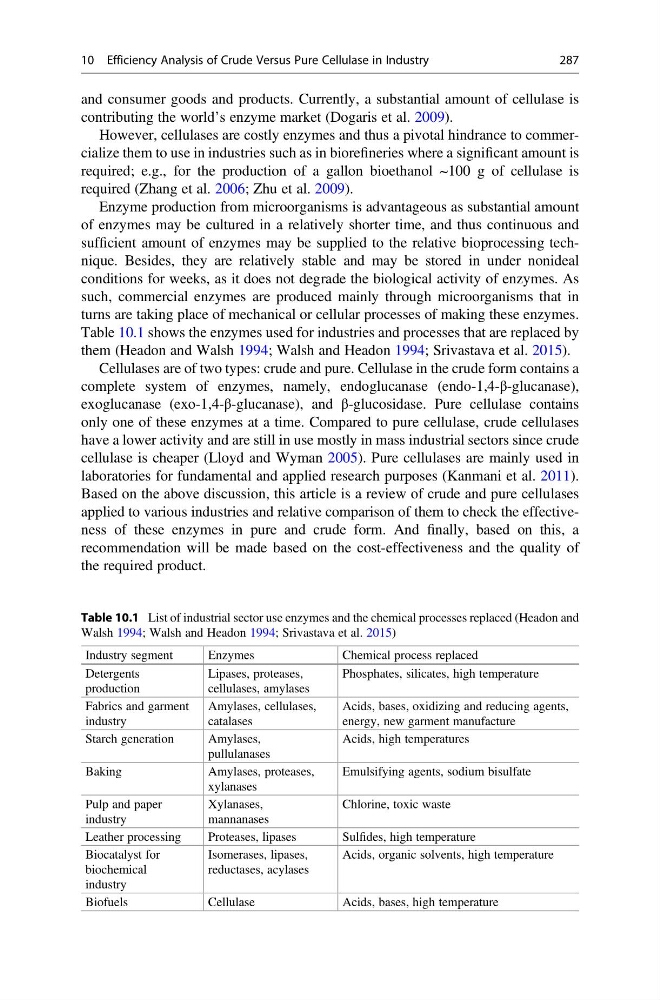
Table 10.1 shows the enzymes used for industries and processes that are replaced by
them (Headon and Walsh 1994; Walsh and Headon 1994; Srivastava et al. 2015).
Cellulases are of two types: crude and pure. Cellulase in the crude form contains a
complete system of enzymes, namely, endoglucanase (endo-1,4-β-glucanase),
exoglucanase (exo-1,4-β-glucanase), and β-glucosidase. Pure cellulase contains
only one of these enzymes at a time. Compared to pure cellulase, crude cellulases
have a lower activity and are still in use mostly in mass industrial sectors since crude
cellulase is cheaper (Lloyd and Wyman 2005). Pure cellulases are mainly used in
laboratories for fundamental and applied research purposes (Kanmani et al. 2011).
Based on the above discussion, this article is a review of crude and pure cellulases
applied to various industries and relative comparison of them to check the effectiveness of these enzymes in pure and crude form. And finally, based on this, a
recommendation will be made based on the cost-effectiveness and the quality of
the required product.
Table 10.1 List of industrial sector use enzymes and the chemical processes replaced (Headon and
Walsh 1994; Walsh and Headon 1994; Srivastava et al. 2015)
Industry segment
Enzymes
Chemical process replaced
Detergents
production
Lipases, proteases,
cellulases, amylases
Phosphates, silicates, high temperature
Fabrics and garment
industry
Amylases, cellulases,
catalases
Acids, bases, oxidizing and reducing agents,
energy, new garment manufacture
Starch generation
Amylases,
pullulanases
Acids, high temperatures
Baking
Amylases, proteases,
xylanases
Emulsifying agents, sodium bisulfate
Pulp and paper
industry
Xylanases,
mannanases
Chlorine, toxic waste
Leather processing
Proteases, lipases
Sulfides, high temperature
Biocatalyst for
biochemical
industry
Isomerases, lipases,
reductases, acylases
Acids, organic solvents, high temperature
Biofuels
Cellulase
Acids, bases, high temperature
10 Efficiency Analysis of Crude Versus Pure Cellulase in Industry
287
contributing the world’s enzyme market (Dogaris et al. 2009).
However, cellulases are costly enzymes and thus a pivotal hindrance to commercialize them to use in industries such as in biorefineries where a significant amount is
required; e.g., for the production of a gallon bioethanol ~100 g of cellulase is
required (Zhang et al. 2006; Zhu et al. 2009).
Enzyme production from microorganisms is advantageous as substantial amount
of enzymes may be cultured in a relatively shorter time, and thus continuous and
sufficient amount of enzymes may be supplied to the relative bioprocessing technique. Besides, they are relatively stable and may be stored in under nonideal
conditions for weeks, as it does not degrade the biological activity of enzymes. As
such, commercial enzymes are produced mainly through microorganisms that in
turns are taking place of mechanical or cellular processes of making these enzymes.
Table 10.1 shows the enzymes used for industries and processes that are replaced by
them (Headon and Walsh 1994; Walsh and Headon 1994; Srivastava et al. 2015).
Cellulases are of two types: crude and pure. Cellulase in the crude form contains a
complete system of enzymes, namely, endoglucanase (endo-1,4-β-glucanase),
exoglucanase (exo-1,4-β-glucanase), and β-glucosidase. Pure cellulase contains
only one of these enzymes at a time. Compared to pure cellulase, crude cellulases
have a lower activity and are still in use mostly in mass industrial sectors since crude
cellulase is cheaper (Lloyd and Wyman 2005). Pure cellulases are mainly used in
laboratories for fundamental and applied research purposes (Kanmani et al. 2011).
Based on the above discussion, this article is a review of crude and pure cellulases
applied to various industries and relative comparison of them to check the effectiveness of these enzymes in pure and crude form. And finally, based on this, a
recommendation will be made based on the cost-effectiveness and the quality of
the required product.
Table 10.1 List of industrial sector use enzymes and the chemical processes replaced (Headon and
Walsh 1994; Walsh and Headon 1994; Srivastava et al. 2015)
Industry segment
Enzymes
Chemical process replaced
Detergents
production
Lipases, proteases,
cellulases, amylases
Phosphates, silicates, high temperature
Fabrics and garment
industry
Amylases, cellulases,
catalases
Acids, bases, oxidizing and reducing agents,
energy, new garment manufacture
Starch generation
Amylases,
pullulanases
Acids, high temperatures
Baking
Amylases, proteases,
xylanases
Emulsifying agents, sodium bisulfate
Pulp and paper
industry
Xylanases,
mannanases
Chlorine, toxic waste
Leather processing
Proteases, lipases
Sulfides, high temperature
Biocatalyst for
biochemical
industry
Isomerases, lipases,
reductases, acylases
Acids, organic solvents, high temperature
Biofuels
Cellulase
Acids, bases, high temperature
10 Efficiency Analysis of Crude Versus Pure Cellulase in Industry
287