

Sugarcane has become a very effective source of biofuel, given that:
1. Bagasse can be used to generate process steam and electricity.
2. Vinasse (the liquid effluent) can be used as a fertilizer and irrigation supply to the
cane fields (Kojima and Johnson 2005).
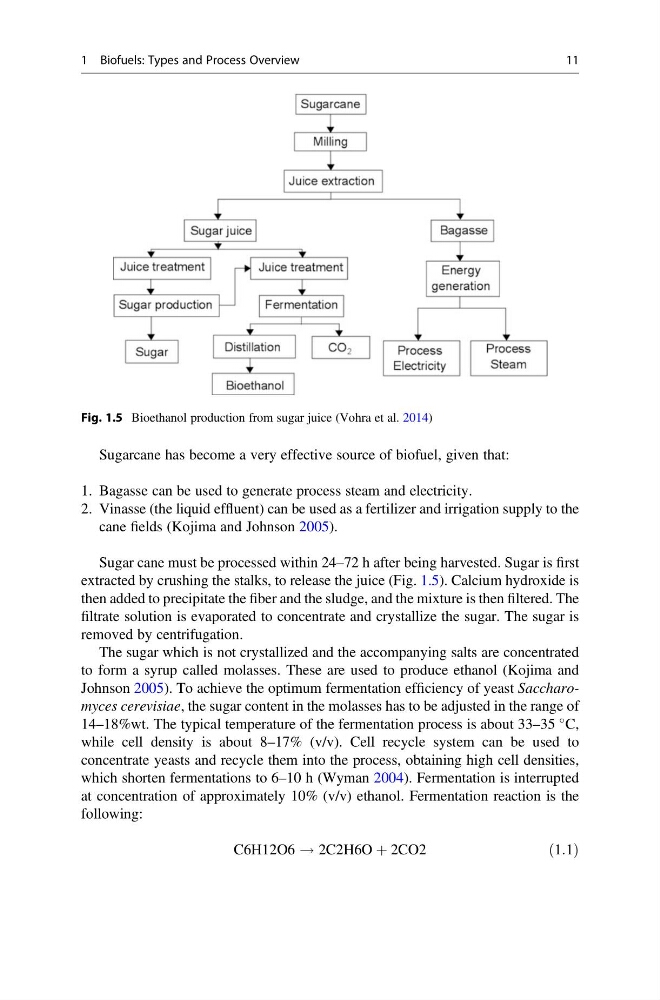
Sugar cane must be processed within 24–72 h after being harvested. Sugar is first
extracted by crushing the stalks, to release the juice (Fig. 1.5). Calcium hydroxide is
then added to precipitate the fiber and the sludge, and the mixture is then filtered. The
filtrate solution is evaporated to concentrate and crystallize the sugar. The sugar is
removed by centrifugation.
The sugar which is not crystallized and the accompanying salts are concentrated
to form a syrup called molasses. These are used to produce ethanol (Kojima and
Johnson 2005). To achieve the optimum fermentation efficiency of yeast Saccharomyces cerevisiae, the sugar content in the molasses has to be adjusted in the range of
14–18%wt. The typical temperature of the fermentation process is about 33–35
C,
while cell density is about 8–17% (v/v). Cell recycle system can be used to
concentrate yeasts and recycle them into the process, obtaining high cell densities,
which shorten fermentations to 6–10 h (Wyman 2004). Fermentation is interrupted
at concentration of approximately 10% (v/v) ethanol. Fermentation reaction is the
following:
C6H12O6 ! 2C2H6O þ 2CO2
ð1:1Þ
Fig. 1.5 Bioethanol production from sugar juice (Vohra et al. 2014)
1 Biofuels: Types and Process Overview
11
1. Bagasse can be used to generate process steam and electricity.
2. Vinasse (the liquid effluent) can be used as a fertilizer and irrigation supply to the
cane fields (Kojima and Johnson 2005).
Sugar cane must be processed within 24–72 h after being harvested. Sugar is first
extracted by crushing the stalks, to release the juice (Fig. 1.5). Calcium hydroxide is
then added to precipitate the fiber and the sludge, and the mixture is then filtered. The
filtrate solution is evaporated to concentrate and crystallize the sugar. The sugar is
removed by centrifugation.
The sugar which is not crystallized and the accompanying salts are concentrated
to form a syrup called molasses. These are used to produce ethanol (Kojima and
Johnson 2005). To achieve the optimum fermentation efficiency of yeast Saccharomyces cerevisiae, the sugar content in the molasses has to be adjusted in the range of
14–18%wt. The typical temperature of the fermentation process is about 33–35
C,
while cell density is about 8–17% (v/v). Cell recycle system can be used to
concentrate yeasts and recycle them into the process, obtaining high cell densities,
which shorten fermentations to 6–10 h (Wyman 2004). Fermentation is interrupted
at concentration of approximately 10% (v/v) ethanol. Fermentation reaction is the
following:
C6H12O6 ! 2C2H6O þ 2CO2
ð1:1Þ
Fig. 1.5 Bioethanol production from sugar juice (Vohra et al. 2014)
1 Biofuels: Types and Process Overview
11