

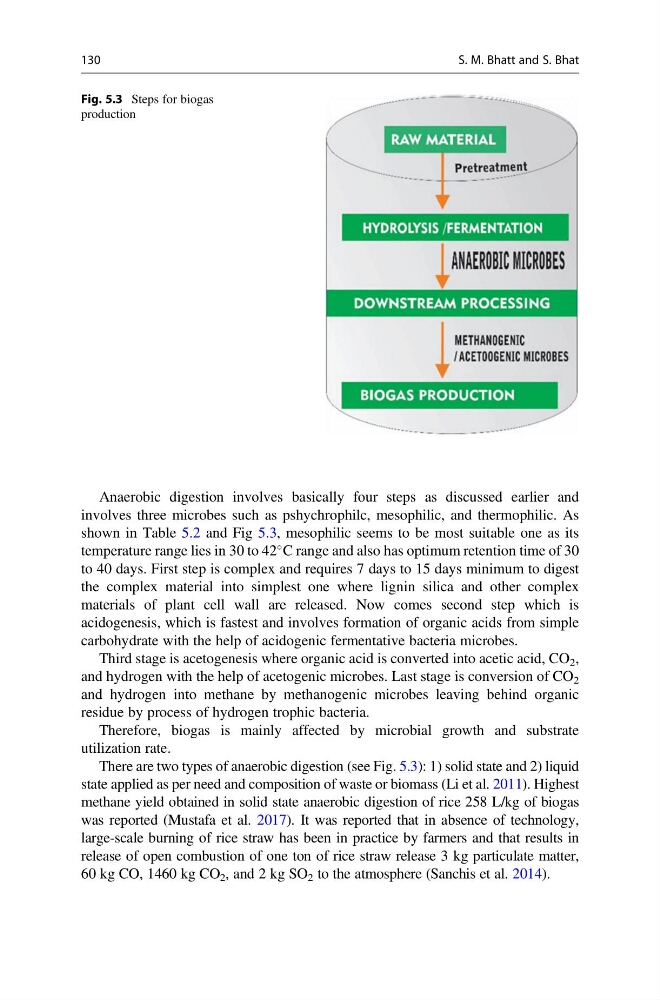
Anaerobic digestion involves basically four steps as discussed earlier and
involves three microbes such as pshychrophilc, mesophilic, and thermophilic. As
shown in Table 5.2 and Fig 5.3, mesophilic seems to be most suitable one as its
temperature range lies in 30 to 42
C range and also has optimum retention time of 30
to 40 days. First step is complex and requires 7 days to 15 days minimum to digest
the complex material into simplest one where lignin silica and other complex
materials of plant cell wall are released. Now comes second step which is
acidogenesis, which is fastest and involves formation of organic acids from simple
carbohydrate with the help of acidogenic fermentative bacteria microbes.
Third stage is acetogenesis where organic acid is converted into acetic acid, CO 2 ,
and hydrogen with the help of acetogenic microbes. Last stage is conversion of CO 2
and hydrogen into methane by methanogenic microbes leaving behind organic
residue by process of hydrogen trophic bacteria.
Therefore, biogas is mainly affected by microbial growth and substrate
utilization rate.
There are two types of anaerobic digestion (see Fig. 5.3): 1) solid state and 2) liquid
state applied as per need and composition of waste or biomass (Li et al. 2011). Highest
methane yield obtained in solid state anaerobic digestion of rice 258 L/kg of biogas
was reported (Mustafa et al. 2017). It was reported that in absence of technology,
large-scale burning of rice straw has been in practice by farmers and that results in
release of open combustion of one ton of rice straw release 3 kg particulate matter,
60 kg CO, 1460 kg CO 2 , and 2 kg SO 2 to the atmosphere (Sanchis et al. 2014).
Fig. 5.3 Steps for biogas
production
130
S. M. Bhatt and S. Bhat
involves three microbes such as pshychrophilc, mesophilic, and thermophilic. As
shown in Table 5.2 and Fig 5.3, mesophilic seems to be most suitable one as its
temperature range lies in 30 to 42
C range and also has optimum retention time of 30
to 40 days. First step is complex and requires 7 days to 15 days minimum to digest
the complex material into simplest one where lignin silica and other complex
materials of plant cell wall are released. Now comes second step which is
acidogenesis, which is fastest and involves formation of organic acids from simple
carbohydrate with the help of acidogenic fermentative bacteria microbes.
Third stage is acetogenesis where organic acid is converted into acetic acid, CO 2 ,
and hydrogen with the help of acetogenic microbes. Last stage is conversion of CO 2
and hydrogen into methane by methanogenic microbes leaving behind organic
residue by process of hydrogen trophic bacteria.
Therefore, biogas is mainly affected by microbial growth and substrate
utilization rate.
There are two types of anaerobic digestion (see Fig. 5.3): 1) solid state and 2) liquid
state applied as per need and composition of waste or biomass (Li et al. 2011). Highest
methane yield obtained in solid state anaerobic digestion of rice 258 L/kg of biogas
was reported (Mustafa et al. 2017). It was reported that in absence of technology,
large-scale burning of rice straw has been in practice by farmers and that results in
release of open combustion of one ton of rice straw release 3 kg particulate matter,
60 kg CO, 1460 kg CO 2 , and 2 kg SO 2 to the atmosphere (Sanchis et al. 2014).
Fig. 5.3 Steps for biogas
production
130
S. M. Bhatt and S. Bhat