

5.4
Sources for Biogas Production
There are various reports of biogas production from various sources, e.g., slaughterhouse (Granada et al. 2018), farm animal waste (Abdeshahian et al. 2016), animal
manure (Recebli et al. 2015), solid organic waste (Nasir et al. 2012), kitchen waste
(Agrahari and Tiwari 2013), municipal wastewater (Appels et al. 2008), food and
green wastes (Liu et al. 2009), coffee waste (Battista et al. 2016), rice straw, and pig
manure (Ye et al. 2013).
Codigestion of manure and organic wastes (Angelidaki and Ellegaard 2003) such
as lignocellulosic waste for biogas production has been reported by some workers
(Ziemiński et al. 2012).
Some work has been done to produce economical biogas, for example 0.41 g
ethanol/g glucose and 178 ML hydrogen per gram sugar obtained from agrowaste
produces (Kaparaju et al. 2009), while methane was produced from 0.381 m
3 /kg
volatile solid. These workers emphasized that while using lignocellulosic biomass,
multiple route of biofuel production must be adapted in order to obtain the economical biofuel production.
Use of rice straw is also recommended for production of biogas after proper
milling and pretreatment (Mustafa et al. 2017)
Kitchen waste produces around 60% of biogas, but other types of sources produce
around 40% of biogas; from cotton wastes, the production of biogas (CH 4 ) was
approximately 65%, while 55% methane production was reported from waste
disposal. Kitchen waste was proved to produce more biogas if cow dung was
mixed with waste of water hyacinth (Tasnim et al. 2017). The calorific value of
biogas is very good (around 4700 kcal or 20 MJ at around 55% methane content).
There are few developments of nano-based technology for rapid digestion of
biomass and thus production of biogas via “nano-clean” technology where
nanoparticles (iron oxide nanoparticles) are used to enhance production of biogas.
Application of Nannotechnology is certainly going to double the production of
biogas using same amount of agrowaste (e.g. wheat straw).
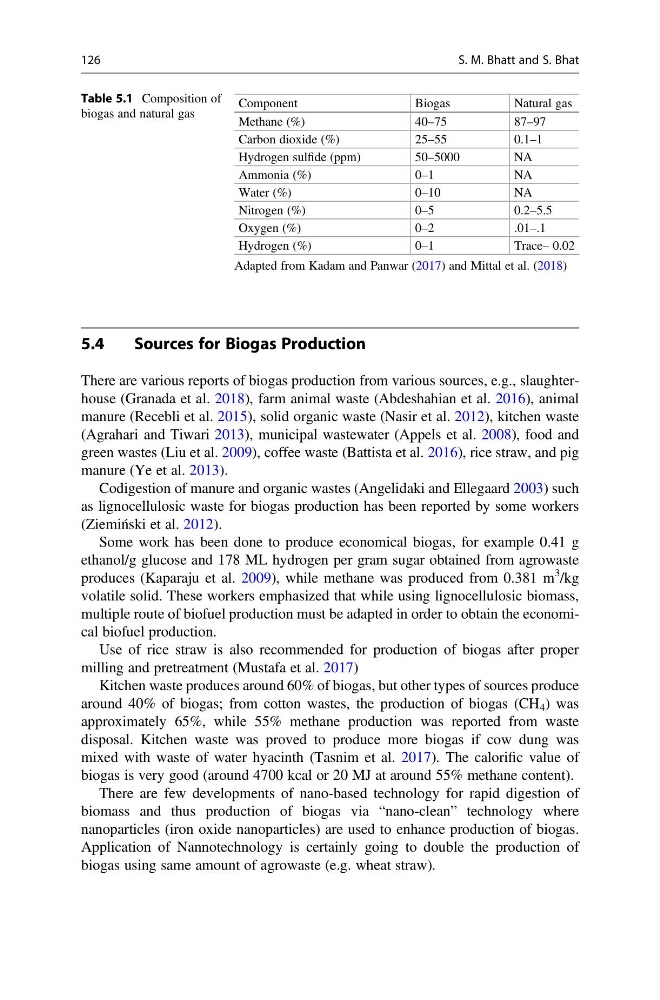
Table 5.1 Composition of
biogas and natural gas
Component
Biogas
Natural gas
Methane (%)
40–75
87–97
Carbon dioxide (%)
25–55
0.1–1
Hydrogen sulfide (ppm)
50–5000
NA
Ammonia (%)
0–1
N A
Water (%)
0–10
NA
Nitrogen (%)
0–5
0.2–5.5
Oxygen (%)
0–2
.01–.1
Hydrogen (%)
0–1
Trace– 0.02
Adapted from Kadam and Panwar (2017) and Mittal et al. (2018)
126
S. M. Bhatt and S. Bhat
Sources for Biogas Production
There are various reports of biogas production from various sources, e.g., slaughterhouse (Granada et al. 2018), farm animal waste (Abdeshahian et al. 2016), animal
manure (Recebli et al. 2015), solid organic waste (Nasir et al. 2012), kitchen waste
(Agrahari and Tiwari 2013), municipal wastewater (Appels et al. 2008), food and
green wastes (Liu et al. 2009), coffee waste (Battista et al. 2016), rice straw, and pig
manure (Ye et al. 2013).
Codigestion of manure and organic wastes (Angelidaki and Ellegaard 2003) such
as lignocellulosic waste for biogas production has been reported by some workers
(Ziemiński et al. 2012).
Some work has been done to produce economical biogas, for example 0.41 g
ethanol/g glucose and 178 ML hydrogen per gram sugar obtained from agrowaste
produces (Kaparaju et al. 2009), while methane was produced from 0.381 m
3 /kg
volatile solid. These workers emphasized that while using lignocellulosic biomass,
multiple route of biofuel production must be adapted in order to obtain the economical biofuel production.
Use of rice straw is also recommended for production of biogas after proper
milling and pretreatment (Mustafa et al. 2017)
Kitchen waste produces around 60% of biogas, but other types of sources produce
around 40% of biogas; from cotton wastes, the production of biogas (CH 4 ) was
approximately 65%, while 55% methane production was reported from waste
disposal. Kitchen waste was proved to produce more biogas if cow dung was
mixed with waste of water hyacinth (Tasnim et al. 2017). The calorific value of
biogas is very good (around 4700 kcal or 20 MJ at around 55% methane content).
There are few developments of nano-based technology for rapid digestion of
biomass and thus production of biogas via “nano-clean” technology where
nanoparticles (iron oxide nanoparticles) are used to enhance production of biogas.
Application of Nannotechnology is certainly going to double the production of
biogas using same amount of agrowaste (e.g. wheat straw).
Table 5.1 Composition of
biogas and natural gas
Component
Biogas
Natural gas
Methane (%)
40–75
87–97
Carbon dioxide (%)
25–55
0.1–1
Hydrogen sulfide (ppm)
50–5000
NA
Ammonia (%)
0–1
N A
Water (%)
0–10
NA
Nitrogen (%)
0–5
0.2–5.5
Oxygen (%)
0–2
.01–.1
Hydrogen (%)
0–1
Trace– 0.02
Adapted from Kadam and Panwar (2017) and Mittal et al. (2018)
126
S. M. Bhatt and S. Bhat