

Recognizing Sustainability in a University Campus …
769
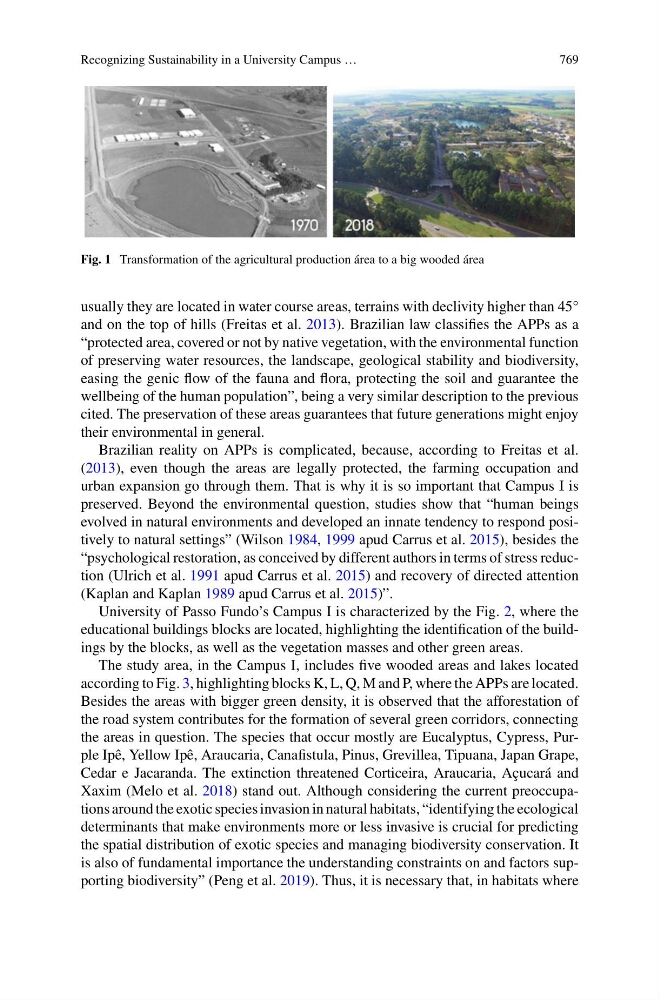
Fig. 1 Transformation of the agricultural production área to a big wooded área
usually they are located in water course areas, terrains with declivity higher than 45°
and on the top of hills (Freitas et al. 2013). Brazilian law classifies the APPs as a
“protected area, covered or not by native vegetation, with the environmental function
of preserving water resources, the landscape, geological stability and biodiversity,
easing the genic flow of the fauna and flora, protecting the soil and guarantee the
wellbeing of the human population”, being a very similar description to the previous
cited. The preservation of these areas guarantees that future generations might enjoy
their environmental in general.
Brazilian reality on APPs is complicated, because, according to Freitas et al.
(2013), even though the areas are legally protected, the farming occupation and
urban expansion go through them. That is why it is so important that Campus I is
preserved. Beyond the environmental question, studies show that “human beings
evolved in natural environments and developed an innate tendency to respond positively to natural settings” (Wilson 1984, 1999 apud Carrus et al. 2015), besides the
“psychological restoration, as conceived by different authors in terms of stress reduction (Ulrich et al. 1991 apud Carrus et al. 2015) and recovery of directed attention
(Kaplan and Kaplan 1989 apud Carrus et al. 2015)”.
University of Passo Fundo’s Campus I is characterized by the Fig. 2, where the
educational buildings blocks are located, highlighting the identification of the buildings by the blocks, as well as the vegetation masses and other green areas.
The study area, in the Campus I, includes five wooded areas and lakes located
according to Fig. 3, highlighting blocks K, L, Q, M and P, where the APPs are located.
Besides the areas with bigger green density, it is observed that the afforestation of
the road system contributes for the formation of several green corridors, connecting
the areas in question. The species that occur mostly are Eucalyptus, Cypress, Purple Ipê, Yellow Ipê, Araucaria, Canafistula, Pinus, Grevillea, Tipuana, Japan Grape,
Cedar e Jacaranda. The extinction threatened Corticeira, Araucaria, Açucará and
Xaxim (Melo et al. 2018) stand out. Although considering the current preoccupations around the exotic species invasion in natural habitats, “identifying the ecological
determinants that make environments more or less invasive is crucial for predicting
the spatial distribution of exotic species and managing biodiversity conservation. It
is also of fundamental importance the understanding constraints on and factors supporting biodiversity” (Peng et al. 2019). Thus, it is necessary that, in habitats where
769
Fig. 1 Transformation of the agricultural production área to a big wooded área
usually they are located in water course areas, terrains with declivity higher than 45°
and on the top of hills (Freitas et al. 2013). Brazilian law classifies the APPs as a
“protected area, covered or not by native vegetation, with the environmental function
of preserving water resources, the landscape, geological stability and biodiversity,
easing the genic flow of the fauna and flora, protecting the soil and guarantee the
wellbeing of the human population”, being a very similar description to the previous
cited. The preservation of these areas guarantees that future generations might enjoy
their environmental in general.
Brazilian reality on APPs is complicated, because, according to Freitas et al.
(2013), even though the areas are legally protected, the farming occupation and
urban expansion go through them. That is why it is so important that Campus I is
preserved. Beyond the environmental question, studies show that “human beings
evolved in natural environments and developed an innate tendency to respond positively to natural settings” (Wilson 1984, 1999 apud Carrus et al. 2015), besides the
“psychological restoration, as conceived by different authors in terms of stress reduction (Ulrich et al. 1991 apud Carrus et al. 2015) and recovery of directed attention
(Kaplan and Kaplan 1989 apud Carrus et al. 2015)”.
University of Passo Fundo’s Campus I is characterized by the Fig. 2, where the
educational buildings blocks are located, highlighting the identification of the buildings by the blocks, as well as the vegetation masses and other green areas.
The study area, in the Campus I, includes five wooded areas and lakes located
according to Fig. 3, highlighting blocks K, L, Q, M and P, where the APPs are located.
Besides the areas with bigger green density, it is observed that the afforestation of
the road system contributes for the formation of several green corridors, connecting
the areas in question. The species that occur mostly are Eucalyptus, Cypress, Purple Ipê, Yellow Ipê, Araucaria, Canafistula, Pinus, Grevillea, Tipuana, Japan Grape,
Cedar e Jacaranda. The extinction threatened Corticeira, Araucaria, Açucará and
Xaxim (Melo et al. 2018) stand out. Although considering the current preoccupations around the exotic species invasion in natural habitats, “identifying the ecological
determinants that make environments more or less invasive is crucial for predicting
the spatial distribution of exotic species and managing biodiversity conservation. It
is also of fundamental importance the understanding constraints on and factors supporting biodiversity” (Peng et al. 2019). Thus, it is necessary that, in habitats where