

676
N. H. Cardozo et al.
– The WUR can be used as a guideline by HEIs who wish to start incorporating
changes to become sustainable, and for those already implementing sustainable
actions, the WUR can also be used as a self-assessment tool.
In relation to HEIs participation increase in the WUR over the years, even with
the variety of previous SATs, it is possible to confirm this growth, since in its first
year (2010), 95 HEIs from 35 countries were present in the ranking, while in 2016,
the WUR released the results of 515 Institutions from 75 countries (Universitas
Indonesia 2017).
6 Benchmarking Four Best-Ranked HEIs and Four
Brazilian HEIs from the WUR
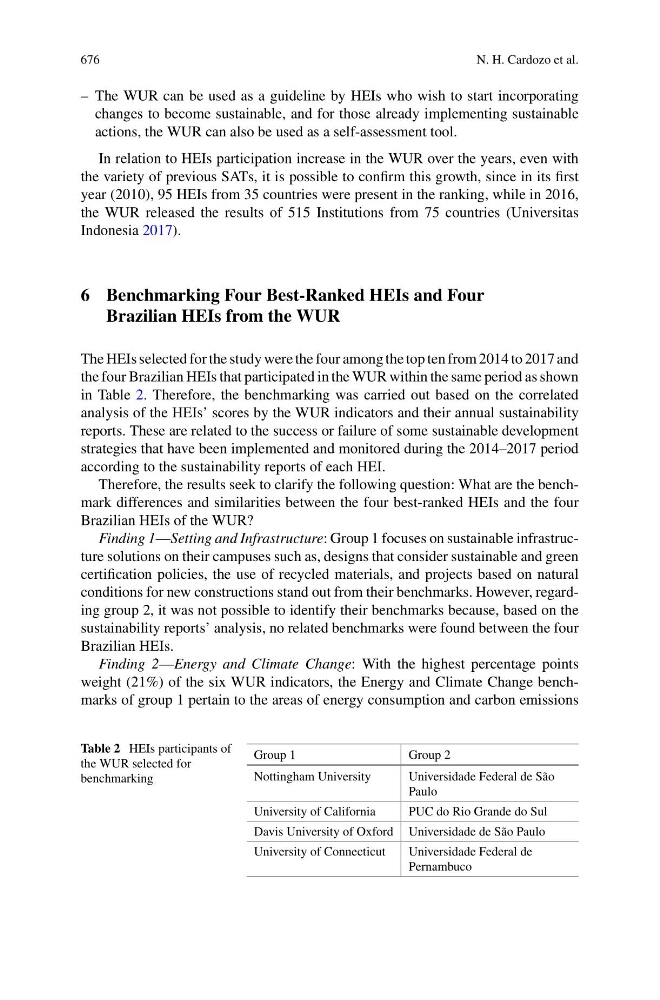
The HEIs selected for the study were the four among the top ten from 2014 to 2017 and
the four Brazilian HEIs that participated in the WUR within the same period as shown
in Table 2. Therefore, the benchmarking was carried out based on the correlated
analysis of the HEIs’ scores by the WUR indicators and their annual sustainability
reports. These are related to the success or failure of some sustainable development
strategies that have been implemented and monitored during the 2014–2017 period
according to the sustainability reports of each HEI.
Therefore, the results seek to clarify the following question: What are the benchmark differences and similarities between the four best-ranked HEIs and the four
Brazilian HEIs of the WUR?
Finding 1—Setting and Infrastructure: Group 1 focuses on sustainable infrastructure solutions on their campuses such as, designs that consider sustainable and green
certification policies, the use of recycled materials, and projects based on natural
conditions for new constructions stand out from their benchmarks. However, regarding group 2, it was not possible to identify their benchmarks because, based on the
sustainability reports’ analysis, no related benchmarks were found between the four
Brazilian HEIs.
Finding 2—Energy and Climate Change: With the highest percentage points
weight (21%) of the six WUR indicators, the Energy and Climate Change benchmarks of group 1 pertain to the areas of energy consumption and carbon emissions
Table 2 HEIs participants of
the WUR selected for
benchmarking
Group 1
Group 2
Nottingham University
Universidade Federal de São
Paulo
University of California
PUC do Rio Grande do Sul
Davis University of Oxford Universidade de São Paulo
University of Connecticut
Universidade Federal de
Pernambuco
N. H. Cardozo et al.
– The WUR can be used as a guideline by HEIs who wish to start incorporating
changes to become sustainable, and for those already implementing sustainable
actions, the WUR can also be used as a self-assessment tool.
In relation to HEIs participation increase in the WUR over the years, even with
the variety of previous SATs, it is possible to confirm this growth, since in its first
year (2010), 95 HEIs from 35 countries were present in the ranking, while in 2016,
the WUR released the results of 515 Institutions from 75 countries (Universitas
Indonesia 2017).
6 Benchmarking Four Best-Ranked HEIs and Four
Brazilian HEIs from the WUR
The HEIs selected for the study were the four among the top ten from 2014 to 2017 and
the four Brazilian HEIs that participated in the WUR within the same period as shown
in Table 2. Therefore, the benchmarking was carried out based on the correlated
analysis of the HEIs’ scores by the WUR indicators and their annual sustainability
reports. These are related to the success or failure of some sustainable development
strategies that have been implemented and monitored during the 2014–2017 period
according to the sustainability reports of each HEI.
Therefore, the results seek to clarify the following question: What are the benchmark differences and similarities between the four best-ranked HEIs and the four
Brazilian HEIs of the WUR?
Finding 1—Setting and Infrastructure: Group 1 focuses on sustainable infrastructure solutions on their campuses such as, designs that consider sustainable and green
certification policies, the use of recycled materials, and projects based on natural
conditions for new constructions stand out from their benchmarks. However, regarding group 2, it was not possible to identify their benchmarks because, based on the
sustainability reports’ analysis, no related benchmarks were found between the four
Brazilian HEIs.
Finding 2—Energy and Climate Change: With the highest percentage points
weight (21%) of the six WUR indicators, the Energy and Climate Change benchmarks of group 1 pertain to the areas of energy consumption and carbon emissions
Table 2 HEIs participants of
the WUR selected for
benchmarking
Group 1
Group 2
Nottingham University
Universidade Federal de São
Paulo
University of California
PUC do Rio Grande do Sul
Davis University of Oxford Universidade de São Paulo
University of Connecticut
Universidade Federal de
Pernambuco